Wiebergron: Process development and optimization research
Overactive bladder (OAB) is a clinical condition that occurs when the bladder muscles contract involuntarily. Symptoms may include urgency, urge incontinence, frequent urination, and nocturia. The bothersome symptoms of OAB can cause significant impairment to a patient's daily activities.
Vibergron is an oral tablet containing 75 mg of vibegron per tablet. This is a small molecule beta3-adrenergic receptor agonist that helps relax the detrusor muscle so that the bladder can hold more urine, thereby reducing OAB symptoms. Vibegron was approved by the Japanese PMDA on September 21, 2018, and was marketed in Japan by Xinglin Pharmaceutical and Kissei under the trade name Beova for the treatment of overactive bladder. On December 23, 2020, it was approved by the US FDA for marketing under the trade name Gemmesa.
From the structural formula of Vibergron API, it can be seen that the drug molecule has four chiral centers, especially the substituent group of CIS on pyrrolidine, which is a major challenge for API process scale-up. Early synthetic routes of the Viebergron:
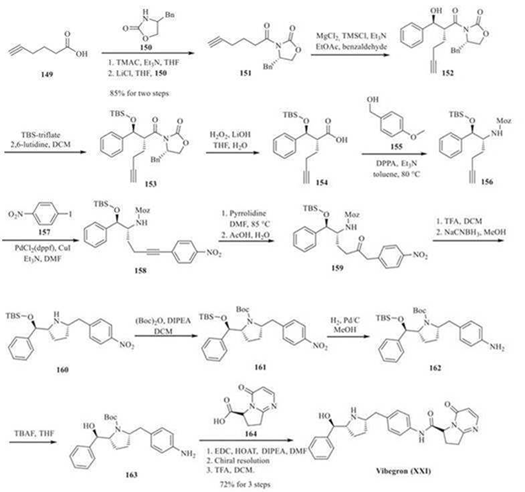
(Early synthetic route of the Viebergron)
Specific process route: firstly, 5-hexenoic acid (149) is coupled with chiral oxazolidinone to obtain chiral acyloxazolidinone 151, and trans-hydroxyaldehyde condensation reaction with benzaldehyde catalyzed by magnesium chloride to obtain high diastereoselective compound 152, which is protected by TBS and hydrolyzed by lithium hydroxide in the presence of H2O2 to obtain oxazolidinone cleavage, followed by Curtius rearrangement with DPPA and p-methoxybenzyl alcohol, PdCl2 (dppf) A series of synthesis steps such as coupling of Sonagashira catalyzed by CuI yielded the key intermediate 158. The alkyne was subsequently oxidized to ketone 159 using a method developed by Fukuyama. At the same time, cyclization is carried out to obtain 2,3-dihydropyrrole intermediates, which are reduced to a mixture of cis- and trans-pyrrolidine isomers under the action of sodium boron hydride 160. The cis-pyrrolidine isomer can be separated from the trans isomer by silica gel column. Subsequently, the key chiral compound 163 was synthesized by a series of steps such as N-Boc protection, Pd/C catalyzed nitro reduction, and TBAF-promoted TBS deprotection. Finally, under the action of EDCI and HOAT condensation reagents, a condensation reaction occurred with the commercial key intermediate 164, and finally chiral decomposition was carried out to successfully obtain the active molecule of vebergron.
This is the early synthesis process route of APIs, in order to improve the enantioselectivity, it is necessary to protect the hydroxyl group first, and then deprotect after the reduction reaction, and the synthesis step is more cumbersome. Moreover, the stereoselectivity of pyrrolidine formed by the ring is low, and cis-pyrrole and trans-pyrrole are generated in the process of reducing amination, and the selectivity is generally in the range of 80:20, requiring column chromatography to separate the product, and the yield of the target product is low, which is not conducive to commercial production.
For the key intermediate 164, the original research has also carried out several process route optimizations, and the optimal process route of the key intermediate 164 is as follows:

(Key intermediates 164 optimal process route)
For the preparation of key chiral acid intermediate 164, methyl(S)-5-oxopyrrolidine-2-carboxylic acid 165 was first methylated using DMS to obtain compound 166. Compounds 166 and 167 react at high temperatures to form [4 +2] cycloaddition product 168, which is opened at high temperature and then hydrolyzed by lithium hydroxide to form the key intermediate 164 of vebergron.
With regard to the synthesis of the key chiral intermediate 163 of vebergron (scheme codified compound 14 below), multiple literature has investigated various synthesis methods for pyrrolidine aniline. One of the process routes uses commercially available chiral materials as the starting material, and the Witting reaction is used twice to form trans olefins, and the synthesis route of the key intermediate 14 of Vibergron is as follows:
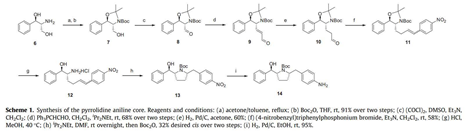
(Key Intermediates 14 Synthesis Route)
Process Description: Commercially available starting material (1R,2R)-2-amino-1-phenyl-1,3-propanediol is first selectively protected to obtain 7. The hydroxyl group is converted to aldehyde by the Swern oxidation reaction, followed by the first Wittig reaction with (triphenylphosphine subunit) acetaldehyde to form unsaturated aldehyde 9. The carbon-carbon double bond is then reduced to saturated aldehyde 10, followed by a second Wittig reaction with (4-nitrobenzene)triphenylphosphonium bromide, resulting in olefin 11 as a cis/trans isomer mixture. After deprotection, under the action of Hünig base, free amines spontaneously cyclize on double bonds by conjugated addition. The pyrrolidine ring is then protected in situ, and the stereoisomer is finally separated, resulting in the desired cis-isomer 13 (32%) and trans-isomer (50%). Finally, nitro hydrogenation is reduced to obtain pyrrolidine aniline intermediate 14.
Considering the need for commercialized large-scale production of APIs, Merck reported a simple route to large-scale synthesis of the drug in 2018; Since the differential isomerization of the stereocenter of the amine protected by Boc in racemic ketones was observed under alkaline conditions, ketone reductase (KRED-p301) was designed to selectively promote the differential isomerization of nicotinamide adenine dinucleotide phosphate (NADPH) and (R)-385, and efficiently convert (R)-385 to chiral aminoalcohol386. Greatly improved chiral selectivity and yield of key intermediates; (Key intermediates numbered 390 in the scheme below) Process route for the synthesis of Viebergron using biocatalytic technology:
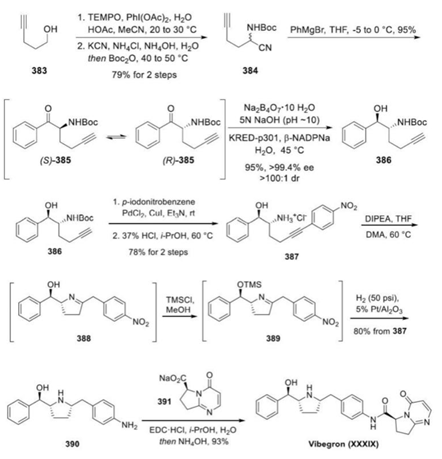
(Process route for synthesizing Viebergron using biocatalytic technology)
Image source: Shangke Biotechnology
The specific route of the new process of Vibergron is as follows: pentynol is reactive by Strecker reaction, Boc protection to generate racemic aminonitrile (384), followed by Grignard addition, followed by acid treatment, to generate racemic ketone (385), under alkaline conditions of racemic ketone Boc-protected amine stereocenter epimerization isomerization, by ketone reductase (KRED-p301) and NADPH, effectively convert (R)-385 into key intermediate chiral amino alcohol 386. Using 386 as raw material, after Sonogashira coupling reaction, deprotection, intramolecular cyclization reaction occurs in the presence of Hunig base, and pyrrolidinol structure compound (388) is generated, which is converted into the corresponding silyl ether (389) before hydrogenation, and the aniline-containing compound (390) is generated by hydrogenation reaction, and finally reacts with the commercial key intermediate 391 under conventional amide bond formation conditions, and finally obtains the large-scale production of Vibegron API with a yield of 93%.
Ketone reductase is used in key production steps of the Viebergron commercial process, which not only has a conversion rate of up to 95%, but also has good chiral selectivity, with an EE of 99.4% and an enantiomal ratio greater than 100:1.
Biocatalysis technology is one of the best solutions to achieve green chemistry, and has many advantages over traditional chemical synthesis: biocatalysis avoids the use of toxic catalysts, allows the reaction to proceed under mild conditions, produces fewer by-products and three wastes, effectively shortens the synthesis route, provides higher catalytic efficiency and stereoselectivity, and achieves low-cost, high-quality production. As an important part of green chemistry, biocatalysis technology has been widely used in the production of blockbuster drugs and key drug intermediates, which also shows the future development trend of the industry, and grafting biocatalysis technology will become a common option for the synthesis process of new drug development.

You May Interested In


High Quality β-Nicotinamide adenine dinucleotide CAS 53-84-9 NADwith ready stock and best price
$3E+1/UNIT FOB


2026-10-25
Trade Alert
Delivering the latest product trends and industry news straight to your inbox.
(We'll never share your email address with a third-party.)

Related News
-
24th Pharma Asia International Exhibition & Conferences to Open in Karachi, Pakistan
-
Pharma Asia 2026: Bringing the Global Pharmaceutical Industry to Pakistan
-
Egyptian Pharmaceutical Market Research
-
CPHI China 2023 | At the Heart of Pharma
-
A Guide Into What the Pharmaceutical Use of Hexamine Is
-
In line with the 8201, Hengrui Pharmaceutical plans the HER2 ADC in this way
-
$50 billion in products were 'returned' to rationalize those blockbuster BD deals
-
Tronsound long-acting IL-36R antibody obtained FDA clinical IND
-
Dapagliflozin is approved in the EU for the treatment of symptomatic chronic heart failure
-
The FDA accepted Zuranolone's NDA application and granted it priority review rights for the treatment of MDD and PDD
Recommend Reading
-
![Death Toll from Fire at China-Russia Amur Polyolefins Project Rises to 15 as Construction Continues]()
Death Toll from Fire at China-Russia Amur Polyolefins Project Rises to 15 as Construction Continues
-
![South Korea to Impose Anti-Dumping Duties on Caustic Soda: Chinese Mainland Firms Face Up to 22.21%, Taiwan Region 38.89%]()
South Korea to Impose Anti-Dumping Duties on Caustic Soda: Chinese Mainland Firms Face Up to 22.21%, Taiwan Region 38.89%
-
![Arkema Triples Transparent Polyamide Capacity in Singapore: a Bet on Virtual Reality Growth or a Move to Strengthen Supply Resilience?]()
Arkema Triples Transparent Polyamide Capacity in Singapore: a Bet on Virtual Reality Growth or a Move to Strengthen Supply Resilience?
-
![Chemours Sells Its Former Titanium Dioxide Site in Taiwan: Turning a “White Powder” Factory into “Wind Power Real Estate” for $360 Million—Buying Not Cash, But Breathing Room]()
Chemours Sells Its Former Titanium Dioxide Site in Taiwan: Turning a “White Powder” Factory into “Wind Power Real Estate” for $360 Million—Buying Not Cash, But Breathing Room
-
![The “Counter-Wind Ledger” of CHF 11.2 Billion: Sika Barely Grew in 2025—Yet Kept Taking Market Share]()
The “Counter-Wind Ledger” of CHF 11.2 Billion: Sika Barely Grew in 2025—Yet Kept Taking Market Share
-
![Business Society’s Market Outlook for Lithium Carbonate on September 2, 2026: Volatile]()
Business Society’s Market Outlook for Lithium Carbonate on September 2, 2026: Volatile
-
![Business Society September 11, 2026 PC Trend Analysis: Clearly Upward]()
Business Society September 11, 2026 PC Trend Analysis: Clearly Upward
-
![In April, the Chinese marine fuel market saw a significant decline]()
In April, the Chinese marine fuel market saw a significant decline
-
![U.S. Section 232 Pharmaceutical Tariffs Take Effect, With 100% Base Rate on Patented Drugs and APIs]()
U.S. Section 232 Pharmaceutical Tariffs Take Effect, With 100% Base Rate on Patented Drugs and APIs
-
![Business Society’s Market Outlook for MIBK on September 2, 2026: Fluctuating Trend]()
Business Society’s Market Outlook for MIBK on September 2, 2026: Fluctuating Trend