In 2022, BASF's coatings business sales will increase by 22%, and sales volume will increase by 5%
According to the "2022 Performance Report" released by the BASF Group on February 24, the sales of the BASF Group in 2022 will be 87.3 billion euros, a year-on-year increase of 11.1%. At €6.9 billion, EBIT before special items was 11.5 percent lower than in the prior-year period.
Among them, the coatings business revenue of BASF's Surface Technologies division (Surface Technologies) was 4.22 billion euros (approximately 4.455 billion U.S. dollars), a significant increase of 22.7% from 3.440 billion euros in the same period in 2021. The main products of BASF's coatings department are coating solutions for automotive applications, surface treatment technologies and system solutions, and decorative coatings. Customer industries and applications cover the automotive industry, body repair shops, steel industry, aviation, aluminum applications in the construction and construction industries, Household appliances, painting companies and private consumers.
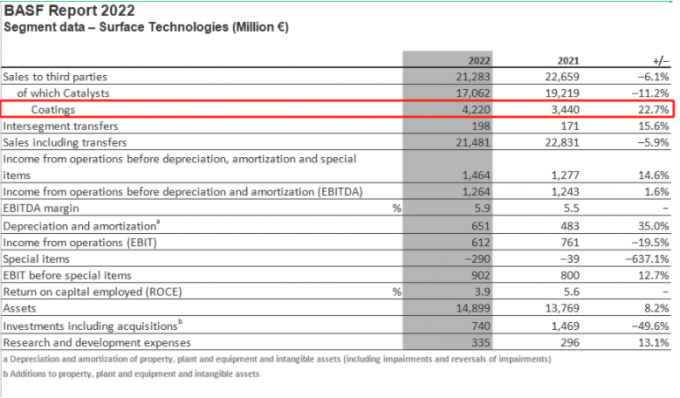
In 2022, the sales volume of BASF's coatings business will increase by 5.1% year-on-year, sales revenue will increase by 12.4%, and the product mix will decrease by 0.8%, while favorable exchange rates will contribute to the increase of 6.0%.

In the sales area of BASF's coatings business, Europe accounts for 30%, in fact, the Asia-Pacific region accounts for 27%, North America 25%, and South America, Africa and the Middle East account for 18%. The sales growth of the coatings department was mainly due to the stimulus opening policy after the unblocking of the epidemic in China, as well as the improvement of the supply chain in North America.

The increase in volume was mainly due to higher prices in almost all business areas affected by higher raw material and energy prices.
The sharp decline in overall sales hindered the growth of the BASF Group's sales and led to a significant decline in profits. However, BASF also said that the revenue of the surface treatment technology sector where the coatings business is located has increased significantly, especially the contribution of the automotive catalyst and battery materials business. Higher prices and volumes in the Coatings business unit also contributed to the earnings performance in this segment.
In 2022, the operating profit of the BASF Group is affected by additional energy costs of 3.2 billion euros worldwide. Europe accounted for around 84% of this cost increase, with the greatest impact on the integrated site in Ludwigshafen. Rising natural gas costs accounted for 69% of the overall increase in global energy costs. As the largest sales region of BASF coatings, Europe is facing great challenges in terms of sales and profits.
Given that economic uncertainty still exists in 2023, BASF has announced specific measures for cost reduction plans in Europe. The cost reduction plan, to be implemented from 2023 to 2024, will focus on rationalizing BASF's cost structure in Europe, especially in Germany, in response to changing framework conditions. After the overall plan is completed, it is expected to reduce the cost of more than 500 million euros per year in non-production areas, namely services, operations, R&D departments and corporate centers, of which more than half will come from the Ludwigshafen integrated base.
The specific measures of the plan will include continuous integration of services into shared service centers, simplification of departmental management structures, rational adjustment of business service scope and improvement of the efficiency of research and development activities. Globally, the measures are expected to have a net impact of about 2,600 jobs. This figure also includes the creation of new jobs, especially in shared service centres.
In addition to the cost reduction plan, BASF has also begun to make structural adjustments to the integrated site in Ludwigshafen, so that it can better cope with the increasingly severe competition challenges in the long run. Production plants related to paint production, such as the TDI plant in Ludwigshafen and the precursor plants for DNT and TDA, will be shut down. BASF said that the demand for TDI was very weak, especially in Europe, the Middle East and Africa, which was much lower than expected. The TDI complex in Ludwigshafen was underutilized and fell short of expectations in terms of economic performance. This situation is further exacerbated by the dramatic increase in the cost of energy and utility services. Relying on its global production network in Geismar, Louisiana, USA, Yeosu, South Korea, and Shanghai, China, BASF will continue to provide European customers with reliable TDI products.
Regarding the outlook for 2023, BASF expects the first half of 2023 to be relatively weak; in the second half of the year, under the influence of the recovery effect including China, the profit environment will improve.

You May Interested In


Glow70/KLOW80 99% China Peptides Warehouse Direct Delivery Lyophilized Powder in Stock
$169/UNIT FOB


2026-10-20
Trade Alert
Delivering the latest product trends and industry news straight to your inbox.
(We'll never share your email address with a third-party.)

Related News
-
BASF and Highsun Group Plan to Establish a Polyamide 6 Joint Venture
-
BASF and Evonik Rumored Potential Acquisition or Merger
-
BASF and Thailand’s NEO Corporate Enter Joint Development Partnership in Personal Care
-
BASF Raises North American Nylon Products by $0.08/lb, Fourth Price Increase in Six Months
-
First New UV Filter in Nearly 27 Years: BASF's Tinosorb® S Approved by FDA, Marking a Historic Shift for the U.S. Sunscreen Market
-
Multiple Chemical Industry Leaders Post Strong H1 Earnings Growth as Sector Profitability Revives
-
The Crop Protection Patent Cliff Is Here
-
BASF's Intensified Moves from May to June: Plant Closures, Divestitures, and Transformation in Sync
-
EU Clears Carlyle's Acquisition of BASF's Coatings Business, but Demands Divestment of Nouryon's Polysulfide Assets: What Are the Underlying Risks?
-
BASF, Covestro, Huntsman Raise MDI Prices in North America Amid Global Supply Crunch
Recommend Reading
-
![Asahi Kasei, Mitsui Chemicals, and Mitsubishi Chemical Agree in Principle to Establish New Joint Venture to Restructure Ethylene Production in Western Japan]()
Asahi Kasei, Mitsui Chemicals, and Mitsubishi Chemical Agree in Principle to Establish New Joint Venture to Restructure Ethylene Production in Western Japan
-
![Henkel's Acquisition of Stahl Enters Regulatory Countdown: Will the €2.1 Billion Deal Go Through?]()
Henkel's Acquisition of Stahl Enters Regulatory Countdown: Will the €2.1 Billion Deal Go Through?
-
![“Hidden Champion” Swallowed Whole: PPG’s Acquisition of EMM Isn’t Just About Three Brands—It’s a Grab for the Next Decade’s Coating Authority]()
“Hidden Champion” Swallowed Whole: PPG’s Acquisition of EMM Isn’t Just About Three Brands—It’s a Grab for the Next Decade’s Coating Authority
-
![“Amputate to Survive, or Bleed to Feed the Vultures?”: Dow’s 4,500 Layoffs Reveal the Life-or-Death Battle in Global Chemicals]()
“Amputate to Survive, or Bleed to Feed the Vultures?”: Dow’s 4,500 Layoffs Reveal the Life-or-Death Battle in Global Chemicals
-
![“Europe’s Chemical Industry Is Bleeding”: 37 Million Tons of Capacity Shut Down in 4 Years—Is the Industrial Heartbeat Failing?]()
“Europe’s Chemical Industry Is Bleeding”: 37 Million Tons of Capacity Shut Down in 4 Years—Is the Industrial Heartbeat Failing?
-
![This Week's Caustic Soda Prices Consolidate (5.18-5.22)]()
This Week's Caustic Soda Prices Consolidate (5.18-5.22)
-
![Premium Global Chemical Sourcing Requests (26 - 30 Jan, 2026)]()
Premium Global Chemical Sourcing Requests (26 - 30 Jan, 2026)
-
![Supply-Demand Dynamics Drive Slight Rise in Toluene Market]()
Supply-Demand Dynamics Drive Slight Rise in Toluene Market
-
![Bottom-fishing and Replenishment Orders & Strong Raw Materials Drive Significant ABS Price Increase in January]()
Bottom-fishing and Replenishment Orders & Strong Raw Materials Drive Significant ABS Price Increase in January
-
![Since May, the natural rubber market has shown a pattern of initial strength followed by weakness, with prices fluctuating at high levels.]()
Since May, the natural rubber market has shown a pattern of initial strength followed by weakness, with prices fluctuating at high levels.