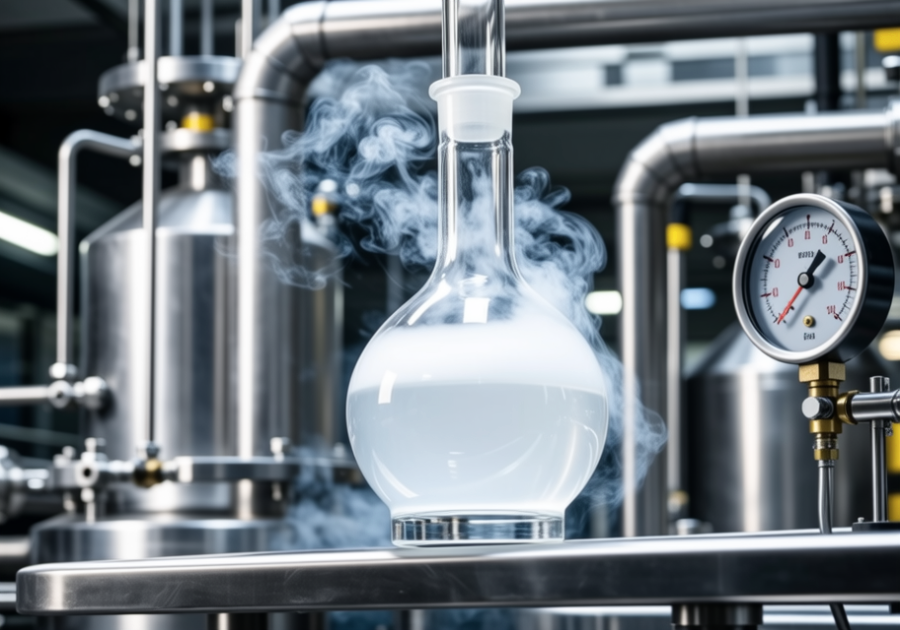
Deionized Water vs Distilled: In-depth Understanding of How They Work
Deionized water vs distilled water, they are different. It's not unusual for people to confuse what distilled and deionized water are and to believe that they both signify the same thing. We want to make it obvious since, in the wrong situation, mixing up the two can have horrifying consequences.
Tap water is ionized, mineral-rich water with a high concentration of sodium, calcium, and magnesium. Since the minerals still present in tap water are beneficial to our health, we utilize it for drinking. In accordance with World Health Organization (WHO) recommendations, additional minerals that are not safe are eliminated during purification. However, you cannot use this water in a lab. The ions and organic substances in the water may interfere with laboratory analysis, decrease application performance, and occasionally produce erroneous results.
Every laboratory, whether it be a life science lab, an analytical lab, or a basic chemistry lab, needs to have a water purification system. Water is used in the laboratory for a variety of tasks, including preparing samples, eluents, standards, blanks, and cleaning glassware or equipment required for laboratory analysis. Lab-purified water aids in the efficiency and accuracy of laboratory analysis.
Different techniques, including Reverse Osmosis, activated carbon, ion exchange, distillation, deionization, and others are frequently used in lab water purification systems. Here, we'll talk you what distillation and deionization are. What are the distinctions and how does it work?
When it comes to deionized water vs distilled water, both are techniques utilized in the laboratory's water purification system. The ionic contaminants are eliminated in both methods, but the purified water is created in distinctly different ways to remove ions. Lab-purified water is produced by distillation and deionization, respectively. Each step of the procedure has benefits and drawbacks of its own. Knowing when to utilize each sort of water purification system for the lab is crucial.
Deionized water vs distilled water: work process
Deionized and distilled water are both extremely clean kinds of water, but they are made in quite different ways. Distilled water may be purer than deionized water, depending on the water source. Deionized water and distilled water aren't necessarily superior, though. Each method has benefits and drawbacks, and the choice ultimately comes down to things like price and intended usage.
- Deionized water
Using tap water or distilled water as a supply, the deionization procedure utilized in the laboratory water purifier creates deionized water. Water is passed through an electrically charged ion exchange resin that has positive (anode) and negative (cathode) charged resins. The cations and anions in the water are drawn to the anode and the cathode, respectively. Deionized water is created by this method, which removes the ions from the water.
When exposed to air, the deionized water produced is extremely reactive and rapidly polluted. It is easily reacted with airborne gases like CO2 to form H+ and HCO3-. Reverse osmosis and ultrafilters are two methods that can be used to remove microorganisms like bacteria and viruses that are not removed by deionization.
The benefits of this technique are its efficiency in removing dissolved ions from water and its ability to regenerate resin beds at a cheap cost of investment. Deionization does not eliminate particles or microorganisms, though, and when utilized for a long time, the operating costs rise.
- Distilled water
The refined form of water acquired through the distillation process is the distilled water that is produced by the laboratory water purifier. Distillation, which converts water from one state to another—from liquid to vapour and back again—to produce pure water, is not a chemical process.
When water containing salts or other contaminants is heated past its boiling point during the distillation process, the water is turned into water vapour. Following passage through the cooling chamber, the water vapour is re-condensed as water is collected. Salts and contaminants are absent from the water that is collected after the distillation process.
Distillation is regarded as a physical separation technique that yields distilled water by separating water from additional contaminants. Tap water is used as the source water throughout the distillation process. It is important to examine the contaminants in the feedwater because some pollutants, such as volatile organic compounds or mercury, evaporate with the water.
This method has the advantages of being reusable, substantially removing pollutants, and having a low cost. However, some pollutants that evaporate with water and have the same boiling point as water can enter the condensate. Boiling water also consumes a lot of counter space and more electrical energy. Meanwhile, careful upkeep is necessary to guarantee purity.
Looking for chemical products? Let suppliers reach out to you!
You May Interested In


Glow70/KLOW80 99% China Peptides Warehouse Direct Delivery Lyophilized Powder in Stock
$169/UNIT FOB


2026-10-16
Trade Alert
Delivering the latest product trends and industry news straight to your inbox.
(We'll never share your email address with a third-party.)

Related News
-
What things to know about the oxidation of minerals that contain iron?
-
Which Minerals React with Acid to Produce CO2? Incredible Properties
-
Chemical Properties and Uses of Tetraetil
-
Flavin Adenine Dinucleotide (FAD): Functions and Applications
-
Magnesium Chloride (MgCl₂): Properties, Uses, and Applications
-
Dicalcium Phosphate: Properties, Uses, and Applications
-
Salinity Solution: Preparation and Uses
-
Rubber Cement: Applications and Safety Guidelines
-
Understanding PCl5: Compound Name and Uses
-
Isoascorbic Acid: Uses and Safety
Recommend Reading
-
![Sulfur Hexafluoride (SF6): Applications and Safety]()
Sulfur Hexafluoride (SF6): Applications and Safety
-
![Sodium Alginate: Properties, Uses, and Benefits]()
Sodium Alginate: Properties, Uses, and Benefits
-
![Microcrystalline Cellulose: Applications in Pharmaceuticals]()
Microcrystalline Cellulose: Applications in Pharmaceuticals
-
![Sulfuric Acid Reactions: With Sugar (Dehydration), Water, and Metals]()
Sulfuric Acid Reactions: With Sugar (Dehydration), Water, and Metals
-
![What is Serine? (Amino Acid Function & Sources)]()
What is Serine? (Amino Acid Function & Sources)
-
![Business Society September 16, 2026 Hydrofluoric Acid Trend Analysis: Fluctuating Trend]()
Business Society September 16, 2026 Hydrofluoric Acid Trend Analysis: Fluctuating Trend
-
![Business Society October 15, 2026 Acrylonitrile Trend Analysis: Strong Consolidation]()
Business Society October 15, 2026 Acrylonitrile Trend Analysis: Strong Consolidation
-
![The FDA Officially Blesses AI for Liver Drug Development]()
The FDA Officially Blesses AI for Liver Drug Development
-
![Business Society’s Maleic Anhydride Trend Analysis for September 15, 2026: Rising]()
Business Society’s Maleic Anhydride Trend Analysis for September 15, 2026: Rising
-
![Business Society October 15, 2026 LDPE Trend Analysis: Mild Correction]()
Business Society October 15, 2026 LDPE Trend Analysis: Mild Correction