India Bans Four Pesticides, Including Controversial Monocrotophos
India has taken a significant step in pesticide regulation by issuing the Insecticides (Prohibition) Order, 2023, banning four highly hazardous pesticides. These pesticides include Dicofol, Dinocap, Methomyl, and the controversial Monocrotophos. The ban went into effect immediately upon publication on October 6, 2023.
Key Provisions of the Order:
- Dicofol, Dinocap, and Methomyl are banned for sale, distribution, and use without any transitional period.
- Monocrotophos, equally hazardous, is given a one-year transitional period to allow farmers to transition to alternative pest control solutions, preventing sudden losses. However, concerns have been raised regarding the clarity of the language in the Order, particularly regarding Monocrotophos, with calls for a clear ban on its manufacture in all formulations to prevent any misuse beyond the transitional period.
The details of the decision regarding these pesticides are outlined in the table below.
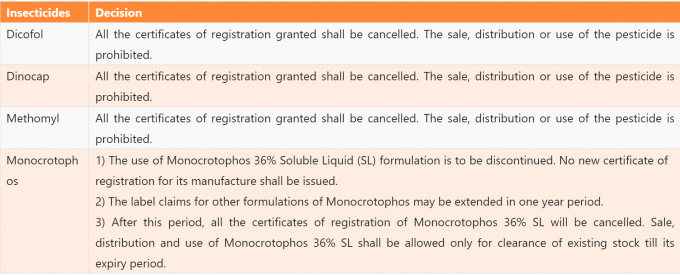
In a parallel move, India has restricted the approved use of label claims for seven other insecticides on specific crops. This means these insecticides are banned for use on the crops initially registered. Manufacturers and marketers must update their labels to reflect these restrictions.
Monocrotophos - A Controversial Pesticide:Monocrotophos, categorized as highly hazardous by the Food and Agriculture Organization (FAO) and the World Health Organization (WHO), has been implicated in numerous pesticide poisoning incidents in India, including the well-known Yavatmal pesticide poisoning incident in 2017 and a school lunch pesticide poisoning case in 2013. It has also been misused for suicides. Pesticide manufacturers and marketers must update their labels to reflect the crops on which these insecticides can be used.
The details are outlined in the table below.

Despite being banned for use on vegetables in 2005, its enforcement was limited. Over the years, India allowed Monocrotophos use on various crops due to its cost-effectiveness and pest control efficacy. However, in 2023, India has finally banned its use, albeit with a one-year transition period.
India's Pesticide Regulation Efforts:In 2013, India formed an Expert Committee to review 66 insecticides, some of which were banned or restricted in other countries but still registered for domestic use in India.
The Ministry of Agriculture in India proposed a draft order in May 2020 to ban 27 pesticides, acknowledging their risks to humans and animals. However, the proposed ban has faced opposition from the agrochemical industry, which relies on these products for domestic and international sales. Future regulatory decisions regarding this draft ban Order will depend on various factors, including its impact on businesses and related concerns.
The 27 pesticides are shown in the table below. The banned four pesticides are marked in red and the restricted seven pesticides are marked in orange.

However, the draft Order has faced challenges from the Indian agrochemical industry, as these products constitute a significant portion of pesticide sales in both domestic and overseas markets. The future regulatory changes regarding the draft ban Order will depend on various factors, including the impact on business and related concerns.
India's ban on these pesticides reflects its commitment to pesticide regulation, human health, and environmental protection, promoting safer and more sustainable agricultural practices in the country.

You May Interested In


High Quality β-Nicotinamide adenine dinucleotide CAS 53-84-9 NADwith ready stock and best price
$3E+1/UNIT FOB


2026-10-23
Trade Alert
Delivering the latest product trends and industry news straight to your inbox.
(We'll never share your email address with a third-party.)

Related News
-
Renaissance BioScience Receives Genome BC Funding to Extend RNAi Biopesticide Platform to Target Soil-Dwelling Crop Pests
-
DBN and MOLBREEDING signed a strategic cooperation agreement to carry out in-depth cooperation in six areas such as the integration of transgenic corn traits
-
DBN and MOLBREEDING signed a strategic cooperation agreement to carry out in-depth cooperation in six areas such as the integration of transgenic corn traits
-
Brazil's Agriconnection uses a new model to import and direct sell pesticides, with revenue exceeding $340 million
-
China's insecticide import and export data for June
-
Jiangsu TrustChem’s degradable pesticide packaging bottle won the domestic and international invention patent authorization
-
Hymexazol was expanded to bean and zucchini in China
-
Two innovative pesticide ingredients of KingAgroot and Japan Nichino have been officially awarded ISO generic names
-
SINO-AGRI and Liaoning Zhonghui signed a strategic cooperation framework agreement
-
Hebang Biological intends to increase its stake in Australian listed company AEV and achieve control
Recommend Reading
-
![Aldi Expands Its Ingredient Ban]()
Aldi Expands Its Ingredient Ban
-
![Pharmaceutical Tariffs Put Ingredients Back in Focus]()
Pharmaceutical Tariffs Put Ingredients Back in Focus
-
![IPEC Updates Excipient Qualification Guidance]()
IPEC Updates Excipient Qualification Guidance
-
![U.S. Onshoring Debate Exposes API Raw-Material Gap]()
U.S. Onshoring Debate Exposes API Raw-Material Gap
-
![FSANZ Advances Caffeine Permission Changes]()
FSANZ Advances Caffeine Permission Changes
-
![In April, China's acetone market first declined then rose]()
In April, China's acetone market first declined then rose
-
![Phosphate Market Prices Fluctuated and Declined in August in China]()
Phosphate Market Prices Fluctuated and Declined in August in China
-
![FDA Tracks Industry Dye Removal]()
FDA Tracks Industry Dye Removal
-
![In August, the Chinese urea market showed fluctuating declines]()
In August, the Chinese urea market showed fluctuating declines
-
![MTBE Market Continues to Rise in China]()
MTBE Market Continues to Rise in China