What is the Reaction between NaOH and NaOCl?
This article goes into the depth of sodium hypochlorite and sodium hydroxide reaction, and its applications on an industrial scale as well.
Introduction:
Before we get into the reaction of sodium hypochlorite and sodium hydroxide, let’s first go through the basics of both compounds. The first one is the Sodium Hypochlorite with the chemical formula NaOCl. It exists as a salt composed of sodium cations (Na+) and hypochlorite anions (ClO-).
The hypochlorite ions (ClO-) are composed of a single chlorine atom which is covalently bonded with an oxygen atom. Both give the ion a collective negative charge. These ions are highly reactive plus oxidation agents and also are very unstable.
Sodium Hydroxide or NaOH is a strong base that exists as a white, odorless solid that is readily soluble in water due to its ionic (Na+) and hydroxide ions (OH-) parts. This chemical is industrially produced through a process called the “chloralkaline process” in which electrolysis of a concentrated sodium chloride solution is carried out. Chlorine leaves the solution, and all left behind are hydroxide ions. This solution is then concentrated and purified to gain NaOH.
Sodium Hypochlorite and Sodium Hydroxide:
Both these compounds react with each other and combine as typical ionic substances in a double replacement reaction, also called the metathesis reaction. In other words, the ions essentially change their partners and become new compounds. The first reactant, Sodium hypochlorite is present is usually present as an aqueous solution (bleach) for this reaction. And the Sodium hydroxide which is usually solid or in pellets at room temperature is dissolved in this solution.
The sodium ions also start to appear along with the already present hypochlorite ions (ClO⁻) of the bleach. Here, the ClO⁻ ions undergo a disproportionation reaction to form chlorate ion (ClO₃⁻) and chloride (Cl⁻) ions. Then the following reaction occurs:
NaClO + 2NaOH → NaClO3 + NaCl + H2O
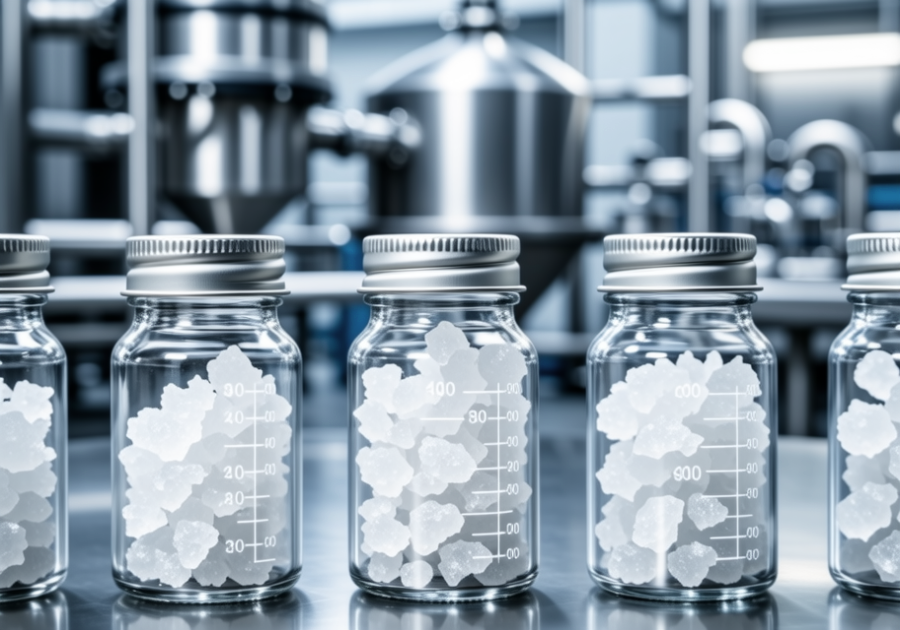
You can see that in the above reaction, cations have left their original partners. The resultant compound sodium chlorate or NaClO3 is a powerful oxidizing agent. It is used in the industry for the production of a very important compound called chlorine dioxide or ClO2. It exists as an odorless and crystalline (sugar-like) solid and is quite irritating to our skin, eyes, and airways. It has a pale yellow to white color and is often used in a water solution.
Sodium chlorate is extensively used in the paper production process where it is employed for the removal of wood pulp during the bleaching process. Moreover, this compound has been heavily used in forestry applications and extensively in the herbicide industry in the last decades. Famers use it to control weed growth in farms as it can be used to selectively limit the photosynthesis activity of certain plants that can cause damage to crop yield.
In recent years, the use of this compound has drastically been reduced because of its aftereffects and damage to the environment. In the EU, it is completely banned from being used as a pesticide. Sodium Chlorate also has found a huge role in the explosive industry for many centuries. It is used in explosive ingredients to increase the impact but in the modern weapon industry, its use has gone low due to safety concerns during production processes.
It is also used in the production of various types of detergents and cleaning products. It also finds use in the textile bleaching processes by acting as a precursor for the production of chlorine dioxide solution which is a common bleaching agent. It also finds its use in the mining industry where it helps the extraction of uranium and vanadium. It does that by acting as an oxidizing agent in certain chemical processes carried out for their extraction.
Wrapping Up:
To conclude the reaction of sodium hypochlorite and sodium hydroxide can be stated that it is a typical double replacement reaction in which cations switch between the compounds. The resultant compound, sodium chlorate has a wide variety of industrial applications but more than 90 percent of the sodium chlorate being produced on the entire planet is used just in the bleaching process of wood pulp for paper production.
Looking for chemical products? Let suppliers reach out to you!
You May Interested In


Glow70/KLOW80 99% China Peptides Warehouse Direct Delivery Lyophilized Powder in Stock
$169/UNIT FOB


2026-10-26
Trade Alert
Delivering the latest product trends and industry news straight to your inbox.
(We'll never share your email address with a third-party.)

Related News
-
Calcium Sulfate: Properties, Uses, and Applications
-
Understanding Reactions Between Silver and Chloride
-
Key Properties and Applications of Para-Nitrophenol
-
What is a Surfactant? (Definition, Types, and How They Work)
-
Oxalic Acid: Acidity (pKa), Sources, and Kidney Stone Risk
-
Sodium Hypochlorite: Uses, Concentration Guide, and Critical Safety Hazards
-
Isopropyl Alcohol (IPA) vs Ethanol: Which Solvent or Disinfectant is Better?
-
Sulfuric Acid (H2SO4): Properties, Battery Uses, and Extreme Safety Hazards
-
What is Trametenolic Acid? (Structure, Sources & Research)
-
Ammonia Chemical Formula: NH3 Structure & Properties
Recommend Reading
-
![Benzyl Alcohol: Uses in Cosmetics, Preservative Efficacy, and Safety]()
Benzyl Alcohol: Uses in Cosmetics, Preservative Efficacy, and Safety
-
![Sodium Benzoate (E211): Safety, Benzene Risk, and Preservative Uses]()
Sodium Benzoate (E211): Safety, Benzene Risk, and Preservative Uses
-
![France’s Vineyards Find a New Shield: Eden’s Mevalone Enters the Frontline of a Changing Fungicide Era]()
France’s Vineyards Find a New Shield: Eden’s Mevalone Enters the Frontline of a Changing Fungicide Era
-
![India Unleashes a Triple-Action Defender: Parijat Introduces NILANIX SC into the Rice Battlefront]()
India Unleashes a Triple-Action Defender: Parijat Introduces NILANIX SC into the Rice Battlefront
-
![Potassium Nitrate Reactions & Uses (KNO3)]()
Potassium Nitrate Reactions & Uses (KNO3)
-
![Both Cost and Demand Weaken, PTA Prices Slightly Decline]()
Both Cost and Demand Weaken, PTA Prices Slightly Decline
-
![Business Society’s Styrene Trend Analysis for September 15, 2026: Fluctuating and Rising]()
Business Society’s Styrene Trend Analysis for September 15, 2026: Fluctuating and Rising
-
![Lithium carbonate inventory data, can it anchor the logic of price fluctuations in China?]()
Lithium carbonate inventory data, can it anchor the logic of price fluctuations in China?
-
![Business Society’s Maleic Anhydride Trend Analysis for September 14, 2026: Volatile]()
Business Society’s Maleic Anhydride Trend Analysis for September 14, 2026: Volatile
-
![Cost-driven, Polyester Bottle Flakes Remain Highly Volatile This Week (Mar. 23–27)]()
Cost-driven, Polyester Bottle Flakes Remain Highly Volatile This Week (Mar. 23–27)