Understanding Reactions Between Silver and Chloride
The central question many students and lab professionals ask is simple: what actually happens when silver meets chloride ions? The conclusion is equally clear—silver ions react rapidly and predictably with chloride to form silver chloride, an insoluble, light-sensitive solid. This process governs analytical chemistry protocols, industrial applications, and even the foundations of early photography. Below is a detailed, experience-driven overview designed to help you understand the full behavior of these systems without unnecessary jargon.
Why Silver and Chloride React So Readily
The interaction between silver and chloride reactions is rooted in solubility rules and the strong driving force toward forming an insoluble salt. Most introductory chemistry courses highlight how Ag+ and Cl− combine almost instantly to yield solid silver chloride (AgCl). Regulatory references such as the USGS solubility data consistently classify AgCl as “practically insoluble,” which is why the reaction is commonly used to confirm the presence of chloride in solutions.
Fundamental Reaction
The reaction follows a simple ionic equation:
Ag+ (aq) + Cl− (aq) → AgCl (s)
This immediate formation of a dense, white precipitate is widely used in qualitative analysis, environmental testing, and gravimetric procedures.
Silver Chloride Precipitation Behavior
The topic of silver chloride precipitation is more nuanced than simply “insoluble.” The salt’s solubility product constant (Ksp) is extremely low, meaning even minute chloride concentrations can trigger precipitation. In practical lab work, this makes AgCl useful for accurate chloride quantification, provided that controlled conditions—ionic strength, temperature, and competing ions—are maintained.
Key Precipitation Characteristics
| Characteristic | Details |
|---|---|
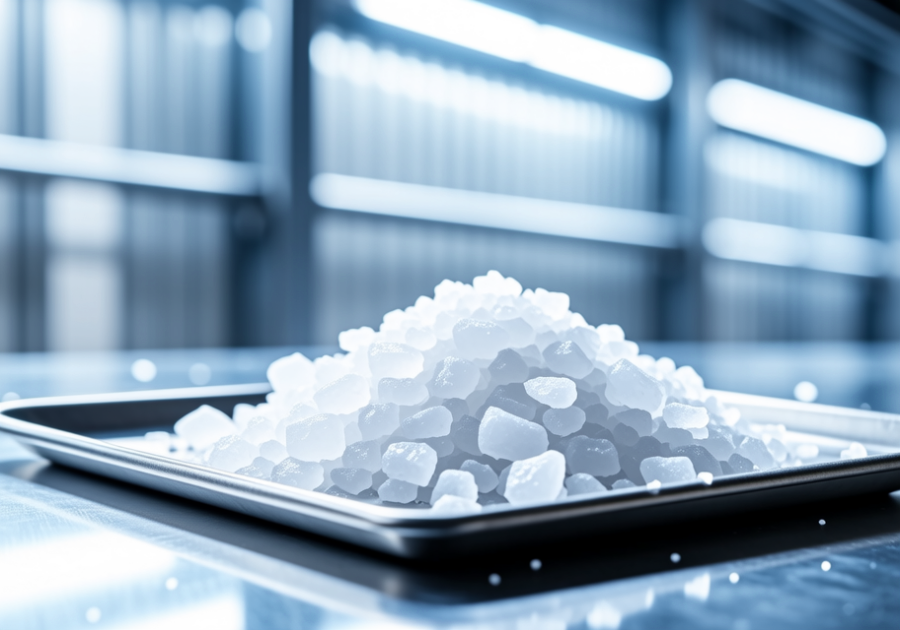
| Appearance | White, curdy solid that darkens under light |
| Solubility | Practically insoluble in water; dissolves in ammonia |
| Ksp | ~1.8 × 10⁻¹⁰ at 25°C |
| Light Sensitivity | Decomposes slowly into metallic silver and chlorine species |
These traits explain why analysts must protect AgCl from strong light during gravimetric drying steps. Even modest photodecomposition can bias results, a detail emphasized in ASTM and EPA laboratory standards.
Solubility and Complex Formation
Although silver chloride is traditionally considered insoluble, its ability to dissolve in ammonia by forming the diamminesilver(I) complex is essential for both laboratory operations and chemical separation techniques:
AgCl (s) + 2 NH3 (aq) → [Ag(NH3)2]+ (aq) + Cl− (aq)
This reversible reaction provides a controlled way to dissolve, transport, and re-precipitate silver chloride during purification or analytical workflows.
Applications in Analytical Chemistry
From titrations to gravimetry, the silver–chloride system underpins many quantitative methods. In Mohr and Volhard titrations, silver nitrate acts as the primary reagent for chloride determination, and endpoint accuracy depends on the predictable formation of AgCl. These methods are widely referenced in standard analytical texts and remain staples of environmental labs measuring chloride in water, soil, and wastewater.
Silver Chloride in Photography
The role of silver chloride in photography connects chemistry to art and technology. Before digital imaging, AgCl and related silver halides formed the backbone of photographic papers. Their unique light sensitivity enabled the creation of stable images through controlled exposure and development.
How AgCl Captures Light
- Light strikes silver chloride crystals embedded in the paper’s emulsion.
- Photons initiate the reduction of some Ag+ ions to metallic silver.
- A latent image forms, invisible until chemical developers amplify these changes.
This mechanism, documented by institutions such as the International Museum of Photography, illustrates why silver chloride was prized for contact printing and fine-art darkroom processes—its slower speed and fine grain produced high-detail images.
Industrial and Environmental Relevance
Outside photography and analytical chemistry, silver–chloride systems appear in sensor technology, electrochemistry, and industrial wastewater treatment. Silver/silver chloride electrodes remain a widely used reference standard because of their stability, reproducibility, and alignment with NIST testing protocols.
Practical Considerations for Lab Work
From years of lab experience, a few consistent practices stand out. Always add silver nitrate slowly to avoid localized supersaturation. Rinse precipitates with chloride-free water to prevent contamination. Protect samples from bright light, especially during filtration and drying. These small steps significantly improve precision in routine analyses.
Conclusion
Reactions between silver and chloride are straightforward yet rich in practical significance. Their fast precipitation, low solubility, and pronounced light sensitivity shape how chemists detect chloride, craft photographic materials, and design stable electrochemical devices. A solid understanding of these behaviors ensures reliable results whether you are working in a classroom, research lab, or industrial setting.
Looking for chemical products? Let suppliers reach out to you!
You May Interested In


Glow70/KLOW80 99% China Peptides Warehouse Direct Delivery Lyophilized Powder in Stock
$169/UNIT FOB


2026-10-11
Trade Alert
Delivering the latest product trends and industry news straight to your inbox.
(We'll never share your email address with a third-party.)

Related News
-
Key Properties and Applications of Para-Nitrophenol
-
Dimethyl Carbonate: Properties and Industrial Applications
-
Hydrobromic Acid: Properties, Uses, and Safety
-
Potassium Carbonate: Properties, Uses, and Applications
-
Cocamidopropyl Betaine: Uses, Benefits, and Safety
-
What is the Formula for Ammonia? (NH3 Structure & Properties)
-
Aluminum Sulfate: Industrial and Water Treatment Applications
-
Ammonia Chemical Formula: NH3 Structure & Properties
-
Benzyl Alcohol: Uses in Cosmetics, Preservative Efficacy, and Safety
-
Understanding Titanium Oxide: Properties and Uses
Recommend Reading
-
![Sodium Benzoate (E211): Safety, Benzene Risk, and Preservative Uses]()
Sodium Benzoate (E211): Safety, Benzene Risk, and Preservative Uses
-
![Calcium Acetate: Medical and Industrial Applications]()
Calcium Acetate: Medical and Industrial Applications
-
![Carbon Tetrachloride: Uses, Hazards, and Industrial Applications]()
Carbon Tetrachloride: Uses, Hazards, and Industrial Applications
-
![Microcrystalline Cellulose: Applications in Pharmaceuticals]()
Microcrystalline Cellulose: Applications in Pharmaceuticals
-
![Sulfur Hexafluoride (SF6): Applications and Safety]()
Sulfur Hexafluoride (SF6): Applications and Safety
-
![This week, the TDI market in China showed a strong upward trend (12.8-12.12)]()
This week, the TDI market in China showed a strong upward trend (12.8-12.12)
-
![This Week's Activated Carbon Prices Remain Stable (10.20-10.24)]()
This Week's Activated Carbon Prices Remain Stable (10.20-10.24)
-
![Business Society September 21, 2026 Caustic Soda Trend Analysis: Trend is Bullish]()
Business Society September 21, 2026 Caustic Soda Trend Analysis: Trend is Bullish
-
![BDO market in China operates steadily]()
BDO market in China operates steadily
-
![Business Society September 20, 2026 Caustic Soda Trend Analysis: Volatile Trading]()
Business Society September 20, 2026 Caustic Soda Trend Analysis: Volatile Trading