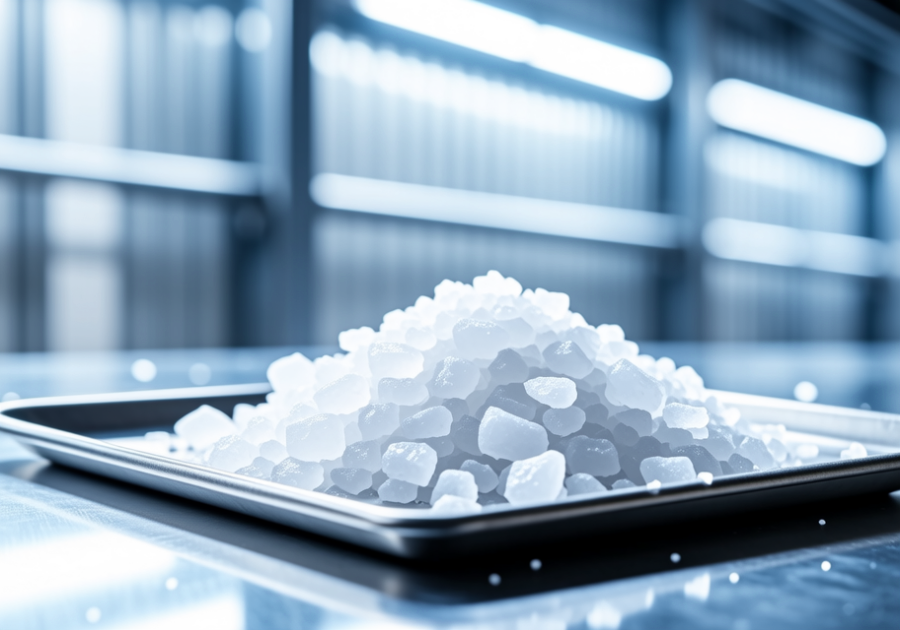
Does Acetone Evaporate Completely? | Theory, Uses, and Safety
Does acetone evaporate, and how do we handle it during transportation, especially when buying from B2B marketplaces for industrial uses? This article explains all of this, including its uses and safety.
Introduction:
Acetone, a common, versatile solvent, is widely used in household products, laboratories, and industries for various purposes. Acetone’s features, like rapid evaporation and ability to dissolve into various substances, make it quite a useful chemical in the aforementioned industrial sectors.
It has a chemical formula of C3H6O, which also goes by the name propanone, is an organic compound, and is the simplest ketone. It is a volatile liquid and has a strong, distinct odor similar to nail polish and other cleaning liquids. It has a boiling point of 56 °C (132.8 °F) and is completely miscible in water.
The molecule of acetone is formed by three carbon atoms combined with six hydrogen atoms and one oxygen atom. There is also a carbonyl group (C=O) bonded to two methyl groups, or CH3, in this molecule, which is held together with weak Van der Waals forces, making it easy to evaporate.
It is also quite commonly used for cleaning, degreasing, and even drying surfaces. However, the question remains: does acetone evaporate completely? And if it does, what is the rate of evaporation, and how can it be transported? Understanding acetone’s properties, evaporation characteristics, and potential residues left behind is crucial to answering all these questions.
Does Acetone Evaporate Completely?
Yes, it does, but it depends on where it is being applied. Acetone, when applied to non-porous surfaces, gets evaporated very easily. This rapid evaporation is one of the reasons it’s used to dry glassware in labs. The evaporation might leave residual moisture or other substances if it is contaminated. But why does it evaporate so easily?
The reason for this is its high volatility and its low boiling point of 56°C or 132.8°F. The molecular structure of acetone makes its molecules less likely to stay in their original liquid form and quickly escape into the air. Moreover, the high vapor pressure of acetone also reflects a high tendency to vaporize. This evaporating feature also makes it extremely flammable and requires care when being used.
Applications of Acetone’s Evaporation:
Its ability to evaporate completely and quickly without leaving a residue when being pure makes it invaluable for many tasks. The most common use case is when it is used to quick-dry solvents, particularly in scientific, industrial, and household applications. Although it has quite significant uses in the current industry landscape, its flammability hazards make it quite a tricky chemical to use and require special attention to avoid any mishaps.
Such chemicals are transported in IBC totes designed for hazardous materials, which are tightly sealed. Industrial use and its transport are done in proper storage containers to minimize exposure to air and prevent vapor loss. Also, cold temperatures are maintained to lower their evaporating rates in hot regions.
Acetone finds many other applications in the current industry, such as being used as a paint thinner to help achieve the desired consistency. It is also used in the production of various plastics like polycarbonate and acrylics and for the production of adhesives and sealants. It is also commonly used in chemistry labs for cleaning of lab equipment where it doesn’t leave any stains and is great for cleaning as it evaporates quickly.
The marketplace of Echemi has hundreds of reliable and certified suppliers that have 99.9 percent purity of acetone. These suppliers also come with a guarantee of no residual removal when it is evaporated for industrial uses, meaning there are no impurities in them. Acetone from this marketplace is also transported in the highest possible safety conditions and in properly sealed containers to avoid any evaporation of acetone.
Conclusion:
Now you know the answer to the question, “Does acetone evaporate completely when applied to a surface?" To conclude, we can state that it evaporated completely, provided it is pure, and I applied it on a flat, non-porous surface. It is very flammable but is still heavily used in industries and laboratories for various purposes. Notably, acetone vapor is highly flammable and can form explosive mixtures with air. Therefore, using acetone in a well-ventilated area is essential to minimize the risk of fire or explosion.
Looking for chemical products? Let suppliers reach out to you!
You May Interested In


Glow70/KLOW80 99% China Peptides Warehouse Direct Delivery Lyophilized Powder in Stock
$169/UNIT FOB


2026-10-13
Trade Alert
Delivering the latest product trends and industry news straight to your inbox.
(We'll never share your email address with a third-party.)

Related News
Recommend Reading
-
![September China urea market trend fluctuates and rises]()
September China urea market trend fluctuates and rises
-
![Both Costs and Supply-Demand Weaken, PTA Prices Edge Lower]()
Both Costs and Supply-Demand Weaken, PTA Prices Edge Lower
-
![Caustic Soda Prices in September Show Overall Consolidation]()
Caustic Soda Prices in September Show Overall Consolidation
-
![Business Society September 22, 2026 PTA Trend Analysis: Clear Downtrend]()
Business Society September 22, 2026 PTA Trend Analysis: Clear Downtrend
-
![Business Society’s Market Outlook for Fuel Oil 180CST on August 31, 2026: Volatile]()
Business Society’s Market Outlook for Fuel Oil 180CST on August 31, 2026: Volatile