The overall trend of the n-butanol market this month bottomed out and rebounded(202104)
1. This issue's core tips and quick overview of trends
The n-butanol market gradually recovered in April
The overall trend of the n-butanol market this month bottomed out and rebounded. The downstream butyl acrylate market has improved, and factory operations have risen. Demand for n-butanol replenishment continues to increase. Orders from overall manufacturers of n-butanol increase this month, and the demand for replenishment by factories continues As a result, the overall transaction volume of the market has increased, and inventory has become tighter again. Manufacturers have continued to increase in the latter part of the month, and the market has recovered steadily.
2. The market summary of the current period
2.1 The Asian market fluctuated within a narrow range this month
The overall amplitude of the Asian n-butanol market narrowed this month, and the overall market trading atmosphere continued to decline steadily. This month, as the domestic market continued to pull back from a high level, while the overall demand for n-butanol declined, the overall center of gravity of the market continued to fall.
The closing price of butanol in Europe and the United States this month and the statistics
| Date April 8 |
area |
Unit |
|||
| CFR China |
CFR Southeast Asia |
FOB Northwest Europe |
FOB United States |
||
| April 15 |
1780 |
1630 |
2200 |
2055 |
USD/ton |
| April 22 |
1630 |
1680 |
2200 |
2105 |
USD/ton |
| April 29 |
1680 |
1740 |
2200 |
2165 |
USD/ton |
| Average price this month |
1740 |
1740 |
2200 |
2165 |
USD/ton |
| Change from last month |
1707.5 |
1697.5 |
2200 |
2122.5 |
USD/ton |
| Date |
202.5 |
782.5 |
502.5 |
613.75 |
USD/ton |
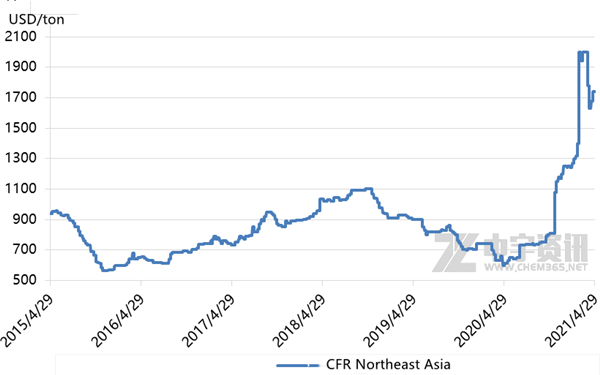
The price trend of n-butanol in Northeast Asia from 2015 to 2021
2.12 Domestic market
Comparison of domestic market price statistics of n-butanol this month
| product |
area |
Closing price at the end of the month (CNY/ton) |
Compared with last month's closing price (CNY/ton) |
| N-butanol |
Jiangsu area |
13300-13400 |
+2100 |
| N-butanol |
Zhejiang area |
13500 |
+2000 |
| N-butanol |
Shandong area |
13000-13100 |
+2000 |
| N-butanol |
Guangdong area |
13500-13600 |
+2000 |
| N-butanol |
North China |
13200 |
+2100 |
| N-butanol |
North-east area |
13000 |
+1900 |
| Isobutanol |
Jiangsu area |
11400-11500 |
+1600 |
| Isobutanol |
Zhejiang area |
11500 |
+1600 |
| Isobutanol |
Shandong area |
10800 |
+800 |
| Isobutanol |
Guangdong area |
11800 |
+1500 |
2015-2021 East China market price trend of n-butanol
East China: In April, the overall n-butanol market in Jiangsu has recovered steadily, and the demand for concentrated purchases of downstream factories has risen. The market transaction atmosphere has generally improved. The spot buying atmosphere has gradually become active in the latter part of this month, plus May Day. The demand for pre-stocking increased, market transactions expanded, and the overall center of gravity continued to rise steadily. By the end of the month, mainstream negotiations and transactions in the local market were concentrated at around RMB 13,300-13,400/ton.
Shandong area: In April, the n-butanol market in Shandong area gradually recovered.
The overall sales continued to rise, and the number of orders from manufacturers in the latter part of the month increased, and the quotations continued to rise. By the end of the month, mainstream transactions in the local market were concentrated at around RMB 13,000-13,100/ton.
North China In 43, the n-butanol market in North China continued to rebound as a whole, and the downstream factories in Hebei and other regions started to work.
Often, the plasticizer factory started to resume, but the overall transaction volume in the local secondary market was poor. By the end of the month, mainstream transactions in the local market were concentrated at around RMB 13,100/ton.
South China: The overall trend of the n-butanol market in South China and Guangdong this month rose sharply and rebounded. CNOOC's installations this month.
Overhaul and parking, and the downstream demand for goods has improved. By the end of the month, mainstream negotiations and transactions in the local market were between 13500-13600 at around RMB/ton.
Northeast China: The market trend of n-butanol in Northeast China continued to rise this month. The Daqing and Jilin Chemical plants were all operating normally, and the starting load of the plants was maintained at about 70% to 80%. The local market is still dominated by primary market transactions. , Factory of the Month.
Domestic production and sales are basically stable. By the end of the month, mainstream transactions in the local market were concentrated at around RMB 13,000-13,100/ton.
3. The next market trend forecast
| Driving factors |
Next forecast |
Drive direction |
| Upstream |
In May, the supply side: the centralized maintenance of domestic refining and chemical plants is gradually ending, and the supply side will gradually weaken. Demand side: Some new PP production capacity is still expected to be released, which may alleviate the conflict between regional supply and demand. In addition, the downstream chemical storage and maintenance plan of some integrated plants will increase the risk of propylene market operation. On the whole, Zhongyu expects that the domestic propylene market may fluctuate and decline in May, and the downstream demand will increase. It is necessary to pay attention to the changes in the main downstream market and the progress of the maintenance of upstream and downstream devices. |
neutral |
| Downstream operating rate Profit |
Butyl acrylate: Arkema in France and Dow in Europe have equipment problems, and factory price sentiment has increased. After the holiday, the offer may be raised. Under the weak propylene market, market participants are cautious when chasing high, negotiating wait-and-see on demand, and short-term market adjusts within a narrow range. |
Good |
| Butyl acetate: On the whole, the current market prices are relatively high, and the downstream has obvious resistance to high prices. However, the overall inventory of the factory is still under control. The high raw material prices make the butyl acetate factory obvious. If the acetic acid factory is restarted next month, The price of butyl acetate may still be expected to weaken, so we still need to pay attention to changes in raw material prices. |
Good |
|
| Import and export |
Next month, the overall operating rate is expected to remain low. Manufacturers' installations may continue to operate at high loads, or even increase, and overall supply is expected to increase. |
Neutral |
| Comprehensive judgment |
At present, the average industry profit of n-butanol is around 6000 CNY/ton, and the profitability is strong. It is expected to fall next month. |
Neutral |
| Downstream operating rate |
In May, it is estimated that domestic imports of n-butanol are still at a low level and may continue to decline. Due to the impact of the devaluation of the RMB exchange rate, the cost is relatively high, coupled with the impact of anti-dumping and trade frictions, the port arrivals will still be small in the short term, and imported goods will affect The circulation link has little impact, and the short-term impact on the market is small. |
neutral |
| Profit |
Next month, it is expected that the n-butanol market as a whole is expected to maintain a steady initial trend. Under the condition of sufficient orders from manufacturers, short-term inventories are still expected to be tight. Downstream factories still have short-term replenishment needs, so manufacturers' increase expectations still exist. However, in the latter part of next month, it is expected that the market will gradually adjust to the decline in the amount of goods received by downstream factories. |
↓200-500 |
4. Charts and detailed data
4.11 Supply analysis and forecast
4.1.1 Spot supply
| March |
Port inventory quantity (tons) |
April |
Port inventory quantity (tons) |
| the first week |
15-20 thousand |
the first week |
15-20 thousand |
| the second week |
15-20 thousand |
the second week |
15-20 thousand |
| The third week |
15-20 thousand |
The third week |
15-20 thousand |
| the fourth week |
15-20 thousand |
the fourth week |
15-20 thousand |
Except for the long-term delivery of some downstream factories, the recent arrivals of imported goods to East China ports are still small. Later this month, due to the increase in downstream replenishment demand, the inventory level has declined slightly, but the increase in actual downstream consumption is limited. . The output of manufacturers is expected to decline, and the overall inventory level is expected to be in the middle next month, but the overall supply is still abundant in the short term.
Manufacturer's production and sales dynamics
Unit: CNY/ton
| Manufacturer |
Products |
Ex-factory price |
Change (compared to last month) |
Device operating status |
| Jilin Petrochemical |
N-butanol |
13000 |
+900 |
Normal |
| Daqing Petrochemical |
N-butanol |
13000 |
+900 |
Normal |
| Qilu Petrochemical Tianjin Soda Plant |
N-butanol |
13000 |
+900 |
Overhaul Normal |
| Isobutanol |
10700 |
+200 |
||
| Shandong Lihuayi Luxi Chemical |
N-butanol |
13000-13100 |
+1200 |
Normal Normal |
| Isobutanol |
- |
- |
||
| Hualu Hengsheng Shandong Yankuang |
N-butanol |
13000 |
+2200 |
Conversion Normal |
| Isobutanol |
10700 |
+700 |
||
| Jiangsu Huachang |
N-butanol |
13000 |
+2000 |
Normal |
| Anqing Shuguang |
N-butanol |
- |
- |
Normal |
| Wanhua Chemical |
N-butanol |
13000 |
- |
normal |
| Manufacturer |
N-butanol |
13300 |
+1300 |
Device operating status |
| Jilin Petrochemical |
N-butanol |
13100 |
+900 |
Normal |
| Daqing Petrochemical |
N-butanol |
13500 |
+1100 |
Normal |
This month, the overall output and start-up of the domestic manufacturers of n-butanol were basically stable compared to the previous month. The Jilin Chemical Plant was in normal production this month, and the Daqing Plant was normal. Luxi plant is operating at full capacity this month. The two plants of Tianjin Bohua Yongli Chemical Co., Ltd. were operating at full capacity this month. The Lihuayi device is normal this month. Qilu Petrochemical Plant is normal. The Yankuang plant was normal this month. One set of Jiangsu Huachang Plant was operating normally this month. Wanhua Chemical's n-butanol plant was in normal production this month. This month, the entire Sichuan Petrochemical plant was operating normally. Anqing Shuguang's butanol plant was in normal production. The Shaanxi extension device is normal, and it will be overhauled in about 10 days in the last ten days. This month, the overall start-up level of downstream butyl acetate, butyl acrylate, DBP and other factories dropped. At the end of the month, the inventory of n-butanol in the port area was around 10,000 tons. The overall operating level of domestic n-butanol was around 80% this month.
2 Demand analysis and forecast
Main downstream start and profit analysis
| Products |
Average profit |
Operating rate |
Profit forecast (CNY/ton) |
| Butyl acetate |
100 |
35% |
0-100 |
| Butyl acrylate |
1500 |
60% |
1500 |
| DBP |
200 |
35% |
0-200 |
At present, the overall operation of terminal solvents, adhesives, emulsions, including plastic products, and other industries continue to remain weak. Under the overall weak domestic demand and export environment, there are environmental protection policy pressures and trade disputes that affect the mentality of industry players. It is expected that downstream and terminal enterprises will order orders next month. The growth is still weak. The operating rate of the butyl ester plant is expected to remain stable next month, but the overall profitability of the industry remains weak.
Main downstream raw material inventory cycle
| Main downstream |
Average inventory days in April |
Average inventory days in May |
| Butyl acrylate |
10-15 |
10 |
| Butyl acetate |
8-10 |
8-10 |
| DBP |
3-5 |
3-5 |
It is expected that downstream factories will have an increase in demand in the month, and the overall raw material inventory cycle is still strong, and the increase is expected to decline.
3 Profit analysis and forecast
Industry profit analysis
At present, the average profit level of the butanol industry is still at a huge profit, which is the highest level in history. At the current market price of propylene in Shandong, the overall profitability of n-butanol is extremely high. However, next month is mainly due to the decline in replenishment demand from downstream butyl ester companies. The center of gravity is expected to decline, and the overall forecast is expected to fall.
Analysis of upstream and downstream profit drivers
Propylene: In May, the supply side: a number of refineries in the north are scheduled to be overhauled, and the propylene devices that were overhauled in the previous period will be restored one after another. The overall supply side still has a certain positive support. Demand side: The main downstream polypropylene plants have been put into production one after another. The spot market is expected to be weak in the future, and the upper limit of propylene prices will continue to be suppressed. Other downstream chemicals are profitable, and purchases are based on demand. It is expected that the domestic propylene market will mainly fluctuate in the range in April, focusing on changes in the main downstream market conditions and the dynamics of the maintenance of upstream and downstream devices.
Downstream: In May, the overall market trend of butyl acrylate and butyl acetate is expected to be weak. The overall operating rate of upstream companies is relatively stable, and the market supply is still relatively abundant. The downstream replenishment demand may still increase in April, but the overall market is expected Insufficient activity.
[Views & Summary]
The overall trend of the n-butanol market in May is expected to remain stable and strong at the initial stage, and it is expected to maintain a sideways trend in the short term. The overall demand for downstream products is expected to remain stable in the short term. There will still be increased demand for replenishment in downstream factories, but the market is expected to gradually increase in the latter part of next month Adjusted, so the market will generally decline next month.
5. Interpretation of hot topics in this issue
5.1 The comprehensive effect of domestic and international factors in the first quarter of import and export achieved a good start
In March 2021, China’s export value (USD calibre) increased by 30.6% year-on-year (Wind consensus expects 31.1%) and 154.9% in February; imports (USD calibre) increased by 38.1% (Wind consensus expectation 19.6%). 17.3%; the trade balance was 13.8 billion U.S. dollars, compared with 37.88 billion U.S. dollars in February.
Exports: Benefiting from better external demand and the continuation of the "substitution effect" of my country's supply chain, exports continued to be prosperous, with a two-year compound growth rate of 10.3% in March. In March, the manufacturing PMI of major economies such as the United States, Europe and Japan continued to maintain a relatively high level of prosperity (rising to 64.7, 62.5, and 52.7 respectively, setting new highs since December 1983, June 1997, and November 2018, respectively. ), which drove my country's USD-denominated export growth rate to reach 30.6% in March, which was slightly lower than Wind's consensus expectation (31.1%), but the overall export continued to remain in the high boom range, with a two-year compound growth rate of 10.3%. According to sub-regional observations, my country’s exports to developed countries and developing countries diverged in March. The growth rate of exports to the United States and Europe continued to grow at a high level (53.3% and 87.3% in March, respectively, a two-year compound The growth rate was 10.2% and 5.3% respectively), but the growth rate of exports to ASEAN countries declined, from 53% in January to February to 14.4% in March, a relatively large drop. Of course, from the overall perspective of the first quarter, ASEAN continued to maintain its position as my country's largest trading partner. In terms of products, my country’s mechanical and electrical products performed relatively well, priced in RMB. In the first quarter, my country’s exports of mechanical and electrical products were 2.78 trillion yuan, an increase of 43%, accounting for 60.3% of the total export value, an increase from the same period last year.
1.7 percentage points; among them, the export of automatic data processing equipment and its parts, mobile phones, and automobiles increased by 54.5%, 38.5%, and 98.9% respectively, showing the continuation of the "substitution effect" of my country's supply chain. As for the export of epidemic prevention materials, my country’s first quarter includes
The export of textiles including masks increased by 30.6%, continuing to maintain a relatively rapid growth rate, but the growth rate has begun to decline significantly, of which the export of medical equipment and textiles increased by 39% and 8.4% year-on-year respectively (previous values were 75% and 61%) ), which is also related to the gradual control of overseas epidemics and the rapid advancement of overseas vaccines. On the whole, we believe that exports are still in a relatively high economic range, and are expected to maintain a relatively rapid growth rate in the first half of the year. In the next period of time, the structural differentiation of export products may further increase along with the recovery of overseas supply.
Imports: Benefiting from the significant increase in demand for bulk commodities, imports grew faster than expected in March, which led to a narrowing of the trade balance in March. In March, my country’s imports increased by 38.1%, significantly exceeding the 19.6% expected by Wind. According to our calculations, the two-year compound growth rate reached 16.7%, the highest level in recent years. It also drove the March trade balance to narrow to US$13.8 billion, a low 37.88 billion U.S. dollars in February. Observed by categories, the increase in imports was significantly promoted by the volume of bulk commodity imports. Throughout the first quarter, my country imported 283 million tons of iron ore, an increase of 8%; imported 139 million tons of crude oil, an increase of 9.5%; and imported 29.388 million tons of natural gas, an increase of 19.6%. In the same period, imports of soybeans were 21.178 million tons, an increase of 19%; corn was 6.727 million tons, an increase of 437.8%; wheat was 2.925 million tons, an increase of 131.2%. At the same time, the prices of these commodities have risen relatively significantly. As of March, the import price of iron ore has increased year-on-year for 7 consecutive months, the import price of copper ore has increased year-on-year for 11 consecutive months, and the import price of soybeans has increased for 4 consecutive months. The month-on-year increase, the import prices of the above products in the first quarter rose by 53.5%, 28% and 11.1% year-on-year respectively. Therefore, both from the perspective of volume and price, the import volume of bulk commodities has significantly driven my country's recent import performance to continue to exceed expectations.
The boom in foreign trade still has continuity. From the perspective of the import and export structure in the first quarter and March, we believe that the relatively strong domestic and foreign demand will continue to be reflected in the performance of import and export activities in the second quarter, and the boom in foreign trade is expected to continue. At the export level, take the United States as an example. As of the end of February this year, the gap between the production side and the demand side in the United States was still at the highest level in history, and the recovery of production continued to be slower than the recovery of demand, indicating that the "substitution effect" of my country's supply chain will continue to export to my country. Formed support; and from the perspective of freight rates, the SCFI index continued to maintain a high level in the first half of April, indicating that external demand is still strong. From its guiding observations over the past year, the relatively high level of this index will also be reflected in the export growth performance for a period of time in the future. As for imports, we also believe that the boom will continue. On the one hand, short-term commodity prices are still expected to remain at a relatively high level, which will support upstream imports; on the other hand, with the gradual stabilization and recovery of my country’s consumer market, my country’s demand for terminal consumer goods still has room for a certain rebound. Both will drive the growth of imports to continue its resilience, and we are not pessimistic about the subsequent growth trend of imports. On the whole, there is a high probability that the relative prosperity of foreign trade will continue, and this will be reflected to a certain extent in the support for the real economy. Over the past year, the growth rate of exports has been in good synchronization with manufacturing investment. Therefore, we also maintain a positive view on manufacturing investment in the next quarter. The internal dynamics of the economy can be restored and it is worth looking forward to.
Ministry of Industry and Information Technology: By 2035, manufacturing enterprises above designated size will fully popularize digitalization
The Ministry of Industry and Information Technology drafted the "Fourteenth Five-Year Plan for Intelligent Manufacturing Development" (Draft for Solicitation of Comments) in conjunction with relevant departments, which is now open to the public for comments. The draft for comments proposes that by 2025, manufacturing enterprises above designated size will be basically digitized, and key enterprises in key industries will initially realize intelligent transformation.
3 Dynamic details of domestic enterprise installations of butanol
Installation dynamics of domestic butanol manufacturers
| Manufacturer |
Octanol device load |
Octanol daily output (tons) |
N-butanol device load |
Daily output of n-butanol (tons) |
| Qilu Petrochemical |
100% |
800+ |
90% |
170+ |
| Luxi Chemical |
100% |
1500+ |
100% |
900+ |
| Wanhua Chemical |
- |
- |
90% |
600+ |
| Shandong Yankuang |
- |
- |
90% |
300+ |
| Tianjin Bohua Wynn |
100% |
700+ |
100% |
500+ |
| Shandong Jianlan |
80-90% |
600+ |
- |
- |
| Hualu Hengsheng |
100% |
500+ |
- |
- |
| Daqing, Jihua |
80% |
300+ |
85% |
200+ |
| Anqing Shuguang |
90% |
270+ |
90% |
300+ |
| Jiangsu Huachang |
80-90% |
200+ |
80-90% |
500+ |
| Sichuan Petrochemical |
80% |
200+ |
80% |
500+ |
| Qilu Plasticizer |
90-100% |
300+ |
- |
- |
| Nanjing Chengzhi |
90-100% |
600+ |
- |
- |
| Dongming Dongfang |
90-100% |
300+ |
- |
- |
| CNOOC and Shell |
- |
- |
- |
- |
| Yangtze BASF |
- |
- |
80% |
600+ |
| Shaanxi Yanchang |
- |
- |
80-90% |
500+ |
| Total industry load |
85% |
|
78% |
|

You May Interested In


High Quality β-Nicotinamide adenine dinucleotide CAS 53-84-9 NADwith ready stock and best price
$3E+1/UNIT FOB


2026-10-24
Trade Alert
Delivering the latest product trends and industry news straight to your inbox.
(We'll never share your email address with a third-party.)

Related News
-
FDA Approves Lantheus’ TAUKLARIFY for Alzheimer’s Tau PET Imaging
-
FDA Grants Accelerated Approval to Bristol Myers Squibb’s ZENBEXUS, Launching First CELMoD Therapy in Multiple Myeloma
-
SIBUR’s Massive Siberian Petrochemical Complex Shuts After Drone Attack, LPG Supply Disrupted
-
Libya’s Largest Refinery Faces Full Shutdown After Five Rounds of Airstrikes
-
China’s Acrylic Emulsion Leaders Raise Prices by Up to 15% as Monomer Costs Surge
-
Evonik Releases Financial Results Statement and Expects No Recovery in Global Chemical Market Demand in 2026
-
EU Eyes Rare Trade Tool as PET, Epoxy Resin and Glass Fibre Face Import Curbs
-
Explosions Reported Near Saudi Aramco Headquarters as Missile Is Intercepted Over Dhahran
-
European Gas Breaks €80 Intraday, Putting Chemical and Fertilizer Output Back Under Pressure
-
Lotte Chemical Jumps Nearly 13% as Korean Petrochemical Stocks Rally on Supply-Tightening Bets
Recommend Reading
-
![Laboratoire PYC showcases its collagen-driven nutricosmetic innovations]()
Laboratoire PYC showcases its collagen-driven nutricosmetic innovations
-
![Kemira to Acquire SIDRA Wasserchemie, Expanding European Water Treatment Footprint]()
Kemira to Acquire SIDRA Wasserchemie, Expanding European Water Treatment Footprint
-
![EU Clears Carlyle's Acquisition of BASF's Coatings Business, but Demands Divestment of Nouryon's Polysulfide Assets: What Are the Underlying Risks?]()
EU Clears Carlyle's Acquisition of BASF's Coatings Business, but Demands Divestment of Nouryon's Polysulfide Assets: What Are the Underlying Risks?
-
![The US Fertilizer Probe Is About More Than Pricing — It Is About Power]()
The US Fertilizer Probe Is About More Than Pricing — It Is About Power
-
![TAKAI Is Being Sold as More Than an Insecticide, and That Is the Point]()
TAKAI Is Being Sold as More Than an Insecticide, and That Is the Point
-
![This Week's Styrene Market Continues to Rise (9.7-9.11) in China]()
This Week's Styrene Market Continues to Rise (9.7-9.11) in China
-
![Supply-Demand Contradiction Persists, Making Weak ABS Market Conditions Hard to Reverse]()
Supply-Demand Contradiction Persists, Making Weak ABS Market Conditions Hard to Reverse
-
![Business Society’s Trend Analysis for Hydrofluoric Acid on September 11, 2026: Volatile (Bearish)]()
Business Society’s Trend Analysis for Hydrofluoric Acid on September 11, 2026: Volatile (Bearish)
-
![Suppliers Hold Firm on Prices, Slight Increase in Butadiene Market in China]()
Suppliers Hold Firm on Prices, Slight Increase in Butadiene Market in China
-
![Business Society’s Trend Analysis for Maleic Anhydride on September 11, 2026: Fluctuating with a Slight Bullish Bias]()
Business Society’s Trend Analysis for Maleic Anhydride on September 11, 2026: Fluctuating with a Slight Bullish Bias