




He Spent 40 Years at Nestlé—Then Was “Cleared Out” Days After Becoming CEO: This Isn’t a Scandal, It’s Capital’s Coldest Face
Nestlé’s global headquarters sits in Vevey, Switzerland, beside placid lake waters—a picture of calm that outsiders often mistake for an unshakable consumer empire, “too stable to ever capsize.” Yet it was precisely within this company, which prizes equilibrium above all, that an astonishing scene unfolded in September 2025: the abrupt dismissal of CEO Laurent Freixe. The reason wasn’t poor performance or strategic failure, but an internal investigation that concluded he had engaged in an undisclosed romantic relationship with a direct subordinate, violating Nestlé’s Code of Business Conduct. The termination was immediate, effective without notice, and came with no severance compensation. This surgical strike—swift, unsentimental, and procedurally ruthless—reads like a textbook case of corporate governance: a lightning-clear “clean sweep.”

The episode was widely described as a form of “public execution” among executives. While sensational from a media standpoint, the deeper story lies not in gossip but in the boardroom’s risk calculus. For a mega-consumer company like Nestlé, the real danger isn’t a personal relationship—it’s the governance collapse triggered by opaque power dynamics. When that relationship involves a direct report, the board automatically extrapolates three systemic risks: potential favoritism or improper influence, the creation of fear and silence within the organization, and unacceptable compliance exposure in the eyes of regulators and investors.
Nestlé’s official statement was deliberately dry and corporate—but packed with subtext. It didn’t just announce a conclusion; it detailed the process: the board ordered the investigation, overseen by then-Chairman Paul Bulcke and Lead Independent Director Pablo Isla, with support from independent external legal counsel. This framing served two critical purposes. First, it signaled that this was not an emotional reaction to office rumors, but a board-level decision grounded in verified governance procedure. Second, it emphasized that this wasn’t management “taking out one of their own”—it was the board, as the ultimate fiduciary guardian, exercising its oversight authority.
Looking back, this “lightning strike” wasn’t isolated—it was the explosive convergence of governance rigor and growth anxiety that had been building for years. In August 2024, Nestlé suddenly replaced its CEO: Mark Schneider, an external hire, departed, and Laurent Freixe— a lifelong Nestlé insider—was named his successor, taking office on September 1, 2024. Reuters later reported that Schneider’s exit was abrupt, driven by board concerns over sluggish growth and slowing innovation cycles. The keyword here is “growth.” Nestlé is so vast that organizational stability is its operational oxygen. Once the growth engine sputters, the board becomes hypersensitive to any secondary risk that could further destabilize confidence.
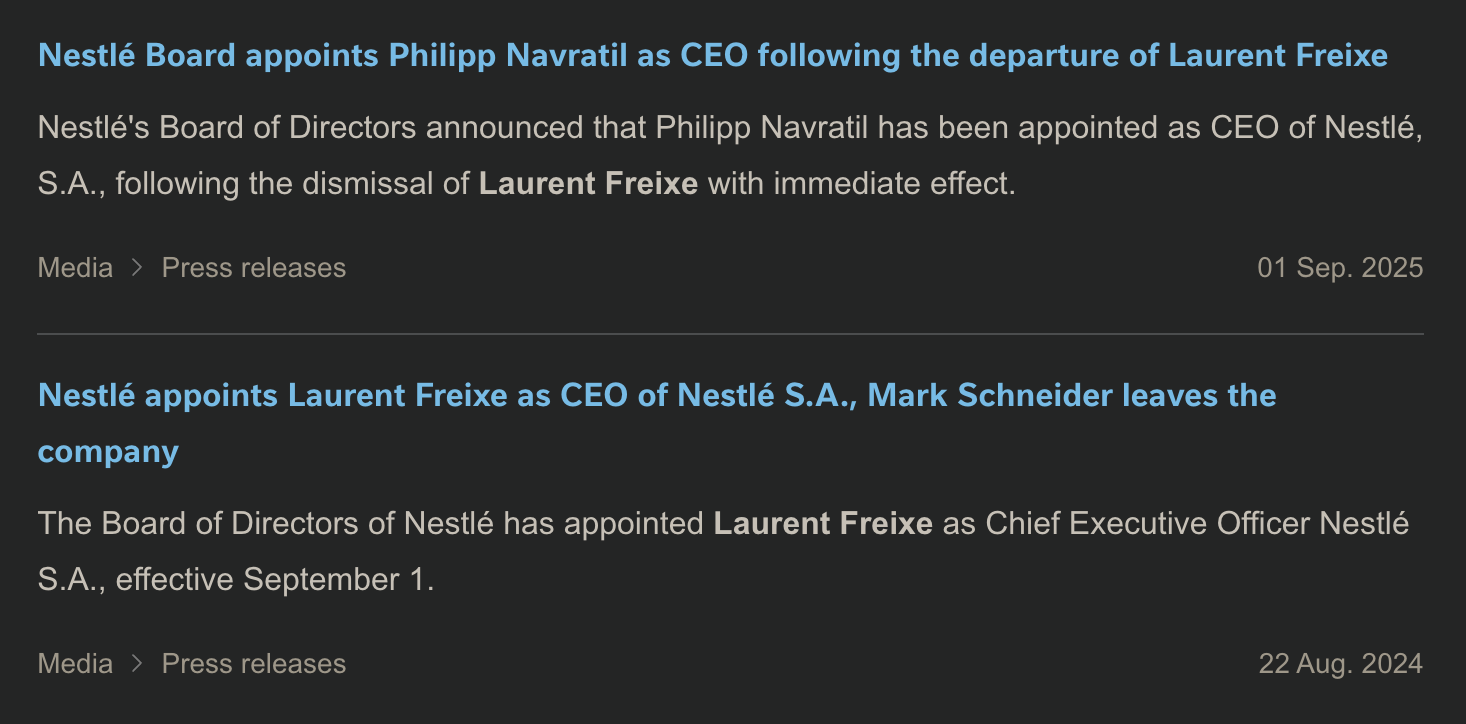
Thus, when Freixe was fired just one year into his tenure, the fallout wasn’t merely a moral debate—it created a far more damaging perception: that Nestlé had gone from “performance-driven leadership change” to “ethics-based purge” in under 12 months, like a corporate drama unfolding in real time. Reuters bluntly stated the episode plunged Nestlé into a leadership crisis, compounding existing pressures from weak stock performance and slowing sales. One could interpret the board’s move as a “damage-control hemorrhage stop,” but in doing so, it also exposed the wound to the world.
More subtly, Nestlé’s decision to publicly frame the incident so starkly was also a form of cultural self-rescue. Historically, many multinationals facing executive misconduct opt for euphemisms like “stepping down for personal reasons”—to avoid turmoil and negative headlines. But Nestlé chose the word “dismissed” and explicitly cited its Code of Business Conduct. This sent a clear message: the company would rather endure short-term market turbulence than compromise its governance principles. And that message wasn’t aimed at the press—it was aimed inward, especially at mid- and senior-level leaders. In a global behemoth, the most costly thing isn’t the severance of a single executive; it’s the signal that rules can be bypassed by privilege, which silently erodes organizational discipline from within.
The succession plan further revealed Nestlé’s governance priorities. The board immediately appointed Philipp Navratil as the new CEO. A long-tenured internal executive, Navratil had led key businesses like coffee and Nespresso before joining the group executive committee. Choosing an insider offered concrete advantages: no lengthy learning curve, minimal strategic whiplash, and—most crucially—the ability to restore a sense of control during organizational panic.
But what truly signaled this wasn’t a one-off incident was the board-level reshuffle that followed. In mid-September 2025, Nestlé announced Paul Bulcke would step down from the board early, and Pablo Isla would assume the role of Chairman effective October 1, 2025. Media widely interpreted this as a governance reset in the wake of crisis: once a CEO scandal escalates into questions about board oversight quality, the board itself comes under scrutiny—and its leadership turnover accelerates accordingly.
The next “hardcore move” cemented the link between governance turmoil and business pressure. In October 2025, Reuters reported that Nestlé would cut approximately 16,000 jobs over two years and raise its cost-saving target to CHF 3 billion by 2027—a figure also confirmed by the Associated Press. This sequence reveals a coherent logic: when leadership instability shakes investor confidence, the company must anchor expectations with tangible, measurable operational actions. Cost discipline and efficiency become the fastest language markets understand.
The true nature of Nestlé’s crisis isn’t about romance or personal failings—it’s about how governance stress and growth pressure amplified each other along the same timeline.
| Timeline | Event | External Signal |
|---|---|---|
| August 2024 | Nestlé replaces CEO; Freixe to take over | Board’s rising anxiety over growth and execution pace |
| September 1, 2025 | Nestlé dismisses Freixe for code violation, no severance; Navratil takes over immediately | Governance red line trumps short-term stability; board uses procedural rigor to isolate risk |
| October 1, 2025 | Pablo Isla becomes Chairman; Bulcke departs early | Turmoil rebounds onto the board itself; governance structure undergoes rapid realignment |
| October 2025 | Nestlé announces ~16,000 job cuts and raises cost-saving target | Uses “quantifiable operational surgery” to re-anchor market expectations |

Now, return to the core drama: why could the board act so decisively against a “lifelong Nestlé man” who had just ascended to the top? The answer is chillingly rational. In today’s multinational governance landscape, this isn’t a moral judgment—it’s risk pricing. When a CEO has an undisclosed relationship with a direct report, the board isn’t fixated on private life; it’s modeling the predictable organizational consequences: Will promotions still be seen as fair? Will whistleblowing mechanisms remain credible? Will top talent flee? Will regulators and media keep digging? Will investors interpret this as a symptom of deeper governance rot? Once these alarms sound simultaneously, the board prefers to “switch off the lights” immediately—because the cost of delay could be catastrophic.
That’s why this story deserves revisiting months later—not to dissect “what exactly happened,” but to understand why Nestlé had to respond this way. Think of Nestlé as a supertanker: it doesn’t fear waves; it fears cracks in the hull that people suspect are being hidden. So it chooses to expose the fracture in full view of the world, cut out the damaged section, and weld on new steel—even if the sparks momentarily alarm every passenger. Because for a company of this scale, the real expense was never the departure of one CEO. It was the moment the market began to believe “the rules don’t apply here.”

You May Interested In


High Quality β-Nicotinamide adenine dinucleotide CAS 53-84-9 NADwith ready stock and best price
$3E+1/UNIT FOB


2026-10-24
Trade Alert
Delivering the latest product trends and industry news straight to your inbox.
(We'll never share your email address with a third-party.)

Related News
-
India Launches Concentrated Anti-Dumping Actions Against Eight Categories of Chinese Chemicals, Covering APIs/Intermediates, Polyurethanes, and Refrigerants
-
Shandong’s Export Growth Is 2.8%; This Category Is 19%: Shandong Has a Chokehold on the Upstream of Global Manufacturing
-
Middle East Crude Exports Rebound Sharply in September as Saudi Arabia Returns to Market at 5.4 Million bpd
-
Saudi Aramco Weighs Discounts of Up to $9/Barrel on Oman STS Crude as Freight Costs Surge
-
Iran Closes Strait of Hormuz to All Vessels: Global Chemical Trade Gets Choked
-
Solvay's "Slimming Action": Soda Ash Production Capacity in Spain Slashed by 180,000 Tons, 77 Jobs to Go
-
U.S. Fighter Jet Strikes Commercial Cargo Ship in Gulf of Oman, Disabling Propulsion
-
Phillips 66 Locks Out 385 Workers at 275,000-bpd Bayway Refinery
-
Behind Japan's Tungsten Hexafluoride Crisis: Can China's Electronic Specialty Gases Seize a New Opportunity?
-
TSMC, Samsung, and SK Hynix Scramble for Electronic-Grade Hydrofluoric Acid as High-End Supply Tightens; Some Suppliers Raise Prices by 30% This Year
Recommend Reading
-
![Small Pharma Firms Under Threat as Regulator Tightens Quality Norms]()
Small Pharma Firms Under Threat as Regulator Tightens Quality Norms
-
![Bridgestone Reports Q3 Growth Amid Challenging North American Market]()
Bridgestone Reports Q3 Growth Amid Challenging North American Market
-
![Sika Undertakes Structural Adjustments Amid Weak Markets]()
Sika Undertakes Structural Adjustments Amid Weak Markets
-
![Trinseo Faces Pressure in Resin Markets but Sees Growth in Recycled Products]()
Trinseo Faces Pressure in Resin Markets but Sees Growth in Recycled Products
-
![EU Blocks Entry of Chinese Food Supplement Due to Unauthorized Ingredient]()
EU Blocks Entry of Chinese Food Supplement Due to Unauthorized Ingredient
-
![Restocking Boosts Short-term Consumption, ABS Stabilizes and Rebounds in the First Half of July in China]()
Restocking Boosts Short-term Consumption, ABS Stabilizes and Rebounds in the First Half of July in China
-
![Crude Oil Boosts Butadiene Market Uptrend]()
Crude Oil Boosts Butadiene Market Uptrend
-
![This Week's Epichlorohydrin Market Transaction Focus Shifted Upward and Stabilized (11.10-11.14)]()
This Week's Epichlorohydrin Market Transaction Focus Shifted Upward and Stabilized (11.10-11.14)
-
![Cost-side Speculative Sentiment Rises, PP Strongly Rebounds in Early July]()
Cost-side Speculative Sentiment Rises, PP Strongly Rebounds in Early July
-
![Remote Raw Material Boost, PC Prices Recover After Falling in the First Half of July in China]()
Remote Raw Material Boost, PC Prices Recover After Falling in the First Half of July in China







- Hot Searches
- sodium nitrite for sale
- hydrofluoroether solvent
- where can i get reta peptide
- pharma chemical suppliers
- active pharmaceutical ingredients bestellen
- hexane 3 4 dione
- sodium sulphate cost
- current price of urea
- methylamine price
- petrol coke price
- retatrutide for sale online usa
- glycerin pricing