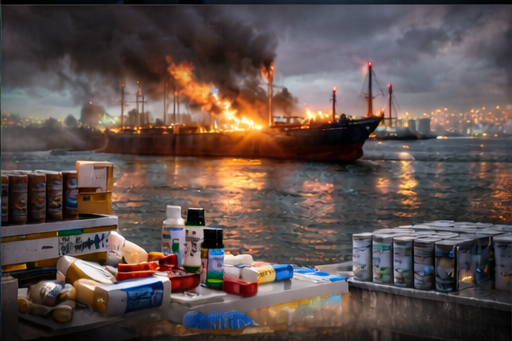
SIBUR’s ZapSibNeftekhim petrochemical complex in Tobolsk, western Siberia, has been shut down following a drone attack, creating a potentially significant disruption to Russia’s LPG and polymer supply chains.
According to Reuters, citing three industry sources, the facility in Russia’s Tyumen region was seriously damaged in a drone attack on August 10, 2026 and has been shut indefinitely while the extent of the damage is assessed. Tyumen Governor Alexander Moor confirmed that a fire had broken out at an industrial site following a drone strike, although he did not publicly identify the facility. SIBUR declined to comment to Reuters.
The most immediate impact is on liquefied petroleum gas supply.
Industry sources estimate that ZapSibNeftekhim produces around 6 million tonnes of LPG per year, equivalent to roughly 40% of Russia’s total LPG output. Around half of that volume is consumed internally as feedstock for SIBUR’s integrated petrochemical operations in Tobolsk.
By August 11, no LPG volumes from the Tobolsk loading point were being offered on the St. Petersburg International Mercantile Exchange, or SPIMEX. Earlier this year, around 4,000 tonnes per day of technical propane-butane mixture had regularly been sold from the location.
That change indicates that the attack has already moved beyond physical plant damage and into the domestic trading and logistics system.
ZapSibNeftekhim is not simply an LPG production site. It is one of Russia’s most important integrated petrochemical complexes.
SIBUR states that the complex has around 2 million tonnes per year of polymer design capacity, including 1.5 million tonnes of polyethylene and 500,000 tonnes of polypropylene. Reuters has separately cited total base-polymer design capacity of approximately 2.5 million tonnes per year when referring to the broader complex, reflecting differences in how the asset base is defined.
Either way, Tobolsk is one of the largest polymer production platforms in Russia.
That means the risk extends well beyond LPG.
Because around half of the LPG produced at the site is consumed as internal petrochemical feedstock, upstream gas processing and downstream polymer production are closely integrated.
If the shutdown persists, disruption could spread across feedstock availability, petrochemical conversion and polymer output, potentially affecting Russian polyethylene and polypropylene supply.
This is what makes the event more significant than a conventional refinery outage: it directly affects an integrated petrochemical value chain rather than only refined fuel production.
Tobolsk lies deep inside western Siberia, far from the Russia-Ukraine front line.
Ukraine’s special forces said their drones struck ZapSibNeftekhim on August 10. Reuters has included the complex among a growing list of Russian energy and petrochemical sites targeted by long-range drone attacks.
Russian refining infrastructure has already suffered repeated attacks in recent months, with several facilities forced to halt crude processing or shut individual units.
Petrochemical complexes, however, can be more complicated to restore than conventional refinery operations.
Large-scale gas separation, compression, polymerization and low-temperature processing systems require extensive safety inspections and controlled restarts following significant damage.
At this stage, the most important uncertainty is the extent of the damage.
Reuters reported that the complex has been shut indefinitely, rather than for a defined maintenance period, and SIBUR had not provided an estimated restart date at the time of reporting.
The market therefore cannot yet determine whether the disruption will last days, weeks or longer.
If damage proves limited, SIBUR may be able to use inventories and production from other locations to reduce the impact on customers, while the Russian LPG market could rebalance through alternative suppliers.
A prolonged shutdown would create a more serious situation.
It could tighten Russian LPG availability, reduce polymer output and force SIBUR to adjust domestic and export allocations.
The immediate global impact may be smaller than the effect inside Russia because Russian LPG and polymer flows are concentrated in regional markets.
However, a sustained production loss could still alter export volumes and trade patterns into markets including Europe, Turkey, Central Asia and parts of Asia.
The clearest market signal so far is that a facility responsible for roughly 40% of Russian LPG production is offline, while spot supply from the Tobolsk trading point has disappeared.
From a wider chemical-industry perspective, the attack shows how geopolitical risk is moving deeper into petrochemical supply chains.
Previous concern around attacks on Russian energy infrastructure focused largely on crude processing, gasoline and diesel availability.
The ZapSibNeftekhim shutdown demonstrates that the same risk now extends more directly to basic chemicals and polymers.
If large integrated petrochemical sites continue to become targets, producers may need to reassess plant security, inventory levels and regional supply strategies.
For LPG and polymer buyers, the next critical developments will be SIBUR’s damage assessment, any indication of a restart timeline and whether contractual deliveries are affected.
For now, there is not enough evidence to describe the situation as a broad international supply shortage.
But the indefinite shutdown of a complex associated with around 6 million tonnes per year of LPG production and major polymer capacity already represents a material petrochemical supply disruption.