Changes and trends in the global drug R&D pipeline in 2021
Under the epidemic, the global drug R&D pipeline continues to expand
The outbreak of the covid-19 epidemic and the restrictions on social isolation brought about by it have brought the development of many industries around the world to a halt and decline. However, the annual report points out that the global drug R&D pipeline has not shrunk as of January 2021. The global R&D pipeline (including pre-clinical, clinical, and drugs that are still being developed for other indications after marketing) contains a total of 18,582 drugs. , An increase of 4.76% compared with 2020. Although in 2020, 798 drugs or vaccines against the new crown epidemic will enter the R&D pipeline, even if drugs or vaccines related to the epidemic are excluded, 4746 new drugs will enter the R&D pipeline in 2020, which is basically the same as the 4730 in 2019. This means that although the new crown-related research has attracted great investment in the field of biomedicine, the entire industry has not slowed down its progress in terms of drug development for other diseases.
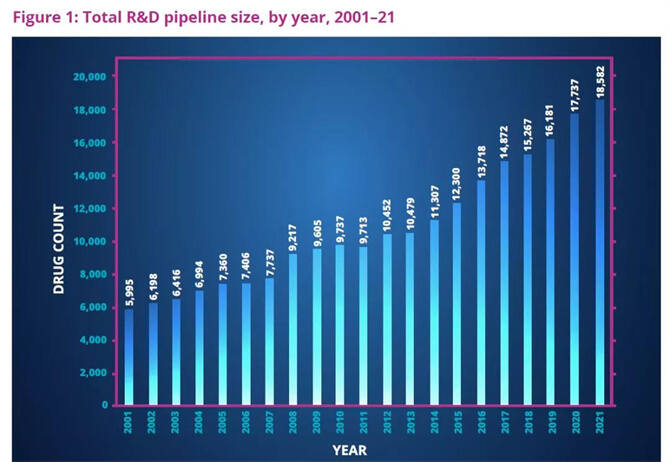
However, the analysis of drug data classified according to the research and development stage can reveal the impact of the new crown epidemic. The number of drugs under research in the preclinical phase and the number of drugs under research in the phase 1 clinical phase is still up by about 6% compared with the previous year. Reflects a relatively healthy momentum in early drug discovery and development. However, the number of drugs in Phase 2 and Phase 3 clinical trials only increased by 2% and 0.9% over the previous year. Although the number of drugs in phase 3 clinical trials has been stable in recent years, compared with previous years, the growth rate of the number of drugs in phase 1 or 2 clinical trials has declined. This may be related to the delay or termination of multiple clinical trials due to the new crown epidemic, resulting in the inability to advance the drug under study to the next clinical stage.

Contributions of large pharmaceutical companies and small companies to the global R&D pipeline
In the drug development ecosystem, there are not only large pharmaceutical companies with hundreds of drugs under research in the pipeline, but also small biotech and pharmaceutical companies with only one or two innovative therapies. In the past year, how did they contribute to the development of new drugs?
The report pointed out that in terms of large pharmaceutical companies, Novartis still has the largest drug R&D pipeline, containing 232 drugs. The company added 145 new drugs in 2021, and it also ranks first among the world's major pharmaceutical companies. . Roche's R&D pipeline ranking rose from 5th last year to 2nd. The fastest climbing in the ranking is AbbVie. Due to the completion of the acquisition of Allergan in May 2020, the company’s R&D pipeline has increased from 89 drugs to 160 drugs, ranking No. 1 in the world.
In 2021, 16 of the Top 25 pharmaceutical companies have expanded their R&D pipelines. Does this mean that major pharmaceutical companies have increased their contributions to the global drug R&D pipeline? However, statistics on the proportion of drugs in the pipeline found that the proportion of drugs in the pipelines of the Top 25 large pharmaceutical companies in the total pipeline drugs has dropped from 9.47% to 9.36%. The proportion of Top 10 pharmaceutical companies' pipelines has also decreased from 5.4% to 5.27%. In comparison, companies with only one or two drugs in the pipeline together account for 19.36%. Although the magnitude of these changes is not large, looking back at history, it can be seen that the increasing proportion of small and medium-sized companies in the global R&D pipeline has not changed.
As of January 2021, a total of 5,099 companies are conducting drug research and development, of which 46% are headquartered in the United States. Companies headquartered in China accounted for 9%. In the past year, the number of pharmaceutical companies headquartered in China increased by 94 (23%) to 522. This reflects the rapid expansion of China's pharmaceutical industry. 55% of the drugs in the global R&D pipeline have certain development activities located in the United States, and one-sixth of the drugs have certain development activities located in China, once again showing China's potential in drug development.
Anti-cancer therapies and gene therapies continue to grow rapidly
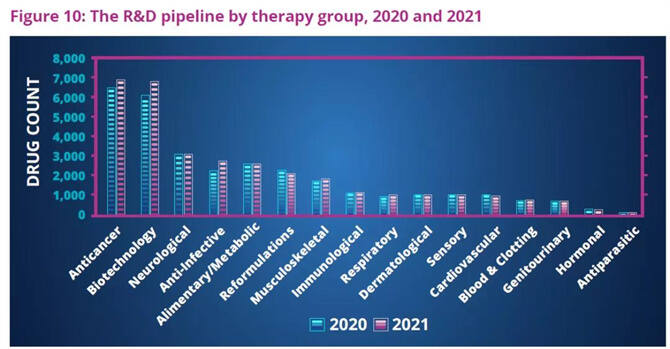
The outbreak of the new crown epidemic has undoubtedly had a significant impact on the focus of drug research and development. In the global research and development pipeline, the number of anti-infective drugs has increased by 22.4% over the previous year, almost entirely due to the increase in drugs and vaccines against COVID-19. Development. Previously, the number of anti-infective drugs was on a downward trend.
The number of oncology drugs in the R&D pipeline reached 6,961 in 2021, an increase of 7.0% compared to the previous year. Oncology is still the most popular research and development area in the world. 37.5% of the drugs in the pipeline are related to oncology, setting a new high in the past 10 years.
A further breakdown of the treatment field shows that the number of cancer immunotherapies is the largest in the global R&D pipeline, an increase of 8.1% compared to the previous year. There are 3,712 cancer immunotherapies worldwide. This reflects the confidence of the drug research and development field in using the human immune system to fight cancer as a treatment strategy. Other types of anti-cancer therapies follow closely, and gene therapy is ranked third. The outbreak of the new crown epidemic has increased the number of antiviral drugs by 126%, making it the fastest growing branch in the field of drug research and development. The number of CAR-T therapies has also reached 612, making it into the top 10 for the first time in the ranking of the report. (The same therapy may have multiple labels. For example, CAR-T therapy also belongs to cancer immunotherapy and gene therapy.)
After nearly 10 years of silence, gene therapy has risen rapidly in recent years and has received widespread attention from the industry. In this year's report, the number of gene therapies under development reached 1,589, an increase of 24.8% in one year. The analysis of historical data on the number of gene therapies shows that in the last 5 years, the number of gene therapies has shown an explosive growth trend, which has tripled compared with the number in 2016. Since 2019, it has maintained its third place in the annual R&D report released by Pharmaprojects.

The renaissance of gene therapy benefited from the increase in the number of two types of therapies. One type is in vitro gene therapy. They genetically engineer cells obtained from the human body in vitro and then transfer them back to the patient. CAR-T therapy is a kind of In vitro gene therapy. The other type is in vivo gene therapy, which means that the manipulation of genes is carried out in the body. For gene therapy, what kind of viral vector is used to deliver transgenes is a concern of the industry. The reported analysis data shows that at present, adeno-associated virus (AAV) vectors are still the most common viral vectors in gene therapy, and they are widely used both in preclinical and clinical development stages. Adenovirus vectors are in the second place. In addition to these two virus vectors, other types of virus vectors have also been studied, including herpes simplex virus, poxvirus, lentivirus and rhabdovirus.

Which targets are the most popular?
If the drugs in the research and development pipeline are classified according to their targets, it can be seen that the number of therapies under investigation that target the HER2 receptor is the largest. As a well-proven target in the treatment of breast cancer, HER2 therapy is the target of a variety of small molecule therapies, targeted therapies, and antibody-conjugated drug therapies. The new generation of antibody-conjugated drugs is no longer limited to breast cancer, but is used in clinical trials to treat HER2-expressing gastric cancer, non-small cell lung cancer and other cancer types. In addition to HER2, epidermal growth factor receptor (EGFR) and vascular endothelial growth factor A (VEFG-A), which are closely related to tumor growth and angiogenesis, are also popular targets.
The rise of cancer immunotherapy is also reflected in popular targets. Among the Top 10 popular targets, 4 are related to immunotherapy. They are PD-L1, PD-1, CD19 and CD3. A variety of immune checkpoint inhibitors targeting PD-L1 and PD-1 have been approved by the FDA, and CAR-T therapy targeting CD19 is the most important component of CAR-T therapy under development. However, a variety of bispecific antibody therapies recruit T cells to the vicinity of tumor cells by binding to the CD3 receptor on the surface of T cells to play their role in killing tumor cells. The number of research therapies targeting CD3 has increased by 28.4%, reflecting the industry's focus on using bispecific antibodies to activate the anti-cancer immune response.
Outside of cancer, glucagon-like peptide 1 receptor (GLP-1R) ranks 10th, and it is an important target for the treatment of type 2 diabetes and obesity. The outbreak of the new crown virus has made the new crown virus spike protein a popular target ranked 20th. It is the target of many vaccines and neutralizing antibodies. Dopamine receptor D2 and serotonin receptor 2A are important targets for the treatment of various neurological diseases
Even under the influence of the new crown epidemic, the report shows that the pace of innovation in the drug development field has not slowed down. Pharmaprojects found that the number of new drug targets added to the pipeline in 2020 reached 139, reaching the second highest level in the past 15 years, second only to 2011 (The reason for the unusually high statistics of this year is due to the fact that bacterial targets were added to the database). Today, the number of targets targeted by therapies under research has reached 1,858, a significant increase from 1,766 last year. This trend lays the foundation for successful future drug development.


You May Interested In


High Quality β-Nicotinamide adenine dinucleotide CAS 53-84-9 NADwith ready stock and best price
$3E+1/UNIT FOB


2026-10-24
Trade Alert
Delivering the latest product trends and industry news straight to your inbox.
(We'll never share your email address with a third-party.)

Related News
-
Domestic substitution is the most difficult one
-
The Development Status Of Pharmaceutical Companies In India
-
New Trend of Multinational Pharmaceutical Companies in China? AstraZeneca Fully Enters Chinese Medicine
-
Top Biotechnology Financing List Released! Two Chinese Pharmaceutical Companies Make The List
-
2021 Global Pharmaceutical Company Revenue TOP20 Announced!
-
Global drug development: Asia on the rise
-
Which pharma companies are the most innovative? Roche, AstraZeneca top the list
-
48 listed pharmaceutical companies report their achievements
-
The proportion of export of pharmaceutical machinery in China is increasing
-
Kemira Acquires AquaBlue
Recommend Reading
-
![Honeywell Acquires Johnson Matthey Catalyst Business at a Discount, Cutting £475 Million from the Price]()
Honeywell Acquires Johnson Matthey Catalyst Business at a Discount, Cutting £475 Million from the Price
-
![Arkema's New Singapore Plant Commences Operations, Tripling Polyamide Capacity]()
Arkema's New Singapore Plant Commences Operations, Tripling Polyamide Capacity
-
![Iran Closes Strait of Hormuz to All Vessels: Global Chemical Trade Gets Choked]()
Iran Closes Strait of Hormuz to All Vessels: Global Chemical Trade Gets Choked
-
![Strait of Hormuz Reopens, Oil Prices Plunge: Is the Chemical Price Rally Over?]()
Strait of Hormuz Reopens, Oil Prices Plunge: Is the Chemical Price Rally Over?
-
![U.S. Chemical Companies Are Benefiting from This Feedstock Shock]()
U.S. Chemical Companies Are Benefiting from This Feedstock Shock
-
![Business Society’s Market Outlook for Maleic Anhydride on September 3, 2026: Volatile]()
Business Society’s Market Outlook for Maleic Anhydride on September 3, 2026: Volatile
-
![Business Society’s Market Outlook for DOP on September 4, 2026: Strong Rebound]()
Business Society’s Market Outlook for DOP on September 4, 2026: Strong Rebound
-
![Business Society’s Market Outlook for Hydrofluoric Acid on September 4, 2026: Price Trend Is Volatile]()
Business Society’s Market Outlook for Hydrofluoric Acid on September 4, 2026: Price Trend Is Volatile
-
![Business Society September 3, 2026 Phosphoric Acid Market View: Bearish Fluctuation]()
Business Society September 3, 2026 Phosphoric Acid Market View: Bearish Fluctuation
-
![Business Society’s Aniline Market Outlook on September 4, 2026: Downward Trend]()
Business Society’s Aniline Market Outlook on September 4, 2026: Downward Trend