Bromoaceticacid 99%
79-08-3
Industrial Grade
99%
QINGDAO
100kg/4kg Blue Iron Drum (Used For Sodium Hydrosulfite)
Yes
2017-02-09

-
Product Description
-
Seller Information
-
DescriptionECHEMI Editorial ReferenceWHITE TO LIGHT YELLOW CRYSTALLINE MASS
Bromoacetic acid appears as colorless crystals. Melting point 51°C. Density 1.93 g / cm3. Corrosive to metals and tissue. Poisonous by ingestion. Used to cause drop of citrus fruit in harvesting.|Aqueous solution.
Bromoacetic acid appears as colorless crystals. Melting point 51°C. Density 1.93 g / cm3. Corrosive to metals and tissue. Poisonous by ingestion. Used to cause drop of citrus fruit in harvesting.|Aqueous solution.
Aqueous solution.
Poison by ingestion, intraperitoneal, and intravenous routes. Irritating and corrosive to skin and mucous membranes. Mutation data reported. When heated to decomposition it emits toxic fumes of Br-. See also BROMIDES.Basic Info-
Product Name:
Bromoacetic acid
Other Name:RARECHEM AL BO 0099;MONOBROMOACETIC ACID;Bromaceticacid;bromoacetateion;bromo-aceticaci;bromoaceticacid,solution;Bromoethanoic acid;bromoethanoicacid
CAS No.:79-08-3
Molecular Formula:C2H3BrO2
InChIKeys:KDPAWGWELVVRCH-UHFFFAOYSA-N
Molecular Weight:138.95
Exact Mass:138.95
BRN:506167
EC Number:201-175-8
UNII:2B3HS32431
NSC Number:141
UN Number:1938|3425
TSCA:TSCA listed
DSSTox ID:DTXSID7021495
Color/Form:White to yellow
HScode:29159000
Characteristics-
PSA:
37.30000
XLogP3:0.46590
Appearance:White to yellow Crystalline Mass or Crystalline Powder, Flakes, Crystals and/or Chunks
Density:1
Melting Point:46-49 °C
Boiling Point:208 °C(lit.)
Flash Point:113ºC (closedºCup)
Refractive Index:1.4804 (estimate)
Water Solubility:miscible
Storage Conditions:0-6ºC
Vapor Pressure:1 mm Hg @ 550C
Flammability characteristics:Non flammable
PKA:2.69(at 25℃)
Henrys Law Constant:1.5×10³mol/(m3Pa) at 25℃, Burkholder et al. (2019)
Dissociation Constants:2.89 (at 20 °C)|pKa = 2.89 at 20 °C
Experimental Properties:Hygroscopic|When heated to decomposition it emits toxic fumes|Hydroxyl radical reaction rate constant = 7.16X10⁻¹³ cu cm/molecule-sec at 25 °C (est)
Air and Water Reactions:Water soluble.
Reactive Group:Acids, Carboxylic
Reactivity Profile:Carboxylic acids, such as BROMOACETIC ACID, donate hydrogen ions if a base is present to accept them. They react in this way with all bases, both organic (for example, the amines) and inorganic. Their reactions with bases, called "neutralizations", are accompanied by the evolution of substantial amounts of heat. Neutralization between an acid and a base produces water plus a salt. Carboxylic acids with six or fewer carbon atoms are freely or moderately soluble in water; those with more than six carbons are slightly soluble in water. Soluble carboxylic acid dissociate to an extent in water to yield hydrogen ions. The pH of solutions of carboxylic acids is therefore less than 7.0. Many insoluble carboxylic acids react rapidly with aqueous solutions containing a chemical base and dissolve as the neutralization generates a soluble salt. Carboxylic acids in aqueous solution and liquid or molten carboxylic acids can react with active metals to form gaseous hydrogen and a metal salt. Such reactions occur in principle for solid carboxylic acids as well, but are slow if the solid acid remains dry. Even "insoluble" carboxylic acids may absorb enough water from the air and dissolve sufficiently in Bromoacetic acid to corrode or dissolve iron, steel, and aluminum parts and containers. Carboxylic acids, like other acids, react with cyanide salts to generate gaseous hydrogen cyanide. The reaction is slower for dry, solid carboxylic acids. Insoluble carboxylic acids react with solutions of cyanides to cause the release of gaseous hydrogen cyanide. Flammable and/or toxic gases and heat are generated by the reaction of carboxylic acids with diazo compounds, dithiocarbamates, isocyanates, mercaptans, nitrides, and sulfides. Carboxylic acids, especially in aqueous solution, also react with sulfites, nitrites, thiosulfates (to give H2S and SO3), dithionites (SO2), to generate flammable and/or toxic gases and heat. Their reaction with carbonates and bicarbonates generates a harmless gas (carbon dioxide) but still heat. Like other organic compounds, carboxylic acids can be oxidized by strong oxidizing agents and reduced by strong reducing agents. These reactions generate heat. A wide variety of products is possible. Like other acids, carboxylic acids may initiate polymerization reactions; like other acids, they often catalyze (increase the rate of) chemical reactions.
Corrosivity:Strong irritant to skin and tissues
Critical Temperature & Pressure:Store below +30°C.
Hazard IdentificationClassification of the substance or mixture
Acute toxicity - Category 3, Oral
Acute toxicity - Category 3, Dermal
Skin corrosion, Sub-category 1A
Skin sensitization, Category 1
Acute toxicity - Category 3, Inhalation
Hazardous to the aquatic environment, short-term (Acute) - Category Acute 1
GHS label elements, including precautionary statements
Pictogram(s) 
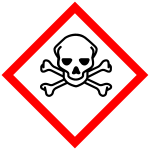
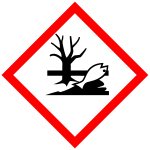
Signal word Danger
Hazard statement(s) H301 Toxic if swallowed
H311 Toxic in contact with skin
H314 Causes severe skin burns and eye damage
H317 May cause an allergic skin reaction
H331 Toxic if inhaled
H400 Very toxic to aquatic life
Precautionary statement(s) Prevention P264 Wash ... thoroughly after handling.
P270 Do not eat, drink or smoke when using this product.
P280 Wear protective gloves/protective clothing/eye protection/face protection/hearing protection/...
P260 Do not breathe dust/fume/gas/mist/vapours/spray.
P261 Avoid breathing dust/fume/gas/mist/vapours/spray.
P272 Contaminated work clothing should not be allowed out of the workplace.
P271 Use only outdoors or in a well-ventilated area.
P273 Avoid release to the environment.
Response P301+P316 IF SWALLOWED: Get emergency medical help immediately.
P321 Specific treatment (see ... on this label).
P330 Rinse mouth.
P302+P352 IF ON SKIN: Wash with plenty of water/...
P316 Get emergency medical help immediately.
P361+P364 Take off immediately all contaminated clothing and wash it before reuse.
P301+P330+P331 IF SWALLOWED: Rinse mouth. Do NOT induce vomiting.
P363 Wash contaminated clothing before reuse.
P304+P340 IF INHALED: Remove person to fresh air and keep comfortable for breathing.
P305+P351+P338 IF IN EYES: Rinse cautiously with water for several minutes. Remove contact lenses, if present and easy to do. Continue rinsing.
P333+P317 If skin irritation or rash occurs: Get medical help.
P362+P364 Take off contaminated clothing and wash it before reuse.
P391 Collect spillage.
Storage P405 Store locked up.
P403+P233 Store in a well-ventilated place. Keep container tightly closed.
Disposal P501 Dispose of contents/container to an appropriate treatment and disposal facility in accordance with applicable laws and regulations, and product characteristics at time of disposal.
Other hazards which do not result in classification
no data available
Handling and StoragePrecautions for safe handling
Handling in a well ventilated place. Wear suitable protective clothing. Avoid contact with skin and eyes. Avoid formation of dust and aerosols. Use non-sparking tools. Prevent fire caused by electrostatic discharge steam.
Conditions for safe storage, including any incompatibilities
Light sensitive, hygroscopic. Keep tightly closed.
-
-
Seller Information
-
Business Type:
Manufactory
-
Location:
Yanhai Economic Development Zone, Changyi, Shandong, China.
Changyi Fengrun Fine Chemical Co.,Ltd. is a leading fine chemical enterprise specialized in the deep processing of chlorine and bromine. Boasting advanced equipments, first-class technical design and great development potential, we are committed to the development, manufacture and technological popularization of plastic modifiers, pharmaceutical intermediates, medical raw materials and new-type auxiliaries. We develop new environmental protection techniques for part of the existing chemicals. And we are qualified in the international trade of chemical and mechanical & electrical products. Keeping a close eye on the international trend on new-type fine chemicals, we are striving to keep pace with the latest technologies and are committed to the development and manufacture of new products with independent intellectual property right. We now own 2 production bases with occupied floor area of over 200 mu, and have various reaction kettles, perfect facilities in steam heating, electrical heating and refrigeration. With the corporate spirit of "Unity, Diligence; Pragmatic, Innovation", we are aiming to become an export-oriented high-tech industrial group.
-
-
Country Product Purchase Quantity Date Posted Post an enquiry for this product
Hot Related Products
-
 Industrial Grade 99.8% Glacial Acetic Acid for Multiple Industrial Manufacturing
 -
 Chinese high-quality acetic acid supplier
 -
 Bioglutide7732-18-5
 -
 METHYL ACETATE 99.5%
 -
 Glacial Acetic Acid 99.9%
 -
 Ethyl acetate CAS#141-78-6
 -
 Glicerina
$900-950/MT FOB
-
 Ethyl acetate Acetic ester Acetic ether Ethyl ester of acetic acid 141-78-6 99.7% Colourless Liquid
 -
 Industrial Grade 99.9% High Purity Ethyl Acetate Organic Solvent
 -
 Ethyl acetate-