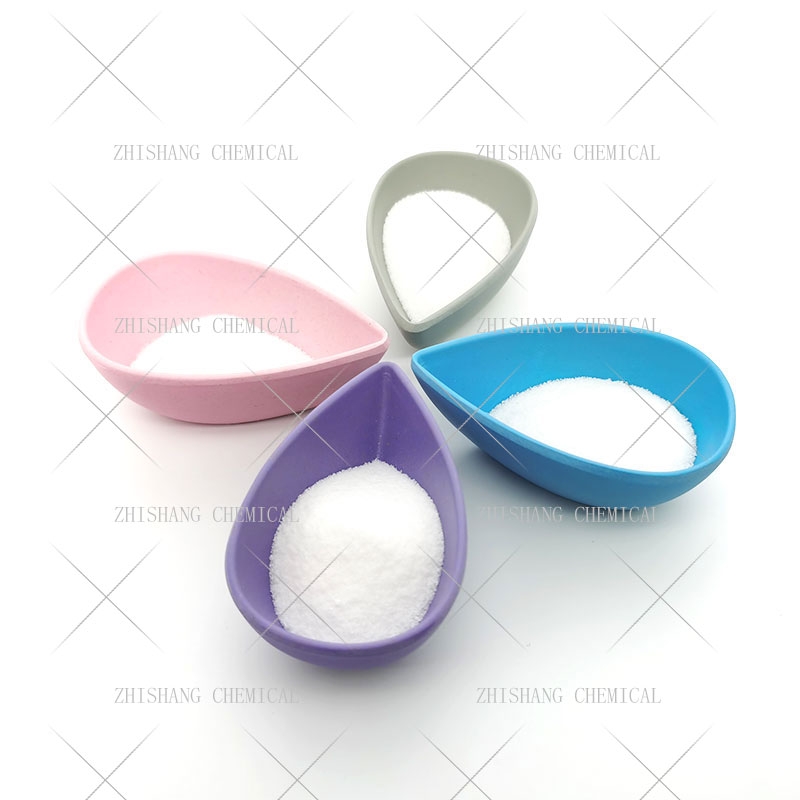
Factory Price Butyronitrile CAS NO (109-74-0) available in bulk
3 Inquiries
109-74-0
Industrial Grade
99%
Durban
Custom
As per customer requirement
Yes
2024-05-30
Sodium Lauryl Ether Sulfate,Caustic Soda,Soda Ash,Citric Acid,Calcium Hypochlorite,Oxalic Acid
-
Product Description
-
Seller Information
-
Inquiry History
-
DescriptionECHEMI Editorial ReferenceColorless liquid with a sharp, suffocating odor. [Note: Forms cyanide in the body.]
Butyronitrile appears as a clear colorless liquid. Flash point 76°F. Less dense than water. Vapors heavier than air. Produces toxic oxides of nitrogen during combustion. Used in the manufacture of other chemicals.|Liquid|COLOURLESS LIQUID WITH CHARACTERISTIC ODOUR.|Colorless liquid with a sharp, suffocating odor. [Note: Forms cyanide in the body.]
Butyronitrile appears as a clear colorless liquid. Flash point 76°F. Less dense than water. Vapors heavier than air. Produces toxic oxides of nitrogen during combustion. Used in the manufacture of other chemicals.|Butyronitrile is a nitrile that is hydrogen cyanide in which the hydrogen has been replaced by a propyl group.Basic Info-
Product Name:
Butyronitrile
Other Name:Butanenitrile;Butyronitrile;Propyl cyanide;n-Butyronitrile;1-Cyanopropane;n-Butanenitrile;γ-Butyronitrile;NSC 8412
CAS No.:109-74-0
Molecular Formula:C4H7N
InChIKeys:InChIKey=KVNRLNFWIYMESJ-UHFFFAOYSA-N
Molecular Weight:69.11
Exact Mass:69.11
BRN:1361452
EC Number:203-700-6
UNII:O3V36V0W0M
ICSC Number:1465
NSC Number:8412
UN Number:2411
DSSTox ID:DTXSID1026823
Color/Form:Colorless liquid
HScode:29269095
Categories:
Characteristics-
PSA:
23.8
XLogP3:0.5/0.6
Appearance:Clear Liquid
Density:0.8091 g/cm3 @ Temp: 0 °C
Melting Point:-112 °C
Boiling Point:117.5 °C @ Press: 760 Torr
Flash Point:62 °F
Refractive Index:n20/D 1.384(lit.)
Water Solubility:Miscible with benzene, alcohol, ether and dimethylformamide. Slightly soluble in water.
Storage Conditions:Flammables area
Vapor Pressure:23 mm Hg ( 25 °C)
Vapor Density:2.4 (vs air)
Toxicity:Oral-rat LD50: 50 mg/kg;Oral-Mouse LD50: 27.689 mg/kg
Flammability characteristics:In case of heat, open flame, oxidant is flammable; high heat releases nitrogen oxide, cyanide gas
Explosive limit:vol% in air: 1.6
Odor:Sharp, suffocating odor.
Henrys Law Constant:5.23e-05 atm-m3/mole|Henry's Law constant = 5.23X10⁻⁵ atm cu m/mole @ 25 °C
Experimental Properties:Dipole moment: 3.5|Standard heat of formation: -5.82 kJ/mol @ 25 °C (liquid), 33.97 kJ/mol @ 25 °C (gas)
Air and Water Reactions:Highly flammable. Slightly soluble in water.
Reactive Group:Nitriles
Reactivity Alerts:Highly Flammable
Reactivity Profile:BUTYRONITRILE can react vigorously with oxidizing reagents, when heated to decomposition, it emits highly toxic fumes of cyanides and oxides of nitrogen [Sax, 9th ed., 1996, p. 609]. Nitriles may polymerize in the presence of metals and some metal compounds. They are incompatible with acids; mixing nitriles with strong oxidizing acids can lead to extremely violent reactions. Nitriles are generally incompatible with other oxidizing agents such as peroxides and epoxides. The combination of bases and nitriles can produce hydrogen cyanide. Nitriles are hydrolyzed in both aqueous acid and base to give carboxylic acids (or salts of carboxylic acids). These reactions generate heat. Peroxides convert nitriles to amides. Nitriles can react vigorously with reducing agents. Acetonitrile and propionitrile are soluble in water, but nitriles higher than propionitrile have low aqueous solubility. They are also insoluble in aqueous acids.
Autoignition Temperature:910 °F (USCG, 1999)|935 °F (501 °C)|501 °C
Heat of Combustion:-2568.68 kJ/mol @ 25 °C
Ionization Potential:11.67 eV
Flammable Limits:LOWER FLAMMABLE LIMIT: 1.65%|Class IB Flammable Liquid: Fl.P. below 73°F and BP at or above 100°F.
Physical Dangers:The vapour mixes well with air, explosive mixtures are easily formed.
Heat of Vaporization:39.33 kJ/mol @ 25 °C
Critical Temperature & Pressure:Critical temperature: 309.1 °C; critical pressure: 37.4 atm
Hazard IdentificationClassification of the substance or mixture
Flammable liquids, Category 2
Acute toxicity - Category 3, Oral
Acute toxicity - Category 3, Dermal
Acute toxicity - Category 3, Inhalation
GHS label elements, including precautionary statements
Pictogram(s) 
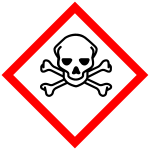
Signal word Danger
Hazard statement(s) H225 Highly flammable liquid and vapour
H301 Toxic if swallowed
H311 Toxic in contact with skin
H331 Toxic if inhaled
Precautionary statement(s) Prevention P210 Keep away from heat, hot surfaces, sparks, open flames and other ignition sources. No smoking.
P233 Keep container tightly closed.
P240 Ground and bond container and receiving equipment.
P241 Use explosion-proof [electrical/ventilating/lighting/...] equipment.
P242 Use non-sparking tools.
P243 Take action to prevent static discharges.
P280 Wear protective gloves/protective clothing/eye protection/face protection/hearing protection/...
P264 Wash ... thoroughly after handling.
P270 Do not eat, drink or smoke when using this product.
P261 Avoid breathing dust/fume/gas/mist/vapours/spray.
P271 Use only outdoors or in a well-ventilated area.
Response P303+P361+P353 IF ON SKIN (or hair): Take off immediately all contaminated clothing. Rinse affected areas with water [or shower].
P370+P378 In case of fire: Use ... to extinguish.
P301+P316 IF SWALLOWED: Get emergency medical help immediately.
P321 Specific treatment (see ... on this label).
P330 Rinse mouth.
P302+P352 IF ON SKIN: Wash with plenty of water/...
P316 Get emergency medical help immediately.
P361+P364 Take off immediately all contaminated clothing and wash it before reuse.
P304+P340 IF INHALED: Remove person to fresh air and keep comfortable for breathing.
Storage P403+P235 Store in a well-ventilated place. Keep cool.
P405 Store locked up.
P403+P233 Store in a well-ventilated place. Keep container tightly closed.
Disposal P501 Dispose of contents/container to an appropriate treatment and disposal facility in accordance with applicable laws and regulations, and product characteristics at time of disposal.
Other hazards which do not result in classification
no data available
Handling and StoragePrecautions for safe handling
NO open flames, NO sparks and NO smoking. NO contact with oxidizing agents. Above 17°C use a closed system, ventilation and explosion-proof electrical equipment. Do NOT use compressed air for filling, discharging, or handling. Handling in a well ventilated place. Wear suitable protective clothing. Avoid contact with skin and eyes. Avoid formation of dust and aerosols. Use non-sparking tools. Prevent fire caused by electrostatic discharge steam.
Conditions for safe storage, including any incompatibilities
Fireproof. Separated from strong oxidants, strong reducing agents, strong bases, strong acids and food and feedstuffs. Keep in a well-ventilated room.
-
-
Seller Information
-
Business Type:
Distributor
-
Main Products:
Sodium Lauryl Ether Sulfate,Caustic Soda,Soda Ash,Citric Acid,Calcium Hypochlorite,Oxalic Acid
-
Location:
13 PROTEA PARK MILKWOOD STREET RANGEVIEW GAUTENG 1739
-
Payment Terms:
TT against copy of documents,TT against B/L draft before shipment
-
Average lead Time:
60 days
-
Total Annual Revenue:
$1 million-$2.5 million
-
Total Employees:
11-50
-
Year of Establishment:
2012
-
-
Inquiry History3 Inquiries
Country Product Purchase Quantity Date Posted  India
India
Butyronitrile
500 KG Jul 8, 2024
India
N- Butyronitrile
20 MT Aug 1, 2024
India
n-Butyronitrile
1000 KG Jul 31, 2026 Post an enquiry for this product


More from this Seller
-
-

-
Berberine Powder Raw Material 99% Powder CAS 2086-83-1 Berberine Powder Raw Material
Industrial Grade / 99%
-
-
-
 Available For Sale At Good Price")
-
Triethylamine CAS NO (121-44-8) Available For Sale At Good Price
Industrial Grade / 99%
-
-
-

-
Sodium Hypochlorite 10%,12%,13%,15% pure Sodium Hypochlorite liquid
Industrial Grade / 15%
-
-
-
 For Sale")
-
Hexamethylene diisocyanate homopolymer CAS NO (28182-81-2) For Sale
Industrial Grade / 99%
-
-
-

-
High quality TiO2 lemon BLR 698 titanium dioxide Industrial whitener food Grade
Pharmaceutical Grade / 99%
-
-
-
 in bulk")
-
Best Seller of Lithium dodecyl sulfate CAS NO (2044-56-6) in bulk
Industrial Grade / 99%
-




Hot Related Products
-
 3-Indolebutyric acid
 -
 AIBN 99%.
 -
 3-Indolebutyric Acid
 -
 Indole-3 Butyric Acid
 -
 AIBN 99%
 -
 Long-Term Supply of 3-Indolebutyric Acid CAS 133-32-4
 -
 Plant Growth Regulator 3-Indolebutyric Acil Iba CAS 133-32-4
 -
 98%TC IBA-K 3-Indolebutyric acid IBA 98%") 3-Indolebutyric acid (K-IBA) 98%TC IBA-K 3-Indolebutyric acid IBA 98%
3-Indolebutyric acid (K-IBA) 98%TC IBA-K 3-Indolebutyric acid IBA 98% -
 Indole-3-butyric acid, CAS:133-32-4
$10-13/KG FOB
-
 3-Indolebutyricacid 99%