Product
Supplier
Encyclopedia
Inquiry
Home > Surfactant > Amphoteric Surfactants > Didecyldimethylammonium chloride for Sale > Didecyl Dimethyl Ammonium Chloride Popular selling didecyl dimethyl ammonium chloride CAS 7173-51-5
Didecyl Dimethyl Ammonium Chloride Popular selling didecyl dimethyl ammonium chloride CAS 7173-51-5 buy - large image1
Didecyl Dimethyl Ammonium Chloride Popular selling didecyl dimethyl ammonium chloride CAS 7173-51-5 buy - image1
Didecyl Dimethyl Ammonium Chloride Popular selling didecyl dimethyl ammonium chloride CAS 7173-51-5 buy - image2
Didecyl Dimethyl Ammonium Chloride Popular selling didecyl dimethyl ammonium chloride CAS 7173-51-5 buy - image3
Didecyl Dimethyl Ammonium Chloride Popular selling didecyl dimethyl ammonium chloride CAS 7173-51-5 buy - image4
Didecyl Dimethyl Ammonium Chloride Popular selling didecyl dimethyl ammonium chloride CAS 7173-51-5 buy - image5
Didecyl Dimethyl Ammonium Chloride Popular selling didecyl dimethyl ammonium chloride CAS 7173-51-5 buy - image6

Didecyl Dimethyl Ammonium Chloride Popular selling didecyl dimethyl ammonium chloride CAS 7173-51-5

18 Inquiries

Unit Price: Get Latest Price
CAS No.:

7173-51-5

Grade:

Industrial Grade

Content:

82%

Port:

Any port in China

Brand:

EAST CHEMSORUCES LIMITED

Packaging:

IBC

Price valid (until):

2024-06-15

Company Type:
Trader
Location:
China
Qualification:
Main Products:

Food additives,Pharmaceutical raw materials,Chemicals,Comestic raw materials

  • Product Description

  • Seller Information

  • Inquiry History

  • Description

    Shop Didecyl Dimethyl Ammonium Chloride Popular selling didecyl dimethyl ammonium chloride CAS 7173-51-5-Detailed Image 1

    SAFETY DATA SHEETS

    According to the UN GHS revision 9

    Version: 1.0

    Creation Date: July 15, 2019

    Revision Date: July 15, 2019

    SECTION 1: Identification

    1.1GHS Product identifier

    Product name

    Didecyldimethylammonium chloride

    1.2Other means of identification

    Product number

    -

    Other names

    didecyl(dimethyl)azanium,chloride;

    1.3Recommended use of the chemical and restrictions on use

    Identified uses

    Industrial and scientific research use.

    Uses advised against

    no data available


    SECTION 2: Hazard identification

    2.1Classification of the substance or mixture

    Acute toxicity - Category 4, Oral

    Skin corrosion, Sub-category 1B

    2.2GHS label elements, including precautionary statements

    Pictogram(s) Shop Didecyl Dimethyl Ammonium Chloride Popular selling didecyl dimethyl ammonium chloride CAS 7173-51-5-Detailed Image 2 Shop Didecyl Dimethyl Ammonium Chloride Popular selling didecyl dimethyl ammonium chloride CAS 7173-51-5-Detailed Image 3
    Signal word

    Danger

    Hazard statement(s)

    H302 Harmful if swallowed

    H314 Causes severe skin burns and eye damage

    Precautionary statement(s)
    Prevention

    P264 Wash ... thoroughly after handling.

    P270 Do not eat, drink or smoke when using this product.

    P260 Do not breathe dust/fume/gas/mist/vapours/spray.

    P280 Wear protective gloves/protective clothing/eye protection/face protection/hearing protection/...

    Response

    P301+P317 IF SWALLOWED: Get medical help.

    P330 Rinse mouth.

    P301+P330+P331 IF SWALLOWED: Rinse mouth. Do NOT induce vomiting.

    P363 Wash contaminated clothing before reuse.

    P304+P340 IF INHALED: Remove person to fresh air and keep comfortable for breathing.

    P316 Get emergency medical help immediately.

    P321 Specific treatment (see ... on this label).

    P305+P351+P338 IF IN EYES: Rinse cautiously with water for several minutes. Remove contact lenses, if present and easy to do. Continue rinsing.

    Storage

    P405 Store locked up.

    Disposal

    P501 Dispose of contents/container to an appropriate treatment and disposal facility in accordance with applicable laws and regulations, and product characteristics at time of disposal.

    2.3Other hazards which do not result in classification

    no data available

    SECTION 3: Composition/information on ingredients

    3.1Substances

    Chemical name Common names and synonyms CAS number EC number Concentration
    Didecyldimethylammonium chloride Didecyldimethylammonium chloride 7173-51-5 230-525-2 100%

    SECTION 4: First-aid measures

    4.1Description of necessary first-aid measures

    If inhaled

    Move the victim into fresh air. If breathing is difficult, give oxygen. If not breathing, give artificial respiration and consult a doctor immediately. Do not use mouth to mouth resuscitation if the victim ingested or inhaled the chemical.

    Following skin contact

    Take off contaminated clothing immediately. Wash off with soap and plenty of water. Consult a doctor.

    Following eye contact

    Rinse with pure water for at least 15 minutes. Consult a doctor.

    Following ingestion

    Rinse mouth with water. Do not induce vomiting. Never give anything by mouth to an unconscious person. Call a doctor or Poison Control Center immediately.

    4.2Most important symptoms/effects, acute and delayed

    no data available

    4.3Indication of immediate medical attention and special treatment needed, if necessary

    Immediate first aid: Ensure that adequate decontamination has been carried out. If patient is not breathing, start artificial respiration, preferably with a demand valve resuscitator, bag-valve-mask device, or pocket mask, as trained. Perform CPR if necessary. Immediately flush contaminated eyes with gently flowing water. Do not induce vomiting. If vomiting occurs, lean patient forward or place on the left side (head-down position, if possible) to maintain an open airway and prevent aspiration. Keep patient quiet and maintain normal body temperature. Obtain medical attention. Poisons A and B

    SECTION 5: Fire-fighting measures

    5.1Suitable extinguishing media

    Use dry chemical, carbon dioxide or alcohol-resistant foam.

    5.2Specific hazards arising from the chemical

    no data available

    5.3Special protective actions for fire-fighters

    Wear self-contained breathing apparatus for firefighting if necessary.

    SECTION 6: Accidental release measures

    6.1Personal precautions, protective equipment and emergency procedures

    Avoid dust formation. Avoid breathing mist, gas or vapours.Avoid contacting with skin and eye. Use personal protective equipment.Wear chemical impermeable gloves. Ensure adequate ventilation.Remove all sources of ignition. Evacuate personnel to safe areas.Keep people away from and upwind of spill/leak.

    6.2Environmental precautions

    Prevent further spillage or leakage if it is safe to do so. Do not let the chemical enter drains. Discharge into the environment must be avoided.

    6.3Methods and materials for containment and cleaning up

    If a spill occurs, clean it up promptly. Don't wash it away. Instead, sprinkle the spill with sawdust, vermiculite, or kitty litter. Sweep it into a plastic garbage bag, and dispose of it as directed on the pesticide product label./Residential uses/

    SECTION 7: Handling and storage

    7.1Precautions for safe handling

    Handling in a well ventilated place. Wear suitable protective clothing. Avoid contact with skin and eyes. Avoid formation of dust and aerosols. Use non-sparking tools. Prevent fire caused by electrostatic discharge steam.

    7.2Conditions for safe storage, including any incompatibilities

    Do not contaminate water, food or feed by storage or disposal. Bardac Wood Preservative 80

    SECTION 8: Exposure controls/personal protection

    8.1Control parameters

    Occupational Exposure limit values

    no data available

    Biological limit values

    no data available

    8.2Appropriate engineering controls

    Ensure adequate ventilation. Handle in accordance with good industrial hygiene and safety practice. Set up emergency exits and the risk-elimination area.

    8.3Individual protection measures, such as personal protective equipment (PPE)

    Eye/face protection

    Wear tightly fitting safety goggles with side-shields conforming to EN 166(EU) or NIOSH (US).

    Skin protection

    Wear fire/flame resistant and impervious clothing. Handle with gloves. Gloves must be inspected prior to use. Wash and dry hands. The selected protective gloves have to satisfy the specifications of EU Directive 89/686/EEC and the standard EN 374 derived from it.

    Respiratory protection

    If the exposure limits are exceeded, irritation or other symptoms are experienced, use a full-face respirator.

    Thermal hazards

    no data available

    SECTION 9: Physical and chemical properties and safety characteristics

    Physical state

    Liquid

    Colour

    Colorless crystals

    Odour

    Mushroom-like odor

    Melting point/freezing point

    94-100 deg C /OECD Guideline 102/

    Boiling point or initial boiling point and boiling range

    >180 deg C; decomposes before boiling at 1 atm /OECD Guideline 103/

    Flammability

    no data available

    Lower and upper explosion limit/flammability limit

    no data available

    Flash point

    no data available

    Auto-ignition temperature

    no data available

    Decomposition temperature

    no data available

    pH

    pH = 6.8 to 6.9 at 25 deg C in a 29.5% water solution

    Kinematic viscosity

    no data available

    Solubility

    In water, 0.65 g/L at 20 deg C /OECD Guideline 115/

    Partition coefficient n-octanol/water

    log Kow = 2.59 at 20 deg C, pH 7

    Vapour pressure

    <4.3X10⁻⁵ mm Hg at 25 deg C, <1.1X10⁻⁵ mm Hg at 20 deg C /OECD Guideline 104/

    Density and/or relative density

    0.95 g/cm3 (20°C)

    Relative vapour density

    no data available

    Particle characteristics

    no data available

    SECTION 10: Stability and reactivity

    10.1Reactivity

    no data available

    10.2Chemical stability

    no data available

    10.3Possibility of hazardous reactions

    no data available

    10.4Conditions to avoid

    no data available

    10.5Incompatible materials

    no data available

    10.6Hazardous decomposition products

    When heated to decomposition it emits very toxic fumes of /nitrogen oxides, ammonia, and hydrogen chloride/.

    SECTION 11: Toxicological information

    Acute toxicity

    • Oral: LD50 Rat oral 84 mg/kg
    • Inhalation: no data available
    • Dermal: no data available

    Skin corrosion/irritation

    no data available

    Serious eye damage/irritation

    no data available

    Respiratory or skin sensitization

    no data available

    Germ cell mutagenicity

    no data available

    Carcinogenicity

    no data available

    Reproductive toxicity

    no data available

    STOT-single exposure

    no data available

    STOT-repeated exposure

    no data available

    Aspiration hazard

    no data available

    SECTION 12: Ecological information

    12.1Toxicity

    • Toxicity to fish: LC50; Species: Lepomis macrochirus (Bluegill); Conditions: freshwater, static; Concentration: 270 ug/L for 96 hr (95% confidence interval: 190-390 ug/L)
    • Toxicity to daphnia and other aquatic invertebrates: EC50; Species: Daphnia magna (Water flea) age <24 hr; Conditions: freshwater, static, 19 deg C, pH 8.2, hardness 209.43 mg/L CaCO3, dissolved oxygen >6.5 mg/L; Concentration: >1000 ug/L for < or =6 hr; Effect: behavioral changes, general /Bardac 22, 45% AI
    • Toxicity to algae: no data available
    • Toxicity to microorganisms: no data available

    12.2Persistence and degradability

    AEROBIC: Didecyl dimethyl ammonium chloride biodegradation test results(1).Test Category Degradation Duration (days) OECD Guideline 301D (Ready Biodegradability: Closed Bottle Test) readily biodegradable 69% 28 OECD Guideline 301B (Ready Biodegradability: CO2 Evolution Test) readily biodegradable 67-72% CO2 evolution 28 Zahns-Wellens test (activated sludge, non-adapted) inherently biodegradable 80% DOC removal 28; >15 day adaptation time observed with rapid degradation afterwards OECD Guideline 303A (Simulation Test - Aerobic Sewage Treatment. A: Activated Sludge Units) >99.95% 59 Soil degradation study using a loam soil 49% mineralization 114

    12.3Bioaccumulative potential

    A BCF of 81 was reported in bluegill sunfish (Lepomis macrochirus) for didecyl dimethyl ammonium chloride(1). According to a classification scheme(2), this BCF suggests the potential for bioconcentration in aquatic organisms is moderate. Didecyl dimethyl ammonium chloride is reported to have low bioconcentration in tests using carp (Cyprinus carpio)(3); BCF values not reported(SRC).

    12.4Mobility in soil

    The log Koc for didecyl dimethyl ammonium chloride has been reported as 5.64 (sand), 5.96 (sandy loam), 6.20 (silty clay loam), 6.17 (silt loam)(1), corresponding to Koc values of 4.4X10+5, 9.1X10+5, 1.6X10+6, and 1.5X10+6 respectively(SRC). In batch equilibrium studies using five different soil types and OECD Guideline 106 (Adsorption - Desorption Using a Batch Equilibrium Method), didecyl dimethyl ammonium chloride had Koc values of 667, 1140, 10456, 14072 and 24433(2). According to a classification scheme(2), these Koc values suggest that didecyl dimethyl ammonium chloride is expected to have low to no mobility in soil with most Koc values suggesting the compound is immobile in soil. Didecyl dimethyl ammounium chloride is a cationic surfactant(1) that may exist in cation form in the environment(SRC), and cations generally adsorb more strongly to soils containing organic carbon and clay than their neutral counterparts(4). Didecyl dimethyl ammounium chloride binds rapidly to suspended solids and sediments(1). Reported Kd values at 25 deg C are 3.03 (sand), 3.91 (sandy loam), 4.52 (silty clay loam), and 4.49 (silt loam)(1).

    12.5Other adverse effects

    no data available

    SECTION 13: Disposal considerations

    13.1Disposal methods

    Product

    The material can be disposed of by removal to a licensed chemical destruction plant or by controlled incineration with flue gas scrubbing. Do not contaminate water, foodstuffs, feed or seed by storage or disposal. Do not discharge to sewer systems.

    Contaminated packaging

    Containers can be triply rinsed (or equivalent) and offered for recycling or reconditioning. Alternatively, the packaging can be punctured to make it unusable for other purposes and then be disposed of in a sanitary landfill. Controlled incineration with flue gas scrubbing is possible for combustible packaging materials.

    SECTION 14: Transport information

    14.1UN Number

    ADR/RID: Not dangerous goods. (For reference only, please check.) IMDG: Not dangerous goods. (For reference only, please check.) IATA: Not dangerous goods. (For reference only, please check.)

    14.2UN Proper Shipping Name

    ADR/RID: Not dangerous goods. (For reference only, please check.) IMDG: Not dangerous goods. (For reference only, please check.) IATA: Not dangerous goods. (For reference only, please check.)

    14.3Transport hazard class(es)

    ADR/RID: Not dangerous goods. (For reference only, please check.) IMDG: Not dangerous goods. (For reference only, please check.) IATA: Not dangerous goods. (For reference only, please check.)

    14.4Packing group, if applicable

    ADR/RID: Not dangerous goods. (For reference only, please check.) IMDG: Not dangerous goods. (For reference only, please check.) IATA: Not dangerous goods. (For reference only, please check.)

    14.5Environmental hazards

    ADR/RID: No IMDG: No IATA: No

    14.6Special precautions for user

    no data available

    14.7Transport in bulk according to IMO instruments

    no data available

    SECTION 15: Regulatory information

    15.1Safety, health and environmental regulations specific for the product in question

    Chemical name Common names and synonyms CAS number EC number
    Didecyldimethylammonium chloride Didecyldimethylammonium chloride 7173-51-5 230-525-2
    European Inventory of Existing Commercial Chemical Substances (EINECS) Listed.
    EC Inventory Listed.
    United States Toxic Substances Control Act (TSCA) Inventory Listed.
    China Catalog of Hazardous chemicals 2015 Not Listed.
    New Zealand Inventory of Chemicals (NZIoC) Listed.
    Philippines Inventory of Chemicals and Chemical Substances (PICCS) Listed.
    Vietnam National Chemical Inventory Listed.
    Chinese Chemical Inventory of Existing Chemical Substances (China IECSC) Listed.
    Korea Existing Chemicals List (KECL) Listed.

    SECTION 16: Other information

    Information on revision

    Creation Date July 15, 2019
    Revision Date July 15, 2019

    Abbreviations and acronyms

    • CAS: Chemical Abstracts Service
    • ADR: European Agreement concerning the International Carriage of Dangerous Goods by Road
    • RID: Regulation concerning the International Carriage of Dangerous Goods by Rail
    • IMDG: International Maritime Dangerous Goods
    • IATA: International Air Transportation Association
    • TWA: Time Weighted Average
    • STEL: Short term exposure limit
    • LC50: Lethal Concentration 50%
    • LD50: Lethal Dose 50%
    • EC50: Effective Concentration 50%


    Pls input...

    Shop Didecyl Dimethyl Ammonium Chloride Popular selling didecyl dimethyl ammonium chloride CAS 7173-51-5-Detailed Image 4

    Items Specifications
    Appearance Colorless to light yellow transparent liquid
    Assay 78-82
    PH 6.0-9.0

    Shop Didecyl Dimethyl Ammonium Chloride Popular selling didecyl dimethyl ammonium chloride CAS 7173-51-5-Detailed Image 5Shop Didecyl Dimethyl Ammonium Chloride Popular selling didecyl dimethyl ammonium chloride CAS 7173-51-5-Detailed Image 6Shop Didecyl Dimethyl Ammonium Chloride Popular selling didecyl dimethyl ammonium chloride CAS 7173-51-5-Detailed Image 7Shop Didecyl Dimethyl Ammonium Chloride Popular selling didecyl dimethyl ammonium chloride CAS 7173-51-5-Detailed Image 8

    Basic Info
    Product Name:

    Didecyldimethylammonium chloride

    Other Name:

    1-Decanaminium,N-decyl-N,N-dimethyl-,chloride (1:1);Ammonium,didecyldimethyl-,chloride;Didecyldimethylammonium chloride;1-Decanaminium,N-decyl-N,N-dimethyl-,chloride;Dimethyldidecylammonium chloride;Bardac 22;Quaternium 12;BTC 1010;Querton 210CL;Dodigen 1881;Arquad 10;Tret-O-Lite XC 507;Bardac 2250;Bardac 2280;Nissan Cation 2DB;Calgon H 130;Astop;Bio-Dac;Arquad 210-50;Bardac 2270E;H 130;H 130 (molluscicide);DDAC;DDC 80;Timbercote 2000;Slaoff 91;Britewood Q;BTC 99;Didecyldimethylammounium chloride;Maquat 4480E;Quartamin D 10E;Quartamin D 10P;D 10P;Cation DDC;BTC 2250;Britewood XL;Catiogen DDM;Arquad 210-50E;AQ 210;Microbiocide B 74;Arquad 210;Arquad 210-80E;Kamin RM 2D50A;Macrotrol MT 200;Sporekill;Arquad 210-80;Stenquat 1010;Asepas 3;Acticide DDQ;Arquad 210-85E;Nissan Cation 2DB500E;K-Sanit BP 80;Bardac 2240;KleenGrow;Cation DDC 50;Acticide DDQ 40;M 21080;Catiogen DDM-PG;2DB 500E;Acticide;Microbiocide N 750;N,N-Didecyl-N,N-dimethylammonium chloride;Septapav KhS 70;New Des 50;Cation DDC 80;Nissan Cation 2DB800E;Fentacare 1021-80;Bardac 2270ETM;Bardac 50;Lipoquad 210-80E;Bardac 2250R;Bardac 2280R;BTC 1010E;Bardac 2280G;Maquat 4450T;Bardac 2250J;Arquad 210-70HFP;Uniquat 2240;Di-n-decyl-dimethylammonium chloride;DDAC 80;126851-24-9;129186-13-6;154765-32-9;446279-85-2;879292-51-0;1632379-58-8

    CAS No.:

    7173-51-5

    Molecular Formula:

    C22H48N.Cl

    InChIKeys:

    InChIKey=RUPBZQFQVRMKDG-UHFFFAOYSA-M

    Molecular Weight:

    362.07600

    Exact Mass:

    361.34800

    EC Number:

    230-525-2

    UNII:

    JXN40O9Y9B

    DSSTox ID:

    DTXSID9032537

    Color/Form:

    Colorless crystals|Clear yellow liquid /commercial aqueous solution/|Solid powder of slight yellowish color at 20 °C

    ATC Code:

    D - Dermatologicals

    HScode:

    2923900090

    Characteristics
    PSA:

    0

    XLogP3:

    log Kow = 2.59 at 20 °C, pH 7

    Appearance:

    Liquid

    Density:

    0.95 g/cm3 (20ºC)

    Melting Point:

    88 °C

    Boiling Point:

    >180 deg C; decomposes before boiling at 1 atm /OECD Guideline 103/

    Water Solubility:

    In isopropanol: 827, 797 and 836 g/L at 10, 20 and 30 deg C, respectively; in-octanol: 248 g/L at 20 deg C; in hexane: 0.000424 g/L at 10 deg C

    Storage Conditions:

    Safe Storage of Pesticides. Always store pesticides in their original containers, complete with labels that list ingredients, directions for use, and first aid steps in case of accidental poisoning. Never store pesticides in cabinets with or near food, animal feed, or medical supplies. Do not store pesticides in places where flooding is possible or in places where they might spill or leak into wells, drains, ground water, or surface water. /Residential uses/

    Vapor Pressure:

    <4.3X10⁻⁵ mm Hg at 25 deg C, <1.1X10⁻⁵ mm Hg at 20 deg C /OECD Guideline 104/

    Toxicity:

    LD50 oral in rat: 84mg/kg

    Odor:

    Mushroom-like odor

    PH:

    pH = 6.8 to 6.9 at 25 °C in a 29.5% water solution

    Henrys Law Constant:

    Henry's Law constant = 6.9X10⁻¹⁰ atm-cu m/mol at 25 °C (est)

    Experimental Properties:

    Extremely hygroscopic|Hydroxyl radical reaction rate constant = 4.6X10⁻¹¹ cu cm/molec-sec at 25 °C (est)

    Corrosivity:

    Anion is corrosive ... treated wood has the disadvantage of being incompatible with many paints and coatings

    Hazard Identification

    Classification of the substance or mixture

    Acute toxicity - Category 4, Oral

    Skin corrosion, Sub-category 1B

    GHS label elements, including precautionary statements

    Pictogram(s)
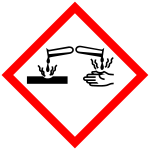
    Signal word

    Danger

    Hazard statement(s)

    H302 Harmful if swallowed

    H314 Causes severe skin burns and eye damage

    Precautionary statement(s)
    Prevention

    P264 Wash ... thoroughly after handling.

    P270 Do not eat, drink or smoke when using this product.

    P260 Do not breathe dust/fume/gas/mist/vapours/spray.

    P280 Wear protective gloves/protective clothing/eye protection/face protection/hearing protection/...

    Response

    P301+P317 IF SWALLOWED: Get medical help.

    P330 Rinse mouth.

    P301+P330+P331 IF SWALLOWED: Rinse mouth. Do NOT induce vomiting.

    P363 Wash contaminated clothing before reuse.

    P304+P340 IF INHALED: Remove person to fresh air and keep comfortable for breathing.

    P316 Get emergency medical help immediately.

    P321 Specific treatment (see ... on this label).

    P305+P351+P338 IF IN EYES: Rinse cautiously with water for several minutes. Remove contact lenses, if present and easy to do. Continue rinsing.

    Storage

    P405 Store locked up.

    Disposal

    P501 Dispose of contents/container to an appropriate treatment and disposal facility in accordance with applicable laws and regulations, and product characteristics at time of disposal.

    Other hazards which do not result in classification

    no data available

    Handling and Storage

    Precautions for safe handling

    Handling in a well ventilated place. Wear suitable protective clothing. Avoid contact with skin and eyes. Avoid formation of dust and aerosols. Use non-sparking tools. Prevent fire caused by electrostatic discharge steam.

    Conditions for safe storage, including any incompatibilities

    Do not contaminate water, food or feed by storage or disposal. Bardac Wood Preservative 80

  • Seller Information
    Business Type:

    Trader

    Main Products:

    Food additives,Pharmaceutical raw materials,Chemicals,Comestic raw materials

    Location:

    Room 501, Unit 6, No. 40, hushan road,Licang,Qingdao

    Payment Terms:

    TT against copy of documents,TT against B/L draft before shipment,100% TT in advance

    Average lead Time:

    10

    Total Annual Revenue:

    $1 million-$2.5 million

    Total Employees:

    11-50

    Year of Establishment:

    2017

    QINGDAO EASTCHEMSORCES TRADE LIMITED is a leading Manufactory supplier of Sorbitol, Citric acid, Sodium hypochlorite based in Qingdao, Shandong, China. With a commitment to quality and customer satisfaction, QINGDAO EASTCHEMSORCES TRADE LIMITED has become a trusted name in the industry. Our product line includes a range of high-quality Sorbitol, Citric acid, Sodium hypochlorite, which are available at competitive prices. QINGDAO EASTCHEMSORCES TRADE LIMITED has established itself as a reliable supplier of chemical products on the echemi.com.

  • Inquiry History
    18 Inquiries
    Country Product Purchase Quantity Date Posted
    China

    Stock High quality Didecyl Dimethyl Ammonium Chloride 99% cas 7173-51-5

    720 KG Sep 6, 2023
    Ecuador

    Didecyl Chloride

    1 20' Fcl Jun 30, 2025
    Angola

    Mixture of Alkyl Dimethyl Benzyl Ammonium Chloride ( and )Didecyl Dimethyl Ammonium Chloride

    1 MT Jan 20, 2026
    Germany

    Ddac 80%

    80 MT May 7, 2026
    Turkey

    Didecyl dimethyl ammonium chloride

    250 KG Sep 24, 2024
    New Zealand

    Didecyldimethyl ammonium chloride

    1000.00 L Jul 10, 2024
    Malaysia

    Didecyldimethylammonium chloride (DDAC)

    1.00 MT Aug 18, 2023
    Germany

    Ddac 80%

    40 MT May 9, 2026
    United States

    Ammonium Disinfectant 12%

    10 MT Jan 20, 2026
    United States

    Didecyl Dimethyl Ammonium Chloride

    5 KG Dec 17, 2025
    Sri Lanka

    DDAC

    200 L Apr 30, 2024
    Turkey

    Didesyl dimethyl ammonium chloride

    2000 KG Sep 28, 2023
    Kuwait

    Didecyl Dimonium Chloride

    1 MT Nov 7, 2025
    India

    Didecyl Dimethyl Ammonium chloride; 80% ( DDAC 80 % Or 50 %)

    15.00 TON Dec 30, 2023
    Egypt

    TIBP-triisobutyl phosphate 99% colorless transparent liquit TIBP XINYA

    Oct 15, 2023
    Egypt

    Mono Ethylene Glycol 99.9% MEG Transparent liquid, free of mechanical impurities

    Oct 15, 2023
    Egypt

    Lauric acid 99% solid

    Oct 15, 2023
    Egypt

    Poly (ethylene glycol) CAS 25322-68-3

    Oct 15, 2023
    Post an enquiry for this product
pic ×

Scan the QR Code to Share

All products displayed on this website are only for non-medical purposes such as industrial applications or scientific research, and cannot be used for clinical diagnosis or treatment of humans or animals. They are not medicinal or edible.

According to relevant laws and regulations and the regulations of this website, units or individuals who purchase hazardous materials should obtain valid qualifications and qualification conditions.

The information shown above is provided by the enterprise itself, and the authenticity, accuracy and legitimacy of the content are the responsibility of the publishing company. ECHEMI does not bear any guarantee responsibility for this. Please be aware that risks in internet transactions objectively exist.

Feedback & Suggestions
Send Message

Thank you for your feedback. If you require further assistance, please contact us by email at info@echemi.com or call us at +86-532-55729510.