Nitrosyl chloride
1 Inquiries
2696-92-6
Industrial Grade
99%
25kg/Cardboard Drum
Yes
2026-11-11

Di-tert-Butyl malonate
-
Product Description
-
Seller Information
-
Inquiry History
-
Description
Nitrosyl chloride (CAS No.: 2696-92-6) is supplied by CHEMLYTE SOLUTIONS CO.,LTD, a Manufactory with 3 years on ECHEMI.
Key details: grade Industrial Grade, content 99%, packaging 25kg/Cardboard Drum.
Sample is available.
Contact the supplier on this page to request a quotation or the latest price.
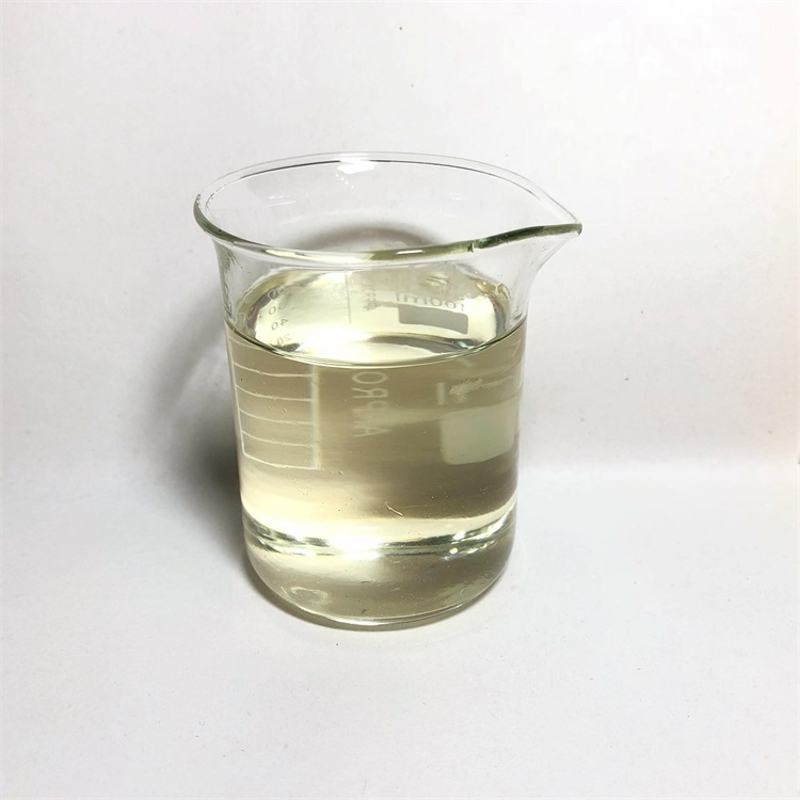
ECHEMI Editorial ReferenceYellow-red liquid or yellow gas.Decomposed by water; dissociates into nitric oxide and chlorine on heating; soluble in fuming sulfuric acid. Nonflammable. Yellow to reddish liquid or yellow/red gas. Choking odor. Liquefies at-5.5°C.
Nitrosyl chloride appears as a yellow to yellowish red gas. Liquefies at -5.5°C. Very toxic by inhalation. Noncombustible, but accelerates burning of combustible material. Decomposed by water to form corrosive hydrochloric acid. Vapors heavier than air. Prolonged exposure to fire or heat can cause containers to rupture violently and rocket .|Liquid|YELLOW GAS WITH PUNGENT ODOUR.
Nitrosyl chloride appears as a yellow to yellowish red gas. Liquefies at -5.5°C. Very toxic by inhalation. Noncombustible, but accelerates burning of combustible material. Decomposed by water to form corrosive hydrochloric acid. Vapors heavier than air. Prolonged exposure to fire or heat can cause containers to rupture violently and rocket .Basic Info-
Product Name:
Nitrosyl chloride
Other Name:Nitrosyl chloride ((NO)Cl);Nitrosyl chloride;Nitrogen oxychloride;Nitrogen oxide chloride (NOCl);Nitrogen oxychloride (NOCl);Nitrosonium chloride;Nitrosochloride;Chlorine nitride oxide (ClNO);Nitrogen chloride oxide (NClO);74734-38-6
CAS No.:2696-92-6
Molecular Formula:ClNO
InChIKeys:InChIKey=VPCDQGACGWYTMC-UHFFFAOYSA-N
Molecular Weight:65.4591
Exact Mass:65.46
EC Number:220-273-1
UNII:NHE5I1E5H6
ICSC Number:1580
UN Number:1069
DSSTox ID:DTXSID5051945
Color/Form:YELLOW GAS OR YELLOW-RED LIQUID OR CRYSTALS
Categories:
Characteristics-
PSA:
29.43000
XLogP3:0.90660
Appearance:Nitrosyl chloride appears as a yellow to yellowish red gas. Liquefies at -5.5°C. Very toxic by inhalation. Noncombustible, but accelerates burning of combustible material. Decomposed by water to form corrosive hydrochloric acid. Vapors heavier than air. Prolonged exposure to fire or heat can cause containers to rupture violently and rocket .
Density:1.417
Melting Point:-64.5 °C
Boiling Point:-5.5 °C
Refractive Index:1.432
Water Solubility:decomposes in H2O; soluble fuming H2SO4 [HAW93]
Vapor Pressure:2,409 mm Hg at 25 deg C, calculated from experimentally derived coefficients
Vapor Density:Relative vapour density (air = 1): 2.3
Explosive limit:COLD SEALED TUBE CONTAINING NITROSYL CHLORIDE, PLATINUM WIRE & TRACES OF ACETONE EXPLODED VIOLENTLY ON BEING ALLOWED TO WARM UP.
Odor:CHOKING ODOR
Experimental Properties:1 MG/CU M IS EQUIV TO 0.37 PPM; 1 PPM IS EQUIV TO 2.7 MG/CU M @ 25 °C, 760 MM HG|DECOMP BY H2O; ORANGE COLOR OF AQUA REGIA IS PRODUCED BY NITROSYL CHLORIDE|VAP: 76 MM HG AT -50 °C
Air and Water Reactions:Dissolves into and reacts with moisture in the air or with water to form hydrochloric acid and toxic red oxides of nitrogen.
Reactive Group:Acyl Halides, Sulfonyl Halides, and Chloroformates
Reactivity Alerts:Strong Oxidizing Agent
Reactivity Profile:NITROSYL CHLORIDE is an oxidizing agent. Dissociates into nitric oxide and chlorine on heating. Gives an explosive reaction when sealed in a tube with a residue of acetone and in the presence of platinum catalyst [Chem. Eng. News 35(43):60. 1967]. May react vigorously or explosively if mixed with diisopropyl ether or other ethers in the presence of trace amounts of metal salts [J. Haz. Mat., 1981, 4, 291].
Autoignition Temperature:Not flammable (USCG, 1999)
Physical Dangers:The gas is heavier than air and may accumulate in lowered spaces causing a deficiency of oxygen.
Corrosivity:VERY CORROSIVE|ALUMINUM IS ATTACKED BY NITROSYL CHLORIDE WHEN COLD.
Heat of Vaporization:164 BTU/LB= 91.0 CAL/G= 3.81X10+5 J/KG
Critical Temperature & Pressure:167 °C; 92.4 ATM
Hazard IdentificationClassification of the substance or mixture
Skin corrosion, Sub-category 1A
Acute toxicity - Category 1, Inhalation
GHS label elements, including precautionary statements
Pictogram(s) 


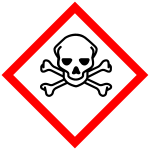
Signal word Danger
Hazard statement(s) H270 May cause or intensify fire; oxidizer
H280 Contains gas under pressure; may explode if heated
H314 Causes severe skin burns and eye damage
H330 Fatal if inhaled
Precautionary statement(s) Prevention P260 Do not breathe dust/fume/gas/mist/vapours/spray.
P264 Wash ... thoroughly after handling.
P280 Wear protective gloves/protective clothing/eye protection/face protection/hearing protection/...
P271 Use only outdoors or in a well-ventilated area.
P284 [In case of inadequate ventilation] wear respiratory protection.
Response P301+P330+P331 IF SWALLOWED: Rinse mouth. Do NOT induce vomiting.
P363 Wash contaminated clothing before reuse.
P304+P340 IF INHALED: Remove person to fresh air and keep comfortable for breathing.
P316 Get emergency medical help immediately.
P321 Specific treatment (see ... on this label).
P305+P351+P338 IF IN EYES: Rinse cautiously with water for several minutes. Remove contact lenses, if present and easy to do. Continue rinsing.
P320 Specific treatment is urgent (see ... on this label).
Storage P405 Store locked up.
P403+P233 Store in a well-ventilated place. Keep container tightly closed.
Disposal P501 Dispose of contents/container to an appropriate treatment and disposal facility in accordance with applicable laws and regulations, and product characteristics at time of disposal.
Other hazards which do not result in classification
no data available
Handling and StoragePrecautions for safe handling
NO contact with flammables. Handling in a well ventilated place. Wear suitable protective clothing. Avoid contact with skin and eyes. Avoid formation of dust and aerosols. Use non-sparking tools. Prevent fire caused by electrostatic discharge steam.
Conditions for safe storage, including any incompatibilities
Separated from incompatible materials. See Chemical Dangers. Cool. Keep in a well-ventilated room.
-
-
Seller Information
-
Business Type:
Manufactory
-
Main Products:
Di-tert-Butyl malonate
-
Location:
CHEMLYTE SOLUTIONS CO.,LTD
-
Payment Terms:
O/A
-
Average lead Time:
20 days
-
Total Annual Revenue:
$10 million-$25 million
-
Total Employees:
11-50
-
Year of Establishment:
2019
-
-
Inquiry History1 Inquiries
Country Product Purchase Quantity Date Posted  South Africa
Nitrosyl Chloride
150 G Jun 2, 2026 Post an enquiry for this product
More from this Seller
-
-

-
6920-22-5 1,2-Hexanediol
Pharmaceutical Grade / 99%
-
-
-

-
868-77-9 2-Hydroxyethyl methacrylate
Pharmaceutical Grade / 99%
-
-
-

-
923-26-2 2-Hydroxypropyl methacrylate
Pharmaceutical Grade / 99%
-
-
-

-
2627-95-4 Divinyl tetramethyl disiloxane
Pharmaceutical Grade / 99%
-
-
-

-
593-85-1 Guanidine carbonate
Pharmaceutical Grade / 99%
-
-
-

-
126-33-0 Sulfolane
Pharmaceutical Grade / 99%
-

Hot Related Products
-
 NITRIC OXIDE CAS NO.: 10102-43-9 99% Dideu-1-73875 Dideu
 -
 Nitric Oxide Supplier NO Gas
 -
 Nitrogen Dioxide Supplier NO2 Gas
 -
 Trimethyltin chloride
 -
 high purity hot sale Trimethyltin Chloride 99% high quality see COA KANBEI
 -
 Cyanogen bromide 98% liquid 506-68-3 Dideu
$1/KG FOB
-
 Cyanogen bromide 506-68-3
 -
 High quality Cyanogen bromide CAS NO.506-68-3
 -
 high quality Silicon tetrafluoride 99% transparent liquid KANBEI
 -
 Silicon Tetrafluoride & SiF4 99% colorless gas Dideu