Product
Supplier
Encyclopedia
Inquiry
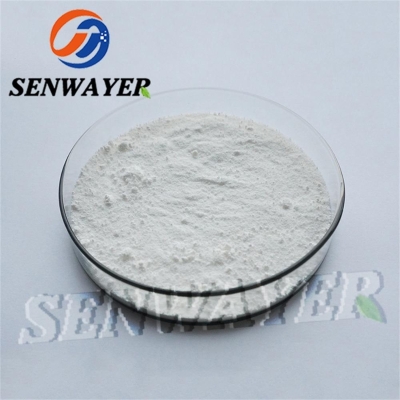
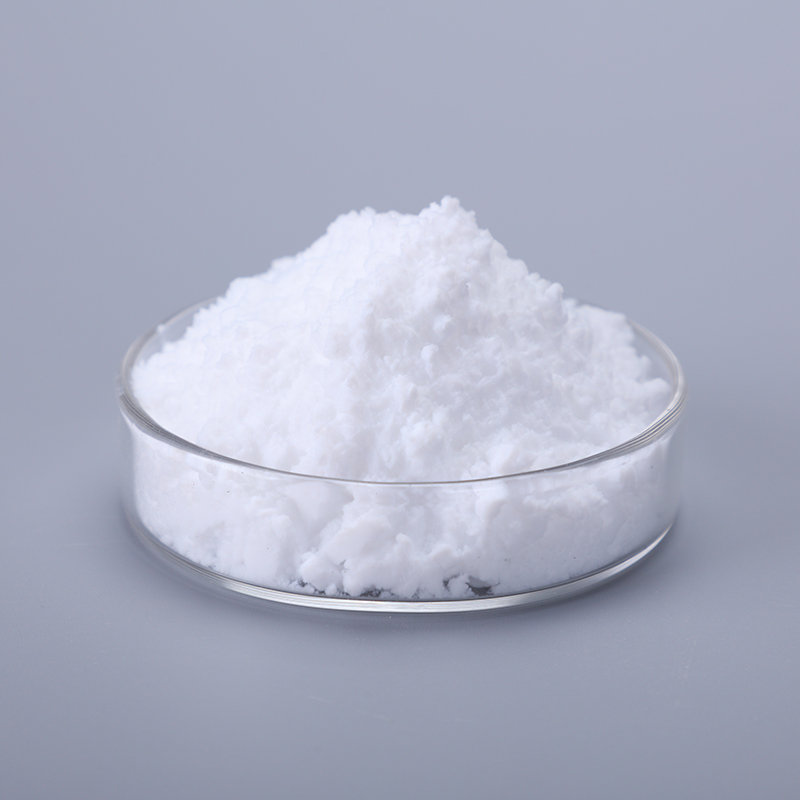
Pyrrolidine123-75-1C4H9N buy - large image1
Pyrrolidine123-75-1C4H9N buy - image1
Pyrrolidine123-75-1C4H9N buy - image2
Pyrrolidine123-75-1C4H9N buy - image3
Pyrrolidine123-75-1C4H9N buy - image4
Pyrrolidine123-75-1C4H9N buy - image5
Pyrrolidine123-75-1C4H9N buy - image6

Pyrrolidine123-75-1C4H9N

4 Inquiries

Unit Price:

$33-34/MT FOB

Get Latest Price
CAS No.:

123-75-1

Grade:

Industrial Grade

Content:

99.5%

Port:

上海

Brand:

OORENT

Packaging:

Vial/Bottle/Bag/Carton

Price valid (until):

2026-07-17

Company Type:
Trader
Location:
China
Qualification:
Main Products:

pharmaceutical intermediates,peptides,electronic chemicals

  • Product Description

  • Seller Information

  • Inquiry History

  • Description

    Product Detail

    Pyrrolidine Basic information
    Product Name: Pyrrolidine
    Synonyms: TETRAMETHYLENEIMINE;pyrrolidine,tetrahydropyrrole;PYRROLIDINE,REAGENT;TETRAHYDROPYRROLE(PYRROLIDINE);PYRROLIDINE 99+%;PYRROLIDINE, REDISTILLED, 99.5+%;1-AZACYCLOPENTANE;AKOS BBS-00003603
    CAS: 123-75-1
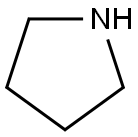
    MF: C4H9N
    MW: 71.12
    EINECS: 204-648-7
    Product Categories: Building Blocks;C4 to C8;Aliphatics;Chemical Synthesis;Heterocyclic Building Blocks;Pyrrolidines;Imidazoles, Pyrroles, Pyrazoles, Pyrrolidines;Flavor;Heterocycles;Intermediates & Fine Chemicals;Pharmaceuticals;123-75-1;bc0001;K00001
    Mol File: 123-75-1.mol
    Shop Pyrrolidine123-75-1C4H9N-Detailed Image 1

    Pyrrolidine Chemical Properties
    Melting point  -63 °C
    Boiling point  87-88 °C/760 mmHg (lit.)
    density  0.852 g/mL at 25 °C (lit.)
    vapor density  2.45 (vs air)
    vapor pressure  128 mm Hg ( 39 °C)
    refractive index  n20/D 1.443(lit.)
    FEMA  3523 | PYRROLIDINE
    Fp  37 °F
    storage temp.  Store below +30°C.
    solubility  water: miscible
    pka 11.27(at 25℃)
    form  Liquid
    color  Colorless to Almost colorless
    Odor at 0.10 % in propylene glycol. ammoniacal animal egg amine
    PH 12.9 (100g/l, H2O, 20℃)
    explosive limit 1.6-10.6%(V)
    Odor Type ammoniacal
    biological source synthetic
    Water Solubility  Miscible with alcohol, ether, chloroform and water.
    Sensitive  Air Sensitive
    Merck  14,8015
    JECFA Number 1609
    BRN  102395
    Henry's Law Constant 4.2×100 mol/(m3Pa) at 25℃, Amoore and Buttery (1978)
    Dielectric constant 8.3000000000000007
    Stability: Stable; flammable. Incompatible with strong acids, strong oxidizing agents.
    InChI 1S/C4H9N/c1-2-4-5-3-1/h5H,1-4H2
    InChIKey RWRDLPDLKQPQOW-UHFFFAOYSA-N
    SMILES C1CCNC1
    LogP 0.22 at 25℃
    Surface tension 30.11mN/m at 293.15K
    CAS DataBase Reference 123-75-1(CAS DataBase Reference)
    NIST Chemistry Reference Pyrrolidine(123-75-1)
    EPA Substance Registry System Pyrrolidine (123-75-1)

    Safety Information
    Hazard Codes  F,T,C
    Risk Statements  11-22-23-34-35-20/21/22-20/22-R35-R20/21/22-R11
    Safety Statements  16-26-36/37/39-45-33-S45-S36/37/39-S26-S16
    RIDADR  UN 1922
    WGK Germany  2
    RTECS  UX9650000
    34
    Autoignition Temperature 653 °F
    TSCA  TSCA listed
    HS Code  2933 99 80
    HazardClass  3
    PackingGroup  II
    Storage Class 3 - Flammable liquids
    Hazard Classifications Acute Tox. 4 Inhalation
    Acute Tox. 4 Oral
    Eye Dam. 1
    Flam. Liq. 2
    Skin Corr. 1A
    Hazardous Substances Data 123-75-1(Hazardous Substances Data)
    Toxicity LD50 orally in Rabbit: 433 mg/kg
    MSDS Information
    Provider Language
    SigmaAldrich English
    ACROS English
    ALFA English

    Pyrrolidine Usage And Synthesis
    Chemical Properties Pyrrolidine appears as a colorless to pale yellow liquid with an ammonia-like odor. It is infinitely miscible with water and conventional organic solvents such as methanol, acetone, ether, and chloroform. It acts as a lachrymator.
    Chemically, pyrrolidine behaves like a secondary amine in every respect. For example, it undergoes Leuckart –Wallach and Mannich reactions and is readily converted into an enamine. In the presence of a catalyst, such as platinum at 360°C or rhodium at 650°C, pyrrole is formed. In the presence of a copper catalyst, N-methylpyrrolidone is converted into N-methylpyrrolidine.
    Physical properties Pyrrolidine has a penetrating amine-type odor, reminiscent of ammonia and piperidine. It is easy to turn yellow when exposed to light or humid air, easily soluble in water and ethanol. It is nauseating and diffusive.
    Occurrence Reported found in beer, bread, wheat bread, salmon caviar, fish, milk, leaves and stalks of celery, Camembert cheese, Limburger cheese, Russian cheeses, tilsit cheese, other cheeses, caviar, raw fatty fish, beer, Finnish whiskey, white wine, red wine, coffee, radish, malt, roasted peanut, sweet corn and roasted barley.
    Uses Pyrrolidine is a flammable alkaline liquid that undergoes reactions typical of secondary amines. It is used to prepare pesticides and rubber accelerators and as a chemical intermediate (usually the hydrochloride form) in the pharmaceutical industry. There is relatively limited industrial exposure to this material.
    Application Pyrrolidine is a heterocyclic compound used as a building block in the synthesis of wide range of pharmaceutical compounds, namely matrix metalloprotein inhibitors (MMPIs) and aminopeptidase N inhibitors (APNIs). It has been used for the synthesis of N-benzoyl pyrrolidine from benzaldehyde via oxidative amination. It may be used as a catalyst for the synthesis of N-sulfinyl aldimines from carbonyl compounds and sulfonamides.
    Pyrrolidine can also be used to synthesize:
    Taddol-pyrrolidine phosphoramidite, a ligand for rhodium-catalyzed [2+2+2] cycloaddition of pentenyl isocyanate and 4- ethynylanisole.
    H,4 PyrrolidineQuin-BAM (′PBAM′), a selective catalyst for the aza-Henry addition of nitroalkanes to aryl aldimines.
    1,2,3,3a,4,9-Hexahydropyrrolo[2,1-b]quinazoline by reacting with o-aminobenzaldehyde.
    Preparation Pyrrolidine is formed by reduction of pyrrole. Via overall 5-endo-trig cyclizations of homoallylic tosylamides. Pyrrolidine can be produced from butanediol and ammonia, e.g., over an aluminum thorium oxide catalyst at 300°C or over a nickel catalyst at 200°C and 20 MPa under hydrogenation conditions. It can also be produced from THF and ammonia over aluminum oxide at 275-375°C.
    Definition ChEBI: Pyrrolidine is a cyclic amine whose five-membered ring contains four carbon atoms and one nitrogen atom; the parent compound of the pyrrolidine family. It is a saturated organic heteromonocyclic parent, a member of pyrrolidines and an azacycloalkane. It is a conjugate base of a pyrrolidinium ion.
    Aroma threshold values Detection: 20.2 ppm
    Taste threshold values Taste characteristics at 50 ppm: ammonia and fishy, amine-like with seaweed and shellfish nuances.
    General Description Pyrrolidine is a saturated heterocycliccompound having one nitrogenatom in a five-membered ring. It is a colorless to pale yellow liquid with an ammonia-like odor. It is found in certain plants andthe ring structure is present in manyalkaloids. Flash point 37°F. Density 0.85 g / cm3. Vapors heavier than air. Produces toxic oxides of nitrogen during combustion.
    Air & Water Reactions Highly flammable. Very soluble in water.
    Reactivity Profile Tetrahydro pyrrole neutralizes acids in exothermic reactions to form salts plus water. May be incompatible with isocyanates, halogenated organics, peroxides, phenols (acidic), epoxides, anhydrides, and acid halides. May generate hydrogen, a flammable gas, in combination with strong reducing agents such as hydrides. An explosion occurred when a mixture of Tetrahydro pyrrole, benzaldehyde, and propionic acid was heated in an attempt to form porphyrins.
    Hazard Flammable, dangerous fire risk. Toxic by ingestion and inhalation.
    Health Hazard The acute toxicity of pyrrolidine is moderateon test animals. It is somewhat less toxicthan pyrrole. The vapors are an irritant tothe eyes and respiratory tract. The liquid iscorrosive to the skin. Contact with the eyescan cause damage. The oral LD50 value inrats is 300 mg/kg, while the inhalation LC50value in mice is 1300 mg/m3/2 h (NIOSH1986).
    Fire Hazard Flammable/combustible material. May be ignited by heat, sparks or flames. Vapors may form explosive mixtures with air. Vapors may travel to source of ignition and flash back. Most vapors are heavier than air. They will spread along ground and collect in low or confined areas (sewers, basements, tanks). Vapor explosion hazard indoors, outdoors or in sewers. Runoff to sewer may create fire or explosion hazard. Containers may explode when heated. Many liquids are lighter than water.
    Flammability and Explosibility Highly flammable
    Safety Profile Poison by ingestion and intravenous routes. Moderately toxic by inhalation. Dangerous fire hazard when exposed to heat or flame; can react vigorously with oxidizing materials. To fight fire, use alcohol foam, CO2, dry chemical. When heated to decomposition it emits hghly toxic fumes of NOx.
    Purification Methods Dry pyrrolidine with BaO or sodium, then fractionally distil it, under N2, through a Todd column (p 11) packed with glass helices. [Beilstein 20 H 159, 20 I 36, 20 II 79, 20 III/IV 2072, 20/1 V 162.]

    Pyrrolidine Preparation Products And Raw materials
    Raw materials Pyrrole-->Tetrahydrofuran-->Ammonia-->Aluminum oxide-->1,4-Butanediol-->Nickel sulfate hexahydrate
    Preparation Products 4-(Pyrrolidin-1-yl)butan-1-amine-->4,5,6,7-TETRAHYDRO-2-METHYLFURO[3,2-C]PYRIDINE-->6-Bromoindole-3-carboxaldehyde-->6-Methoxyindole-->Ramipril-->6-Methoxy-1H-indole-3-carbaldehyde-->N-[2-(4-Bromophenoxy)ethyl]pyrrolidine-->Bis(pinacolato)diboron-->1-BENZYL-3-METHYL-4-PIPERIDONE-->6-Benzyloxyindole-->1-(2-Chloroethyl)pyrrolidine Hydrochloride-->BEPRIDIL-->1-(4-AMINO-2,6-DICHLOROPHENOXY)-3-(PYRROLIDIN-1-YL)PROPAN-2-OL-->Alizapride-->3,5-DIMETHYLISOXAZOLE-4-CARBONYL CHLORIDE-->(2-PYRROLIDIN-1-YL-ETHYL)-HYDRAZINE-->Gestrinone-->6-Fluorotryptamine hydrochloride-->1-(2-Aminoethyl)pyrrolidine-->Simvastatin-->Indole-6-carboxylic acid-->3,5-DIMETHYLISOXAZOLE-4-CARBOXYLIC ACID-->TOSUFLOXACIN TOSILATE-->3-Methyl-4-isoxazolecarboxylic acid-->1-(3-PYRROLIDINOPROPYL)PIPERAZINE-->5-BROMO-2-(PYRROLIDIN-1-YL)PYRIMIDINE-->ETHYL 3,5-DIMETHYLISOXAZOLE-4-CARBOXYLATE-->METHYL 3-((PYRROLIDIN-1-YL)METHYL)BENZOATE-->[6-(1-PYRROLIDINYL)-3-PYRIDINYL]METHANOL-->4-(1-Pyrrolidinyl)piperidine-->6-(1-PYRROLIDINYL)NICOTINALDEHYDE-->6-(1-PYRROLIDINYL)-3-PYRIDINAMINE-->Barnidipine hydrochloride-->PYRROLIDIN-1-YL-ACETIC ACID-->Rocuronium bromide-->PYRROLIDINE-1-SULFONYL CHLORIDE-->Methyl 1-Methyl-2-oxopyrrolidine-3-carboxylate-->5-NITRO-2-(1-PYRROLIDINYL)PYRIDINE-->5-BROMO-2-(PYRROLIDIN-1-YL)PYRIDINE-->Sultopride hydrochloride

    Shop 3-Chloro-1-propene107-05-1-Detailed Image 2 Shop 3-Chloro-1-propene107-05-1-Detailed Image 3 Shop 3-Chloro-1-propene107-05-1-Detailed Image 4 Shop 3-Chloro-1-propene107-05-1-Detailed Image 5 Shop 3-Chloro-1-propene107-05-1-Detailed Image 6 Shop 3-Chloro-1-propene107-05-1-Detailed Image 7


    Basic Info
    Product Name:

    Pyrrolidine

    Other Name:

    Pyrrolidine;Azacyclopentane;Prolamine;Pyrrole,tetrahydro-;Tetrahydropyrrole;Tetramethylenimine;Pyrrolidine ring;Butylenimine;Azolidine;Perhydropyrrole;NSC 62781;9: PN: WO2017048620 SEQID: 14 claimed sequence

    CAS No.:

    123-75-1

    Molecular Formula:

    C4H9N

    InChIKeys:

    InChIKey=RWRDLPDLKQPQOW-UHFFFAOYSA-N

    Molecular Weight:

    71.12

    Exact Mass:

    71.12

    BRN:

    102395

    EC Number:

    204-648-7

    UNII:

    LJU5627FYV

    ICSC Number:

    1315

    NSC Number:

    62781

    UN Number:

    1922

    DSSTox ID:

    DTXSID3059559

    Color/Form:

    Colorless to pale yellow liq

    HScode:

    2933990090

    Categories:

    Synthetic Fragrances

    Characteristics
    PSA:

    12

    XLogP3:

    0.46

    Appearance:

    Liquid

    Density:

    0.8520 g/cm3 @ Temp: 22.5 °C

    Melting Point:

    57.69 °C

    Boiling Point:

    86.71 °C

    Flash Point:

    37 °F

    Refractive Index:

    1.428

    Water Solubility:

    Miscible with alcohol, ether, chloroform and water.

    Storage Conditions:

    Flammables area

    Vapor Pressure:

    128 mm Hg ( 39 °C)

    Vapor Density:

    2.45 (vs air)

    Toxicity:

    Oral-Rat  LD50: 300 mg/kg; Oral-Mouse LD50: 450 mg/kg

    Flammability characteristics:

    It is flammable in case of open flame, high temperature and oxidant; produces toxic nitrogen oxide gas when heated

    Explosive limit:

    1.6-10.6%(V)

    Odor:

    Unpleasant, ammoniacal odor

    Taste:

    POWERFUL, AMMONIACAL TASTE

    Henrys Law Constant:

    2.39e-06 atm-m3/mole|Henry's Law constant = 2.39X10⁻⁶ atm-cu m/mol at 25 dec C

    Dissociation Constants:

    pK at 25 °C = 2.89|pKa = 11.31

    Experimental Properties:

    Hydroxyl radical reaction rate constant = 7.85X10⁻¹¹ cu cm/molec-sec at 25 °C (est)

    Air and Water Reactions:

    Highly flammable. Very soluble in water.

    Reactive Group:

    Amines, Phosphines, and Pyridines

    Reactivity Alerts:

    Highly Flammable

    Reactivity Profile:

    PYRROLIDINE neutralizes acids in exothermic reactions to form salts plus water. May be incompatible with isocyanates, halogenated organics, peroxides, phenols (acidic), epoxides, anhydrides, and acid halides. May generate hydrogen, a flammable gas, in combination with strong reducing agents such as hydrides. An explosion occurred when a mixture of pyrrolidine, benzaldehyde, and propionic acid was heated in an attempt to form porphyrins.

    Heat of Combustion:

    -673.75 Kcal/mol at 298 K and 1 atm

    Flammable Limits:

    LOWER: 2.9% @ -2 °C, UPPER 13.0% @ 29.8 °C

    Physical Dangers:

    The vapour is heavier than air and may travel along the ground; distant ignition possible.

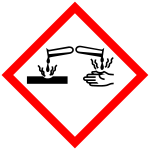
    Corrosivity:

    Corrosive

    Heat of Vaporization:

    529 J/g at 0.1 MPa

    Critical Temperature & Pressure:

    Critical temperature: 568.55 K; Critical pressure: 5.6134X10+6 Pa

    Hazard Identification

    Classification of the substance or mixture

    Flammable liquids, Category 2

    Acute toxicity - Category 4, Oral

    Skin corrosion, Sub-category 1A

    Serious eye damage, Category 1

    Acute toxicity - Category 4, Inhalation

    GHS label elements, including precautionary statements

    Pictogram(s)
    Signal word

    Danger

    Hazard statement(s)

    H225 Highly flammable liquid and vapour

    H302 Harmful if swallowed

    H314 Causes severe skin burns and eye damage

    H332 Harmful if inhaled

    Precautionary statement(s)
    Prevention

    P210 Keep away from heat, hot surfaces, sparks, open flames and other ignition sources. No smoking.

    P233 Keep container tightly closed.

    P240 Ground and bond container and receiving equipment.

    P241 Use explosion-proof [electrical/ventilating/lighting/...] equipment.

    P242 Use non-sparking tools.

    P243 Take action to prevent static discharges.

    P280 Wear protective gloves/protective clothing/eye protection/face protection/hearing protection/...

    P264 Wash ... thoroughly after handling.

    P270 Do not eat, drink or smoke when using this product.

    P260 Do not breathe dust/fume/gas/mist/vapours/spray.

    P261 Avoid breathing dust/fume/gas/mist/vapours/spray.

    P271 Use only outdoors or in a well-ventilated area.

    Response

    P303+P361+P353 IF ON SKIN (or hair): Take off immediately all contaminated clothing. Rinse affected areas with water [or shower].

    P370+P378 In case of fire: Use ... to extinguish.

    P301+P317 IF SWALLOWED: Get medical help.

    P330 Rinse mouth.

    P301+P330+P331 IF SWALLOWED: Rinse mouth. Do NOT induce vomiting.

    P363 Wash contaminated clothing before reuse.

    P304+P340 IF INHALED: Remove person to fresh air and keep comfortable for breathing.

    P316 Get emergency medical help immediately.

    P321 Specific treatment (see ... on this label).

    P305+P351+P338 IF IN EYES: Rinse cautiously with water for several minutes. Remove contact lenses, if present and easy to do. Continue rinsing.

    P305+P354+P338 IF IN EYES: Immediately rinse with water for several minutes. Remove contact lenses, if present and easy to do. Continue rinsing.

    P317 Get medical help.

    Storage

    P403+P235 Store in a well-ventilated place. Keep cool.

    P405 Store locked up.

    Disposal

    P501 Dispose of contents/container to an appropriate treatment and disposal facility in accordance with applicable laws and regulations, and product characteristics at time of disposal.

    Other hazards which do not result in classification

    no data available

    Handling and Storage

    Precautions for safe handling

    NO open flames, NO sparks and NO smoking. Closed system, ventilation, explosion-proof electrical equipment and lighting. Use non-sparking handtools. Prevent build-up of electrostatic charges (e.g., by grounding). Handling in a well ventilated place. Wear suitable protective clothing. Avoid contact with skin and eyes. Avoid formation of dust and aerosols. Use non-sparking tools. Prevent fire caused by electrostatic discharge steam.

    Conditions for safe storage, including any incompatibilities

    Fireproof. Separated from strong oxidants and acids. Well closed.Bundling and sills should be provided to prevent spread of liquid accidentally escaping from storage and process vessels.

  • Seller Information
    Business Type:

    Trader

    Main Products:

    pharmaceutical intermediates,peptides,electronic chemicals

    Location:

    Room 102, 1st Floor, East Office Building, No. 45 Pengwan Road, Qianwan Bonded Port Area, Qingdao Zone, China (Shandong) Pilot Free Trade Zone

    Payment Terms:

    100% TT in advance

    Average lead Time:

    10

    Total Annual Revenue:

    $10 million-$25 million

    Total Employees:

    51-100

    Year of Establishment:

    2024

    A reliable supplier is like insurance.

    We are mainly specilized in supply of pharmaceutical intermediates, electronic chemicals,food additives, and other fine chemical products.
    Integrity is the foundation, quality is life. We would like to work together with you to build a greener and brighter future.

    Website: orientchem.cc
    Email: scarlett@orientchem.cc
    WhatsApp: +86 17753254221

  • Inquiry History
    4 Inquiries
    Country Product Purchase Quantity Date Posted
    Poland

    Pyrrolidine

    20 MT Mar 12, 2025
    Australia

    pyrrolidine

    1 KG Mar 30, 2026
    United Kingdom

    Pyrrolidine

    100 KG Oct 14, 2024
    Mexico

    Tetrahydropyrrole

    10 KG Sep 30, 2023
    Post an enquiry for this product
pic ×

Scan the QR Code to Share

All products displayed on this website are only for non-medical purposes such as industrial applications or scientific research, and cannot be used for clinical diagnosis or treatment of humans or animals. They are not medicinal or edible.

According to relevant laws and regulations and the regulations of this website, units or individuals who purchase hazardous materials should obtain valid qualifications and qualification conditions.

The information shown above is provided by the enterprise itself, and the authenticity, accuracy and legitimacy of the content are the responsibility of the publishing company. ECHEMI does not bear any guarantee responsibility for this. Please be aware that risks in internet transactions objectively exist.

Feedback & Suggestions
Send Message

Thank you for your feedback. If you require further assistance, please contact us by email at info@echemi.com or call us at +86-532-55729510.