Semaglutide once a week for the treatment of adolescent obesity Phase III results appear in the New England Journal of Medicine: significantly reduce BMI
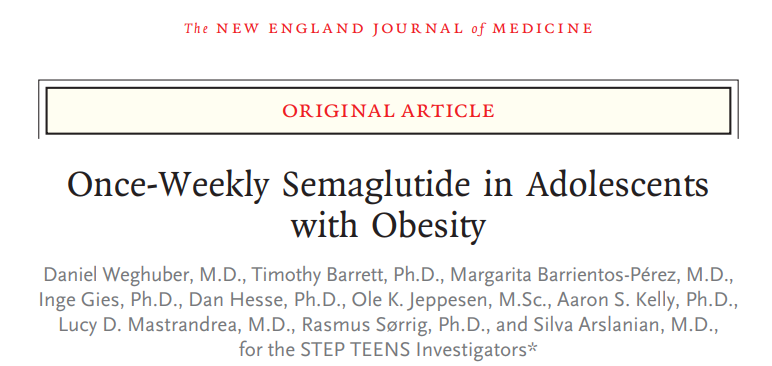
On November 2, the New England Journal of Medicine published an article entitled "Once a week Semaglutide treatment of adolescent obesity", which showed that 2.4 mg Semaglutide treatment+lifestyle intervention was better than lifestyle intervention alone, which could reduce the BMI of adolescent obesity more (- 16.1% vs 0.6%).
On the same day, Novo Nordisk released its Q3 financial report. Wegovy (2.4mg subcutaneous injection once a week), a weight loss product of smectide series, contributed DKK 3742 million (about USD 497 million) in revenue this year.
Obesity is a common chronic disease requiring long-term treatment, which will bring many complications, including type 2 diabetes, heart disease, non-alcoholic fatty liver disease and cancer, and ultimately affect the mental health and quality of life of patients. It is estimated that by 2030, more than 250 million children and adolescents worldwide will be obese.
At present, FDA has approved once a day Liraglutide (3.0 mg), orlistat (120 mg) and fentamine+topiramate (7.5 mg+46 mg or 15 mg+92 mg) for obese adolescents over 12 years of age.
In June 2021, Novo Nordisk's Wegovy was approved by the FDA to be marketed for long-term weight management in combination with diet and exercise in patients with adult obesity (initial BMI ≥ 30 kg/m2) or overweight (initial BMI ≥ 27 kg/m2) and at least one weight related complication.
In order to further explore the efficacy and safety of Semaglutide in treating adolescents with obesity, Novo Nordisk conducted a double-blind, randomized, placebo-controlled Phase IIIa STEP TEENS study. Eligible subjects (n=201) were randomly assigned to receive subcutaneous injection of Semaglutide (2.4 mg) or placebo once a week in a 2:1 ratio for 68 weeks.
The results showed that at week 68, the mean change of BMI from baseline was - 16.1% in the Semaglutide group and 0.6% in the placebo group. The study reached the primary endpoint (estimated difference - 16.7%; P<0.001).
The efficacy of Semaglutide continued until 7 weeks after the end of treatment. At week 75, the change in BMI from baseline was - 13.2% in the Semaglutide group and 1.2% in the placebo group (estimated difference - 14.4%).
In addition, 73% of subjects in Semaglutide group lost 5% or more weight, while only 18% of subjects in placebo group achieved this goal (estimated odds ratio 14.0; P<0.001). 62% of the Semaglutide group and 8% of the placebo group lost 10% or more of their weight, respectively.
Compared with the placebo, Semaglutide made the subjects achieve more significant benefits in weight loss and improvement of cardiovascular metabolic risk factors, including waist circumference, glycosylated hemoglobin and blood lipid levels.
In terms of safety, 79% of subjects in Semaglutide group reported adverse events, while 82% in placebo group; The incidence of adverse events in the Semaglutide group was higher than that in the placebo group (435.7 vs 362.9 events per 100 persons/year). Gastrointestinal diseases (mainly nausea, vomiting and diarrhea) are the most common adverse events of Semaglutide (62% vs 42%), with mild to moderate severity and short duration.
The proportion of subjects in the two groups reporting serious adverse events was similar (9% vs 11%), and no fatal adverse events were reported. A similar proportion of subjects (5% vs 4%) in the two groups stopped Semaglutide or placebo due to adverse events. Gastrointestinal events were the most common reason for stopping Semaglutide in the Semaglutide group.
According to the article, the decrease in body weight and BMI observed in adolescents with obesity treated with Semaglutide was far greater than that of other GLP-1R agonists and other weight loss drugs. At week 68, the BMI change of Semaglutide once a week compared with placebo was - 16.7%. The change of liraglutide once a day in the 56th week compared with the placebo was - 4.6%. The absolute BMI index of orlistat changed less than that of placebo (- 0.5 to - 0.9), while that of Semaglutide in this study was - 6.0. Of course, it should be noted that these are not head to head comparisons.

You May Interested In


Glow70/KLOW80 99% China Peptides Warehouse Direct Delivery Lyophilized Powder in Stock
$169/UNIT FOB


2026-10-23
Trade Alert
Delivering the latest product trends and industry news straight to your inbox.
(We'll never share your email address with a third-party.)

Related News
-
Novo Nordisk’s Oral Wegovy Wins EU Approval as Weight-Loss Competition Shifts from Injections to Pills
-
Novo Nordisk to Undergo Major Restructuring, Cutting 9,000 Jobs Worldwide
-
Novo Nordisk acquires Cardior Pharmaceuticals
-
Study Finds Semaglutide Lower Suicide Ideation Risk Compared to Other Diabetes and Obesity Medications
-
Eli Lilly Says It Opposes Use of Its Weight-Loss Drug as Beauty Cosmetic
-
Can Novo Nordisk's Weight Loss Drug Revolutionize the Pharmaceutical Industry?
-
Is Novo Nordisk a Better Investment Than Eli Lilly?
-
Are GLP-1 Receptor Agonists Linked to Hair Loss and Suicidal Thoughts?
-
Will Novo Nordisk's Etavopivat Revolutionize Treatment for Sickle Cell Disease?
-
Can New Entrants Succeed in the Competitive GLP-1 Drug Market?
Recommend Reading
-
![EU Biocidal Data Protection Extension Raises the Stakes for Chemical Market Entry]()
EU Biocidal Data Protection Extension Raises the Stakes for Chemical Market Entry
-
![FDA’s Warning to Compounders Raises the Stakes for API and Excipient Suppliers]()
FDA’s Warning to Compounders Raises the Stakes for API and Excipient Suppliers
-
![U.S. Announces Preliminary Dumping Margins of Up to 70.21% on Chinese Xanthan Gum]()
U.S. Announces Preliminary Dumping Margins of Up to 70.21% on Chinese Xanthan Gum
-
![Trump Urges Ukraine to Halt Russian Refinery Strikes as Diesel Shortage Becomes a Global Policy Issue]()
Trump Urges Ukraine to Halt Russian Refinery Strikes as Diesel Shortage Becomes a Global Policy Issue
-
![U.S. Announces Preliminary 0.61% Dumping Margin for India's SRF PET Film]()
U.S. Announces Preliminary 0.61% Dumping Margin for India's SRF PET Film
-
![Business Society’s Trend Analysis for Heavy-Weight Pure Soda Ash on September 11, 2026: Strong Consolidation]()
Business Society’s Trend Analysis for Heavy-Weight Pure Soda Ash on September 11, 2026: Strong Consolidation
-
![Business Society’s Ethanol Market Outlook on September 3, 2026: Clearly Upward Trend]()
Business Society’s Ethanol Market Outlook on September 3, 2026: Clearly Upward Trend
-
![Business Society’s September 11, 2026, Petroleum Coke Trend Analysis: Volatile]()
Business Society’s September 11, 2026, Petroleum Coke Trend Analysis: Volatile
-
![Business Society’s Market Outlook for Acetic Acid on September 3, 2026: Clearly Upward Trend]()
Business Society’s Market Outlook for Acetic Acid on September 3, 2026: Clearly Upward Trend
-
![Palm Oil Market in December Experiences Volatile Decline]()
Palm Oil Market in December Experiences Volatile Decline