Recent Trends and Opportunities in The Global Agrochemical Market
Agrochemical Market Overview
The agrochemical market reached an estimated $73.4 billion at the ex-manufacturer level (i.e. brand owner to first stage of distribution) in 2021, an increase of 8.0% over 2020 in nominal terms. This rate of growth was significantly ahead of the average over recent years, with the market having increased in the low-single digit range annually since the significant market decline experienced in 2015 and stagnant market in 2016. The average CAGR of the Crop Protection (CP) industry was 1.3% per annum between 2015 and 2020, and 2021 represented an anomalous year in terms of growth for the industry. Despite this, there remains significant growth potential for agrochemicals in particular segments.
In recent years, the agrochemical industry has come under increasing scrutiny due to perceived unacceptable environmental and social impacts of certain chemistries. Despite this, whilst pests exist in crops, as they always will do in some form, there will remain a market for control of these pests to protect yields, and the key drivers for conventional agrochemical usage remain in place. Notable growth drivers include improved agricultural economics in developing agricultural economies, such as in South and Southeast Asia, where usage intensity is relatively low compared to more mature developed markets; and a requirement for higher yields to feed an increasing global population.
The crop protection industry is forecast to increase at an average rate of 2.3% per annum between 2020 and 2025, with some of the key growth drivers outlined as follows:
Resistance Development: Pests have developed resistance to existing pesticidal modes of action (MoA), representing an opportunity for new/novel MoA or resistance-breaking technologies (e.g. BASF’s cinmethylin was developed by Shell and originally introduced in 1989, for rice; however, the AI has since been discovered to have a novel mode of action, with potential in the high value EU cereals market for grass weed control).
Regulation: A strict regulatory environment has already led to the loss from the market of many AIs in the EU, leaving an opportunity for any new introduction which can replace lost uses. Further to this, loss of low-cost resistance management AIs such as mancozeb, chlorpyrifos and chlorothalonil in several markets, notably the EU, has created opportunities for new MoA chemistries (typified by Corteva’s fenpicoxamid, a new MoA fungicide with good potential in Septoria resistance management in cereals
Sustainability Legislation: Sustainability legislation in markets such as the EU, China and Japan has called for a significant reduction in pesticide volumes (e.g. 50% reduction in chemical pesticide risk/volume index in the EU by 2030), providing an opportunity for replacement of older high application rate products with newer low-rate alternatives (e.g. the rice grass weed herbicide butachlor was introduced in 1969 and is used at a rate of ~1Kgai/Ha, whilst Corteva’s grass weed herbicide penoxsulam, first introduced in 2005, is used at a typical rate of only 0.03Kgai/Ha).
Due to these factors, growth opportunities can widely be found for different agrochemical active ingredients, with growth generally stronger for newer, lower application rate, higher prices AIs. Figure 1 shows the value of crop protection active ingredients by decade of introduction in 2015 and 2020, and forecast to 2025. This demonstrates that AIs introduced in more recent decades have grown more strongly in recent years and will continue to be the key drivers for growth over the medium term.
Figure 1: Crop Protection Market by AI Decade of Introduction.

Due to these drivers and other market dynamics, navigating the constantly changing CP industry can be difficult for fine chemical companies, CMOs and CDMOs supplying materials to the market. AgbioInvestor has developed AgbioChem to help companies identify agrochemical active ingredients (AIs), intermediates and fine chemicals that not only fit their existing technology/asset portfolio but also help in developing a strategy that capitalizes on opportunities provided by drivers such as those outlined above. As shown in Figure 2, AgbioChem’s unique inclusion of market data (e.g., AI global volume, AI global technical price, etc.) together with chemical/technical information (e.g. technologies, reagents, intermediates, fine chemicals) with an easy to use interface and powerful search engine provides an extra level of intelligence, delivering a complete overview of both the required synthetic processes for each step of manufacture, as well as the available market data (value, volume, technical price) as well as an outline of the leading companies with involvement in each AI.
Figure 2: AgbioChem Overview.

To investigate how these key drivers are creating opportunities in the CP industry in more depth and how AgbioChem can help companies understand how best to approach these opportunities, several short case-studies investigating each of the key drivers are provided below:
Pyroxasulfone: A Story of Growth for Glyphosate Resistance Management.
The isooxazoline herbicide pyroxasulfone was first launched in 2011 by Kumiai Chemical as Sakura. In 2020, sales of the active ingredient amounted to $249 million, with sales between 2015 and 2020 having seen substantial average growth of 18.9% p.a., significantly in advance of the overall herbicide market.
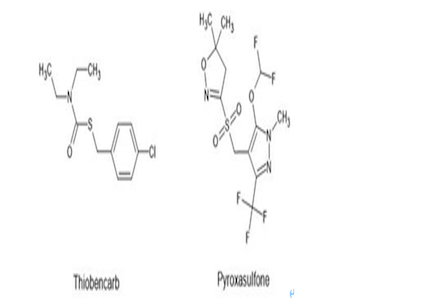
Kumiai discovered pyroxasulfone through its investigations into the herbicide thiobencarb1, which has been on the market since 1970 and is used in rice production systems around the world. As shown in Figure 3, Kumiai primarily maintained the thiocarbamate linkage in thiobencarb although converting the sulfide to a sulfone and the carbonyl to an imine contained in the oxazole ring. Ultimately, the chlorobenzene and the diethyl amide functionalities were changed to improve efficacy.
Figure 3: Thiobencarb and Pyroxasulfone.
Kumiai Chemical has pursued a relatively large number of licensing opportunities, to the clear benefit of sales, Kumiai having strong representation in Japan and Brazil (e.g. through Iharabras), but less so in key cereal, soybean and maize markets, notably Australia and the USA. BASF gained a license to single formulations in the USA, with FMC and Sumitomo Chemical gaining access to mixtures (e.g. including the PPO inhibitors sulfentrazone and flumioxazin, respectively) in the country. In addition, Bayer distributes the product in the single formulation Sakura, and new mixtures including Mateno Complete (with aclonifen / diflufenican) in Australia, whilst BASF and Summit Agro have introduced products more recently in Argentina. Indeed, the inclusion of proprietary actives such as pyroxasulfone can help maintain sales of off-patent mixture partners, a strategy clearly pursued by FMC for its sulfentrazone business.
This broad licensing approach has significantly enhanced market reach, whilst the physiochemical properties in combination with the resistance management capability (VLCFA inhibition is a herbicidal MoA with very few resistant species) fit a significant market need for a very efficacious weed resistance management tool. Indeed, pyroxasulfone sales have increased in particular due to the need for control of herbicide resistant small seeded broadleaved and grass weed species such as common ragweed (US soybeans) and annual ryegrass (Australian cereals) – often replacing control once offered by older, higher rate actives such as glyphosate and trifluralin.
AgbioChem outlines the syntheses, required technologies and market information for pyroxasulfone (see Figure 4) and other AIs used in the mixtures above. Producers of thiobencarb who possess the thiochemistry capabilities would be able to identify what other technologies are required to produce pyroxasulfone. Others would be able to identify the capabilities needed to produce the mixture components sullfentrazone, flumioxazin, aclonifen and diflufenican benefiting from pyroxasulfone.
Figure 4: Pyroxasulfone synthesis and commercial situation displayed in AgbioChem.

Acetamiprid: A Neonicotinoid Benefiting from Competitor Regulation.
The nicotinamide insecticide acetamiprid was developed by Nippon Soda and launched in 1996 as Mospilan. The product was initially launched for use on fruit & vegetables, providing control of a broad range of pests including Lepidoptera, Coleoptera and Hemiptera. Since this time, a significant off-patent market has emerged with offerings from off-patent leaders UPL, Sipcam Oxon and Nufarm, and the active ingredient is increasingly included in innovative differentiated mixture formulations by such companies.
Sales of the active ingredient were relatively flat in the years between 2014 and 2018 at around $400 m., however regulation is expected to be a key driver for sales growth in the EU. The major nicotinamides, clothianidin, thiamethoxam and imidacloprid, all lost their approval for outdoor uses in the EU in 2019, and subsequently were not re-approved on approval expiry in 2019 (clothianidin, thiamethoxam) and early 2020 (imidacloprid). Acetamiprid does not face the same regulatory pressures as other products in the class due to its more favourable environmental profile, and the product has been re-approved until the early 2030s in the EU. This represents a significant opportunity for acetamiprid in replacing lost uses of other nicotinamides, as well as other sucking pest insecticides.
Imidacloprid producers using or producing the key intermediate 2-chloro-5-chloromethylpyridine (CCMP) benefit from AgbioChem by identifying other AIs using CCMP or requiring similar chlorination technology. In addition, AgbioChem details the other technologies necessary to produce acetamiprid.
Bispyribac-Sodium: A Low Rate, Efficient Rice Herbicide Alternative.
The pyrimidinyl(thio)benzoate rice herbicide bispyribac-sodium was developed by Kumiai and Ihara, and was introduced in 1997. The product is used post-emergence for the control of a range of grass and sedge weeds, as well as some broadleaved weeds. China and India are two of the leading rice herbicide markets globally, however a large part of these markets is still based on older high-rate technologies such as butachlor and pretilachlor. Bispyribac is active at around only 0.03Kgai/Ha, significantly lower than the average rate of application of older products, typically 0.5-1.0 Kgai/Ha, and has usage benefits for growers including lower handling volumes.
The Chinese government has put in place measures to significantly reduce pesticide volumes as part of a drive for greater efficiency of production and to meet sustainability goals, to the benefit of bispyribac. The AI represents an efficient low-rate rice weed control option and can be recommended by extensionists as an alternative to older high rate products. Indeed, whilst treated acres for butachlor have declined by an average of some 6% per annum over the period between 2015 and 2020 in China, bispyribac treated acres have increased by a factor of 5x; partly as a result of the volume reduction targets outlined above. Also aiding this has been a significant increase in the number of companies offering the product in the market, with the AI having come off-patent in the early 2010s, and a number of Chinese and Indian manufacturers now active in the AI, increasing market reach.
The synthesis and technologies (e.g., chlorination, thiochemistry, oxidation, ether formation) required to produce bispyribac are shown in Figure 5. In addition to this, AgbioChem outlines additional AIs using these technologies and also enables the identification of other low volume-high value AIs.
Figure 5: Bispyribac-sodium synthesis and commercial situation displayed in AgbioChem.

The Future for New Agrochemical Technology
As outlined in the case studies above, significant growth opportunities remain in the agrochemical market for technology which can be positioned to make the most of the prevalent growth drivers. Although there are clear growth opportunities for newer chemistries, the number of active ingredients coming to market has remained low until recently compared to the historical rate of introduction – affected by the costs of R&D for new AIs. This has increased the reliance of the industry overall on fewer active ingredients and increased the potential for novel mixtures which offer strong efficacy at a relatively lower cost than proprietary actives. Prevailing growth drivers in combination for the need for faster, more cost-efficient agrochemical discovery (e.g. at the R&D driven industry majors) has led to a significant increase in the number agrochemical discovery start-up companies who often utilise novel approaches (e.g. DNA encoded libraries or computational approaches) to generate higher quality agrochemical leads than was possible using traditional approaches. Companies such as Enko Chem (USA), MoA Technology (UK), AgPlenus (Israel), and AgreMatch (Israel) are all active in this field and are all clearly positioning themselves to make the most of the need for new technology as outlined in this article. Regardless of the source, any increase in the rate of introduction of new modes of action and chemistries could lead to opportunities throughout the entire chemical supply chain.
AgbioChem includes unique features such as: each AI synthesis is first divided into chemical rings which are further broken down into searchable reaction steps, whilst searchable market information for each AI allows for analysis of whether the AI/intermediate meets financial targets. This combination of insight covering both chemical/technical information and market information (e.g., AI Technical Price, AI volumes, est. intermediate volumes, integrated AgbioCrop)) allows the user to answer several critical questions when addressing these significant growth opportunities in the agrochemical market:
Which AIs and chemical intermediates fit my technology set?
Am I maximizing my asset profitability?
Are there higher value targets I should be focusing on?
Does my technology portfolio match my customer needs? Is there a better customer mix?
Which adjacent technologies should I add?
Should I adjust my strategy?
Which acquisitions would generate the most profitable synergies?
References: Yoshihiro Yamaji et al., J. Pestic. Sci. 41(3), 107–112 (2016)
Market data is provided by AgbioInvestor, the leading source of market information and intelligence for the global crop protection and seeds & traits industries. The inclusion of AgbioInvestor data provides the most accurate view of market information for each AI in the AgbioChem database. AgbioInvestor’s AgbioTrade and AgbioSelect platforms provide more detailed views of the AI volume/price data from import/export data and grower market research data, respectively.
For all enquiries, please contact: Jack Hopper, Head of Sales, AgbioInvestor, +44 (0) 131 677 0267, jack@agbioinvestor.com, www.agbioinvestor.com

You May Interested In


Glow70/KLOW80 99% China Peptides Warehouse Direct Delivery Lyophilized Powder in Stock
$169/UNIT FOB

SS-31 Cosmetic peptides, discounted price improving cognitive impairment factory supply
$78/UNIT FOB


2026-10-15
Trade Alert
Delivering the latest product trends and industry news straight to your inbox.
(We'll never share your email address with a third-party.)

Related News
-
ACE will be held during 14-16,Oct.,2026. There are detailed information about ACE.
-
Renaissance BioScience Receives Genome BC Funding to Extend RNAi Biopesticide Platform to Target Soil-Dwelling Crop Pests
-
Brazil's Agriconnection uses a new model to import and direct sell pesticides, with revenue exceeding $340 million
-
The Indian biopesticide market will grow at a CAGR of 9.38%
-
China's insecticide import and export data for June
-
Jiangsu TrustChem’s degradable pesticide packaging bottle won the domestic and international invention patent authorization
-
Hebang Biological intends to increase its stake in Australian listed company AEV and achieve control
-
The operating rate of Brazil's chemical industry has deteriorated: at just 58%, the latest figure is the lowest since 1990
-
Adama President and CEO Change! He took office on October 1
-
BURSA AGRICULTURE Fair will be held in Bursa from October 08 to 12
Recommend Reading
-
![AkzoNobel–Axalta $25 Billion Merger Nears EU Clearance With Vehicle Refinish Divestment]()
AkzoNobel–Axalta $25 Billion Merger Nears EU Clearance With Vehicle Refinish Divestment
-
![When BASF Lets Agriculture Fly Solo: A Capital Repricing of Scale and Ambition]()
When BASF Lets Agriculture Fly Solo: A Capital Repricing of Scale and Ambition
-
![Production Down 6%, Profits Cut by $3.7 Billion: Middle East Conflict Hits ExxonMobil Hard]()
Production Down 6%, Profits Cut by $3.7 Billion: Middle East Conflict Hits ExxonMobil Hard
-
![BASF Commits to Safeguarding Jobs at the Ludwigshafen Site Through 2028 with Multi-Billion-Euro Investments]()
BASF Commits to Safeguarding Jobs at the Ludwigshafen Site Through 2028 with Multi-Billion-Euro Investments
-
![“Strategic Amputation” or “Phoenix Rebirth”? AkzoNobel’s Global Retreat and a $25 Billion Gamble]()
“Strategic Amputation” or “Phoenix Rebirth”? AkzoNobel’s Global Retreat and a $25 Billion Gamble
-
![Business Society October 9, 2026 MTBE Trend Analysis: Strong Rebound]()
Business Society October 9, 2026 MTBE Trend Analysis: Strong Rebound
-
![UK Proposes Anti-Dumping Duties of Up to 63.66% on Chinese Rutile Titanium Dioxide]()
UK Proposes Anti-Dumping Duties of Up to 63.66% on Chinese Rutile Titanium Dioxide
-
![Maintenance Fails to Counter Large-Scale Supply, PP Prices Fluctuate and Fall in the First Half of November]()
Maintenance Fails to Counter Large-Scale Supply, PP Prices Fluctuate and Fall in the First Half of November
-
![In October, the Chinese acetic acid market showed a weak downward trend]()
In October, the Chinese acetic acid market showed a weak downward trend
-
![Negative Factors Dominate, Hydrogen Peroxide Market Continues to Weaken]()
Negative Factors Dominate, Hydrogen Peroxide Market Continues to Weaken