Step on the gas pedal and activate the immune checkpoint molecule 4-1BB.
4-1BB, also known as CD137, is an important activating immune checkpoint molecule on the surface of T cells. It belongs to the tumor necrosis factor receptor family (TNFR) and is encoded by the tumor necrosis factor receptor superfamily member 9 (TNFRSF9) gene.
4-1BB was mainly expressed in antigen-activated T cells, but not in quiescent T cells. In addition to T cells, 4-1BB is also expressed on dendritic cells (DCl) and NK cells.
When 4-1BB is bound to its ligand 4-1BBL, first, it will activate the transcription factor NF-kB signaling pathway, increase the expression of anti-apoptotic genes bcl-xL and Bcl-L, and promote the survival of CD8+T lymphocytes. Secondly, the production and secretion of cytokines are promoted through c-JunN terminal kinase (JNK) and other pathways.
By activating downstream NF-κB, JNK/SAPK signaling pathways, promote the proliferation of T cells, but also stimulate macrophages to produce a variety of inflammatory cytokines, such as IL-6, TNF-α, and so on, so as to activate the body's immune system, to inhibit the development of tumors, promote the removal of tumor cells.
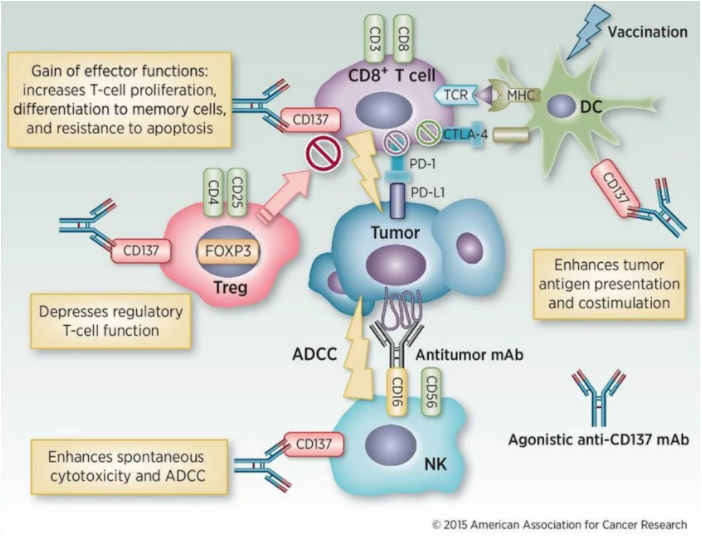
Immunomodulatory mechanism of 4-1BB (CD137)
As an excitatory receptor, 4-1BB mainly plays the role of "stepping on the accelerator", different from the "debraking" function of inhibitory receptors such as PD-1. Although their mechanisms are different, both of them can effectively enhance the antitumor activity of immune cells. But the development of drugs targeting 4-1BB has not been smooth sailing.
Monoclonal antibody development is limited by efficacy or toxicity
Urelumab is the first monoclonal antibody targeting 4-1BB to enter clinical trials. Developed by BMS, Urelumab is a fully human IgG4 monoclonal antibody that first entered human trials in 2005. In 2008, preliminary clinical data of Urelumab was released, showing good clinical efficacy. However, in phase I/II trials, Urelumab demonstrated targeted and dose-related hepatotoxicity, which hampered its clinical development.
Utomilumab is a humanized IgG2 monoclonal antibody targeting 4-1BB developed by Pfizer. The mechanism of action of Utomilumab is different from that of Urelumab. Utomilumab can not only activate 4-1BB, but also block the binding of 4-1BBL, so it has relatively mild excitability on immune cells and high safety. But clinical trials have shown that as a single agent, Utomilumab has limited antitumor activity.
To overcome the problem of efficacy and toxicity, researchers began to explore novel development strategies that maximized the stimulatory effects of 4-1BB while minimizing 4-1BB-induced toxicity. These strategies include intratumoral administration, bispecspecific antibodies, development of proteolytic activated antibodies, and FC-free design. Among them, the development of double, triple and quadruple antibodies is the mainstream of drug research and development targeting 4-1BB.
Double antibody research and development progress ahead
By having different affinity for surface targets of tumor cells and 4-1BB, bisspecific antibodies are expected to preferentially bind to surface targets of tumor cells, activate T cells, and kill tumor cells. By precisely targeting tumor cells, the effect of off-target toxicity is reduced and the efficacy and safety of drugs are improved. At present, targeting 4-1BB dual antibody research and development layout is enthusiastic, many domestic and foreign pharmaceutical companies have entered the bureau.
BioNTechSE and Genmab collaborated to develop GEN1046, a full-length IgG1 isoform of PD-L1×4-1BB dual antibody, based on Genmab's proprietary DuoBody technology platform generated by Fab arm exchange of monoclonal full-human PD-L1 and 4-1BB antibodies. The structure and pharmacokinetics of natural IgG were preserved. Preclinical studies showed that GEN1046 was able to bind both PD-L1 and 4-1BB expressed cells in a wide concentration range (0.01-1μg/mL).
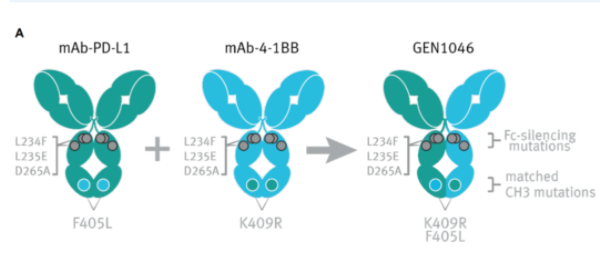
The structure of GEN1046
BT7480 is a tumor-targeting immune cell agonist developed by Bicycle Company using the unique bicyclic peptide technology. The dicyclic peptide molecule integrates the characteristics of antibodies, small molecule drugs and peptides, and has similar affinity and specificity to antibodies. Meanwhile, its peptide properties provide a regulated pharmacokinetic half-life and renal clearance pathway. BT7480 is conjured by three dicyclic peptides, one of which binds Nectin-4 and two of which binds 4-1BB(CD137).
Preclinical studies have shown that BT7480 can significantly stimulate immune cell invasion and eliminate Nectin-4 expressing tumors in animals without continuous administration.
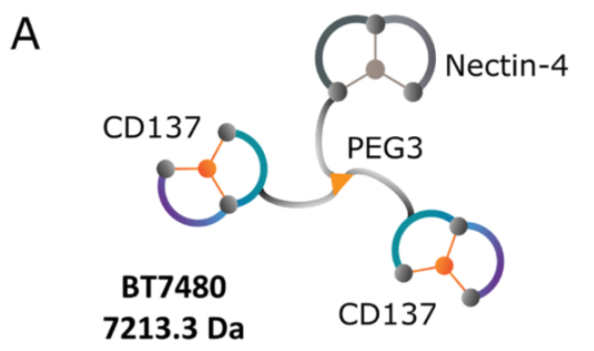
Structure diagram of BT7480
LBL-024 is a PD-L1/4-1BB double antibody developed by Welibo. It binds to PD-L1 in tumor microenvironment with high affinity, so that LBL-024 targets tumor cells, avoids peripheral activation of 4-1BB and reduces toxicity. After binding to PD-L1, it blocks PD-L1/PD-1 pathway. Remove the inhibition of PD-1 on immune cells.
At the same time, the co-stimulation effect of LBL-024 on 4-1BB depends on cross-linking. Only when LBL-024 binds to PD-L1 expressed on tumor cells, and binds to 4-1BB on immune cells at the same time to form cross-linking, can the 4-1BB pathway be activated.
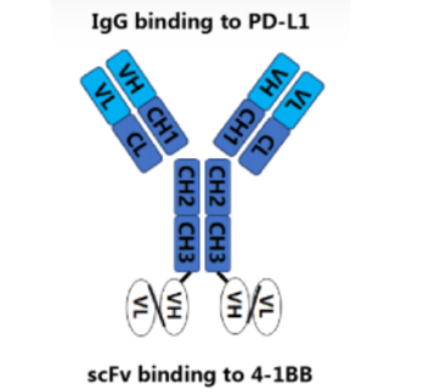
Structure diagram of LBL-024
LBL-024 is currently undergoing Phase I/II clinical trials to evaluate its safety, tolerability and initial efficacy in patients with advanced malignant tumors.
TJ-CD4B is a key product in the Celestial Bioinnovation dual antibody pipeline. It targets both Claudin18.2 and 4-1BB, and specifically binds to these two targets to increase lymphocyte tumor invasion and enhance tumor immune response. Preclinical studies have shown that TJ-CD4B can bind to tumor cells and produce good immune activity even with low expression of Claudin18.2. Based on the unique 4-1BB binding epitope, TJ-CD4B activates T cells only when it binds to Claudin18.2. Thus preventing the development of liver toxicity. TJ-CD4B is currently in Phase I clinical studies.
ATG-101 is a novel PD-L1/4-1BB double antibody developed by Deqi Pharmaceutical and Yuanqi Biology. Preclinical studies demonstrated strong antitumor activity in animal tumor models against PD-1/L1 relapse resistance, and demonstrated excellent safety in non-clinical study Quality Management Practice (GLP) toxicology studies. As Australia's first PD-L1/4-1BB dual antibody to enter the clinic, ATG-101 is currently undergoing clinical trials in Australia, China and the United States.
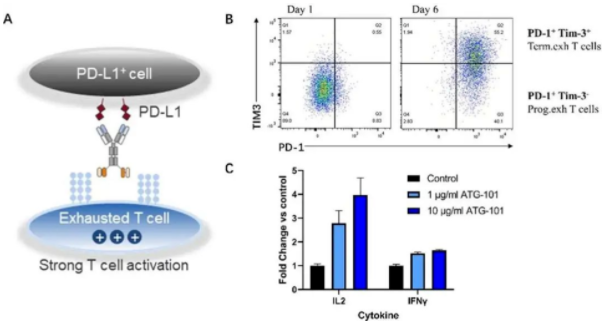
Preclinical efficacy of ATG-101
The three and four Resistances are gaining momentum
In addition to double-antibody drugs, domestic Keystone Biological and Baili Pharmaceutical have also developed three-antibody and four-antibody drugs targeting 4-1BB. NM21-1480 is a multi-specific antibody targeting PD-L1, 4-1BB and HSA developed by Keystone Pharmaceutical. NM21-1480 binds to the unique epitope of 4-1BB only when it binds to PD-L1 on the surface of tumor cells, thus activating T cells and killing tumor cells while avoiding liver toxicity problems associated with traditional 4-1BB agonist mab. In addition, NM21-1480's unique unit price structure and ultra-high affinity for PD-L1 are expected to reduce the frequency of drug administration in patients and overcome clinical problems such as primary and secondary resistance to PD-1/PD-L1 antibodies.
GNC-038 is a four-specific "targeted immunity" antibody developed by Baili Pharmaceutical. It has four domains targeting CD19, CD3, PD-L1 and 4-1BB. It can activate the first and second signals of T cells to target and kill tumor cells through the anti-CD19 and PD-L1 domains.
GNC-039 is also a four-specific antibody that binds to EGFR, PD-L1, CD3, and 4-1BB simultaneously. It can stimulate the formation of specific tumor immune lethality, and it is also expected to penetrate the blood-brain barrier and overcome the heterogeneous expression of tumor targets.
GNC-035 can simultaneously bind to four targets of ROR1, PD-L1, CD3 and 4-1BB to stimulate the body to form specific tumor targeted immune killing, maintain the killing ability of tumor cells for a long time, and reverse the inhibitory tumor immune microenvironment. All three drugs are currently in phase I.
In addition to double-antibody drugs, domestic Keystone Biological and Baili Pharmaceutical have also developed three-antibody and four-antibody drugs targeting 4-1BB. NM21-1480 is a multi-specific antibody targeting PD-L1, 4-1BB and HSA developed by Keystone Pharmaceutical. NM21-1480 binds to the unique epitope of 4-1BB only when it binds to PD-L1 on the surface of tumor cells, thus activating T cells and killing tumor cells while avoiding liver toxicity problems associated with traditional 4-1BB agonist mab. In addition, NM21-1480's unique unit price structure and ultra-high affinity for PD-L1 are expected to reduce the frequency of drug administration in patients and overcome clinical problems such as primary and secondary resistance to PD-1/PD-L1 antibodies.
GNC-038 is a four-specific "targeted immunity" antibody developed by Baili Pharmaceutical. It has four domains targeting CD19, CD3, PD-L1 and 4-1BB. It can activate the first and second signals of T cells to target and kill tumor cells through the anti-CD19 and PD-L1 domains.
GNC-039 is also a four-specific antibody that binds to EGFR, PD-L1, CD3, and 4-1BB simultaneously. It can stimulate the formation of specific tumor immune lethality, and it is also expected to penetrate the blood-brain barrier and overcome the heterogeneous expression of tumor targets.
GNC-035 can simultaneously bind to four targets of ROR1, PD-L1, CD3 and 4-1BB to stimulate the body to form specific tumor targeted immune killing, maintain the killing ability of tumor cells for a long time, and reverse the inhibitory tumor immune microenvironment. All three drugs are currently in phase I.
Summary
4-1BB is a classic inflammatory immune checkpoint target, although the development of its monoclonal antibody has been hindered by efficacy and hepatotoxicity. However, some achievements have been made in the development of a new generation of 4-1BB agonists based on maximizing excitability and minimizing toxicity. It is expected that further breakthroughs in this target will be made in the future to open up a new path for tumor immunotherapy.
4-1BB is a classic inflammatory immune checkpoint target, although the development of its monoclonal antibody has been hindered by efficacy and hepatotoxicity. However, some achievements have been made in the development of a new generation of 4-1BB agonists based on maximizing excitability and minimizing toxicity. It is expected that further breakthroughs in this target will be made in the future to open up a new path for tumor immunotherapy.

You May Interested In


High Quality β-Nicotinamide adenine dinucleotide CAS 53-84-9 NADwith ready stock and best price
$3E+1/UNIT FOB


2026-10-21
Trade Alert
Delivering the latest product trends and industry news straight to your inbox.
(We'll never share your email address with a third-party.)

Related News
-
The world's first! FDA approves new drug for type 1 diabetes
-
Out of money? Another Biotech sold the plant at a loss and announced its entry into the CRO
-
The World's First CD20/CD3 Double Antibody Was Approved for Marketing
-
Roche says antibody test for COVID-19 should be ready in May
-
India Prepares New Seed and Pesticide Laws
-
The Carbon Tollbooth Is Open: EU’s CBAM Ushers in a New Era of Climate-Linked Trade
-
Sherwin-Williams Surpasses $100 Billion in Market Cap: Is This the ‘Apple Moment’ for Paint, or America’s Industrial ‘One Hundred Years of Solitude’?
-
G20 Pushes Fertilizer Access as Food-Security Risk Rises
-
Carbon Fiber’s Price Surge Signals a New Era of Strategic Value—and Supply Tension
-
South Korea Retires 1.39 Million Tonnes of Ethylene Capacity as Northeast Asia’s Petrochemical Reset Turns Real
Recommend Reading
-
![Domo Chemicals’ German Subsidiary Insolvencies: Energy Costs, Weak Demand and Chinese Nylon Competition]()
Domo Chemicals’ German Subsidiary Insolvencies: Energy Costs, Weak Demand and Chinese Nylon Competition
-
![US-Iran Conflict Escalates Again as Oil Tops $90 and Petrochemical Feedstock Risks Return]()
US-Iran Conflict Escalates Again as Oil Tops $90 and Petrochemical Feedstock Risks Return
-
![Saudi Aramco Weighs Discounts of Up to $9/Barrel on Oman STS Crude as Freight Costs Surge]()
Saudi Aramco Weighs Discounts of Up to $9/Barrel on Oman STS Crude as Freight Costs Surge
-
![Death Toll from Fire at China-Russia Amur Polyolefins Project Rises to 15 as Construction Continues]()
Death Toll from Fire at China-Russia Amur Polyolefins Project Rises to 15 as Construction Continues
-
![The US Fertilizer Probe Is About More Than Pricing — It Is About Power]()
The US Fertilizer Probe Is About More Than Pricing — It Is About Power
-
![Fundamentals of Supply and Demand Weaken, August Phenol Market Trends Downward in China]()
Fundamentals of Supply and Demand Weaken, August Phenol Market Trends Downward in China
-
![This Week PVC Continues to Fall, Short-term Market May Maintain Range-bound Fluctuations]()
This Week PVC Continues to Fall, Short-term Market May Maintain Range-bound Fluctuations
-
![In August, the epoxy resins market in China remained stable within a narrow range with weak supply and demand on both sides]()
In August, the epoxy resins market in China remained stable within a narrow range with weak supply and demand on both sides
-
![Business Society October 8, 2026 Adipic Acid Trend Analysis: Volatility]()
Business Society October 8, 2026 Adipic Acid Trend Analysis: Volatility
-
![A New Weapon Against Spider Mites: Canada Moves to Approve Novel Miticide for Greenhouse Growers]()
A New Weapon Against Spider Mites: Canada Moves to Approve Novel Miticide for Greenhouse Growers