




What is Cellulose Ether?
Cellulose ether is the powdered cellulose ether generated with wood fiber or refined short cotton fiber as the main raw materials, after chemical treatment and by the reaction of etherifying agents such as chlorinated ethylene, chlorinated propylene and oxidized ethylene.
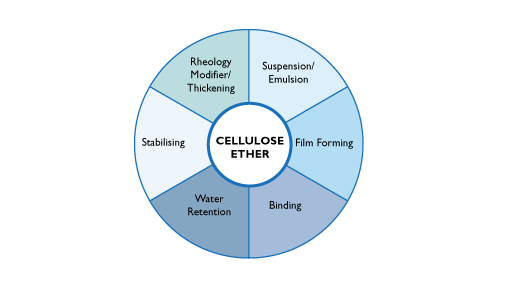
The production process of cellulose ether is complex. It starts with the extraction of cellulose from cotton or wood, which then transforms into alkaline cellulose after adding sodium hydroxide and by chemical reaction (alkaline solution). Under the action of etherifying agents (etherification reaction), cellulose ethers are generated from alkaline cellulose through such processes as washing with water, drying and grinding.

Different etherifying agents can turn alkaline cellulose into different types of cellulose ethers. The molecular structure of cellulose is composed of the molecular bonds of dehydrated glucose units. Each glucose unite contains three hydroxyl groups. Under certain conditions, the hydroxyl groups will be substituted by methyl, hydroxyethyl, hydroxypropyl and the like groups, and can form cellulose of different varieties (for example, if substituted by methyl, then it is called methyl cellulose; if substituted by hydroxyethyl, then it is called hydroxyethyl cellulose; if substituted by hydroxypropyl, then it is called hydroxypropyl cellulose). Since methyl cellulose is a mixed ether produced by the etherification reaction, with methyl as the main material but containing a small amount of hydroxyethyl or hydroxypropyl, it is called methyl hydroxyethyl cellulose ether or methyl hydroxypropyl cellulose ether.

Due to the difference in the substituents (such as methyl, hydroxyethyl and hydroxypropyl) and the difference in the degree of substitution (the amount of substituted substance of reactive hydroxyl in each cellulose), cellulose ethers of different varieties and grades can be obtained. Different varieties can be widely used in construction, food and pharmaceutical industries, as well as other different fields such as daily chemical industry and petroleum industry.
Cellulose ethers used in the building materials are mainly methyl cellulose ether (MC), hydroxypropyl methyl cellulose ether (HPMC), hydroxyethyl methyl cellulose ether (HEMC), hydroxyethyl cellulose ether (HEC), hydroxyethyl ethy cellulose ether (EHEC), etc. Among them, HPMC and HEMC have been widely used in dry mixed mortar products due to their excellent characteristics.

You May Interested In


High Quality β-Nicotinamide adenine dinucleotide CAS 53-84-9 NADwith ready stock and best price
$3/UNIT FOB


2026-10-15
Trade Alert
Delivering the latest product trends and industry news straight to your inbox.
(We'll never share your email address with a third-party.)

Related News
-
Fluorine-Free Superhydrophobic Coating Made from Cellulose Nanofibrils
-
What is Modified Cellulose? Uses, Health Risks
-
What is Cellulose Gum? Risks, Benefits, and Uses
-
What is the Commonality of Cellulose Ether?
-
What is the Commonality of Cellulose Ether?
-
Cellulose in Food: The Importance, Sources, and Benefits of this Essential Dietary Fiber
-
How To Make Ether? Step By Step Guide On Making Ether
-
Japanese Plastics Market Accelerates its Shifts to Recycled Materials and Bioplastics
-
German Chemical Sentiment Hits a Three-Year Low: Supply Disruption Amplifies Pressure on European Manufacturing
-
Asia’s Plastics Chain Faces a Shock: Tight Naphtha Supply Drives Up Polymer Costs
Recommend Reading
-
![EU Chemical Antidumping Complaints Hit a Record High: Trade Remedies Reshape Export Competition]()
EU Chemical Antidumping Complaints Hit a Record High: Trade Remedies Reshape Export Competition
-
![New York’s Additive Ban Signals a Tougher Era for Food Formulation]()
New York’s Additive Ban Signals a Tougher Era for Food Formulation
-
![Retinol in Cosmetics: Regulatory Tightening and Market Changes]()
Retinol in Cosmetics: Regulatory Tightening and Market Changes
-
![China, U.S. and Australia Escalate Antidumping Scrutiny: Chemical Exports Face Rising Compliance Pressure]()
China, U.S. and Australia Escalate Antidumping Scrutiny: Chemical Exports Face Rising Compliance Pressure
-
![US-Iran Conflict Escalates Again as Oil Tops $90 and Petrochemical Feedstock Risks Return]()
US-Iran Conflict Escalates Again as Oil Tops $90 and Petrochemical Feedstock Risks Return
-
![Business Society’s Market Outlook for Heavy-Weight Pure Soda Ash on September 1, 2026: Volatile]()
Business Society’s Market Outlook for Heavy-Weight Pure Soda Ash on September 1, 2026: Volatile
-
![A New Weapon Against Spider Mites: Canada Moves to Approve Novel Miticide for Greenhouse Growers]()
A New Weapon Against Spider Mites: Canada Moves to Approve Novel Miticide for Greenhouse Growers
-
![Rubber Sector Rises Across the Board in August]()
Rubber Sector Rises Across the Board in August
-
![Business Society September 21, 2026 BDO Trend Analysis: Volatile Consolidation]()
Business Society September 21, 2026 BDO Trend Analysis: Volatile Consolidation
-
![In August, the epoxy resins market in China remained stable within a narrow range with weak supply and demand on both sides]()
In August, the epoxy resins market in China remained stable within a narrow range with weak supply and demand on both sides










- Hot Searches
- aluminum cholride
- chemical suppliers & distributors
- fornaldehyde
- sodium tolyltriazole sds
- disodium octaborate tetrahydrate distributor
- pvc prices
- mono propylene glycol for sale
- msds of acetaminophen
- ethylene vinyl acetate price
- uranium hexafluoride
- request for order fl 300
- retatrutide buy online usa