Tempest Therapeutics' Breakthrough in Liver Cancer Treatment Sends Stock Soaring
On October 11th, Tempest Therapeutics made a groundbreaking announcement regarding their Phase Ib/II study on TPST-1120, a PPAR⍺ antagonist, for patients with unresectable or metastatic hepatocellular carcinoma (HCC). The study results demonstrated a significant improvement in both patient survival and treatment response.
The data release had an immediate impact on Tempest's stock, with shares skyrocketing by nearly 4000% during trading. According to SeekingAlpha, the company's stock opened at $2.13 and closed at $9.77 on the same day.
TPST-1120, an oral small molecule candidate, acts by blocking the transcription factor PPAR⍺, which is overexpressed in various cancers, including hepatocellular carcinoma, cholangiocarcinoma, and renal cell carcinoma. It is the flagship product in Tempest Therapeutics' pipeline.
HCC is an aggressive cancer, with over 900,000 people worldwide diagnosed each year. The mortality rate of HCC is steadily rising, and it is projected to become the third leading cause of cancer-related deaths by 2030.
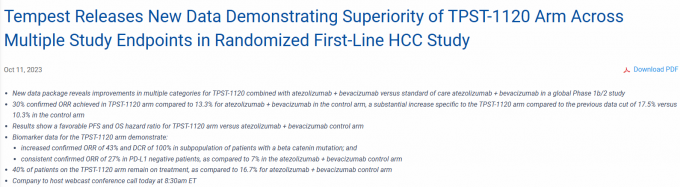
The new data on TPST-1120 emerged from a Phase 1b/2 randomized study that evaluated the combination of TPST-1120 with Roche's Avastin (bevacizumab) and Tecentriq (atezolizumab) compared to the standard therapy involving Avastin and Tecentriq alone.
Patients treated with the TPST-1120 combination therapy achieved a confirmed objective response rate (cORR) of 30%, surpassing the primary endpoint of the study. This cORR was more than double the 13.3% cORR observed in patients receiving standard treatment.

Overall survival (OS) was a key secondary endpoint of the study. After a follow-up of 9.2 months, the TPST-1120 treatment group showed a median progression-free survival (PFS) of 7 months, while the control group had a PFS of 4.27 months during a 9.9-month follow-up. The TPST-1120 group has not yet reached the median overall survival, whereas the standard treatment group had a median overall survival of 15.1 months.
According to Tempest's announcement, the hazard ratios for PFS and OS with TPST-1120 were 0.7 and 0.59, respectively. However, these data are not yet mature enough to assess their significance. TPST-1120 demonstrated a favorable safety profile, with a comparable incidence of adverse events between the two treatment groups.
Stephen Brady, CEO of Tempest, stated in a press release that the disclosed study results, including more mature clinical data, validate the superiority of the TPST-1120 triplet therapy over earlier interim analyses. Tempest previously released preliminary results of this study in April 2023, but a significant portion of response rate data was unconfirmed at that time.
Stephen further mentioned that based on these study findings, Tempest is currently planning to advance TPST-1120 into pivotal research.
Prior to this announcement, Tempest's board of directors approved a "poison pill" shareholder rights plan, which automatically activates if existing major shareholders increase their stakes or new shareholders acquire 10% of the company's shares. This defensive strategy, commonly known as a "poison pill," aims to counter potential acquisition threats.
In conclusion, Tempest Therapeutics' breakthrough in liver cancer treatment with TPST-1120 has shown remarkable clinical outcomes, leading to a surge in their stock value. The company's commitment to advancing innovative therapies for challenging cancers positions them as a significant player in the field of oncology research and development.

You May Interested In


High Quality β-Nicotinamide adenine dinucleotide CAS 53-84-9 NADwith ready stock and best price
$3/UNIT FOB


2026-10-15
Trade Alert
Delivering the latest product trends and industry news straight to your inbox.
(We'll never share your email address with a third-party.)

Related News
-
China’s Acrylic Emulsion Leaders Raise Prices by Up to 15% as Monomer Costs Surge
-
FDA Approves Lantheus’ TAUKLARIFY for Alzheimer’s Tau PET Imaging
-
Moldova Proposes Stricter Quality Standards for Edible Casein and Caseinates
-
FDA Grants Accelerated Approval to Bristol Myers Squibb’s ZENBEXUS, Launching First CELMoD Therapy in Multiple Myeloma
-
EU mulls expanding tariff scope on Chinese chemicals, sector-wide measures in the pipeline
-
BASF Raises European NPG and HDO Prices by Up to €300/Tonne as Costs Climb
-
Hormuz Is Reopening, But Chemical Logistics May Take Months to Recover
-
EU Authorises Propionic Acid and Its Salts as Feed Additives Until 2035
-
Strides Pharma Reports Strong Q2 as Net Profit Surges 82%
-
SIBUR’s Massive Siberian Petrochemical Complex Shuts After Drone Attack, LPG Supply Disrupted
Recommend Reading
-
![India Strengthens Drug Approval Oversight with Expanded CDSCO Powers]()
India Strengthens Drug Approval Oversight with Expanded CDSCO Powers
-
![Libya’s Largest Refinery Faces Full Shutdown After Five Rounds of Airstrikes]()
Libya’s Largest Refinery Faces Full Shutdown After Five Rounds of Airstrikes
-
![EFSA Renews Authorisation of Inositol for Use in Fish and Crustacean Feed]()
EFSA Renews Authorisation of Inositol for Use in Fish and Crustacean Feed
-
![EFSA Reports Avian Influenza Situation in Europe and Human Cases in Asia]()
EFSA Reports Avian Influenza Situation in Europe and Human Cases in Asia
-
![Canada Launches Re-Evaluation of Herbicide Iodosulfuron-Methyl-Sodium]()
Canada Launches Re-Evaluation of Herbicide Iodosulfuron-Methyl-Sodium
-
![Price Cuts and Weak Demand Create Tension as October PC Prices Rise, Then Retreat]()
Price Cuts and Weak Demand Create Tension as October PC Prices Rise, Then Retreat
-
![Fundamental Factors Fail to Deliver Positive Momentum; October ABS Prices Gradually Decline]()
Fundamental Factors Fail to Deliver Positive Momentum; October ABS Prices Gradually Decline
-
![In October, the Chinese marine fuel market trended downward with fluctuations]()
In October, the Chinese marine fuel market trended downward with fluctuations
-
![Consumption Fails to Match High Supply, October PP Refutes Peak Season Trend in China]()
Consumption Fails to Match High Supply, October PP Refutes Peak Season Trend in China
-
![This week, the Chinese propylene oxide market showed a trend of surging and then retreating (6.15-6.18)]()
This week, the Chinese propylene oxide market showed a trend of surging and then retreating (6.15-6.18)