“Anti-Overcapacity” Backfires: China’s Chemical Industry Trapped in a Hell of Its Own Making—and Global Pushback
In early 2026, China’s chemical sector stands at the epicenter of a silent storm. On one side, Beijing loudly champions its “anti-overcapacity” campaign, urging firms to voluntarily cut output and exit low-end competition. On the other, harsh reality bites: profits have slumped for three straight years, product price indices have plunged by 36%, and exports are now facing a global wall of anti-dumping probes. This is no mere cyclical downturn—it’s a full-blown structural crisis, with China’s chemical industry being strangled from within by its own excess capacity and from without by systemic global rejection.
On the surface, the problem seems simple: too many players chasing the same market. From basic organic intermediates to engineering plastics, from fertilizers to dyes, China long ago solved the question of “whether we can produce.” Now it faces a far more painful dilemma: “We produce so much that no one can sell anything profitably.” According to China’s National Bureau of Statistics, while industrial profits rose modestly by 1.9% year-on-year in the first ten months of 2025, the chemical raw materials and products manufacturing sector saw profits drop by 5.4%, totaling just $43 billion. Even more alarming, China’s chemical product price index has fallen for three consecutive years, cumulatively down nearly 36%. In plain terms: the more you sell, the more you lose.
The root cause lies in the investment frenzy of the past four years. As data from CITIC Securities shows, fixed asset investment in chemicals surged between 2021 and 2024. Although growth slowed in 2025, new capacity continues to flood the market. In the words of Cinda Securities analyst Zhang Yansheng: “The capacity expansion cycle hasn’t run its course yet.” Put bluntly, today’s losses are the inevitable reckoning for yesterday’s reckless project approvals.
And yet, the much-touted “anti-overcapacity” policy—launched with fanfare in early 2025—has proven largely performative. In March, top leaders explicitly called for curbing “low-end repetitive construction” and pushing “high-quality development.” Markets briefly rallied: caprolactam, a key nylon intermediate, jumped ~5% in November after major producers jointly cut output by 20%; the industry prosperity index even climbed above 100 for two months (August–October). But this was nothing more than a fleeting last gasp. By November, the index had tumbled back to 97.21, re-entering contraction territory.
Why does “anti-overcapacity” fail to take hold? Guangzhou New Energy Industry Association Secretary-General Qiu Dengke cuts to the chase: “Few companies are willing to unilaterally reduce output and hand market share to rivals—especially in fragmented sectors dominated by thousands of small and medium enterprises.” The chemical industry is hyper-fragmented, and local protectionism runs deep. For provincial governments, shutting plants means lost tax revenue, rising unemployment, and damaged political performance metrics. Thus, “anti-overcapacity” becomes empty rhetoric—a prisoner’s dilemma where “whoever cuts first loses.”
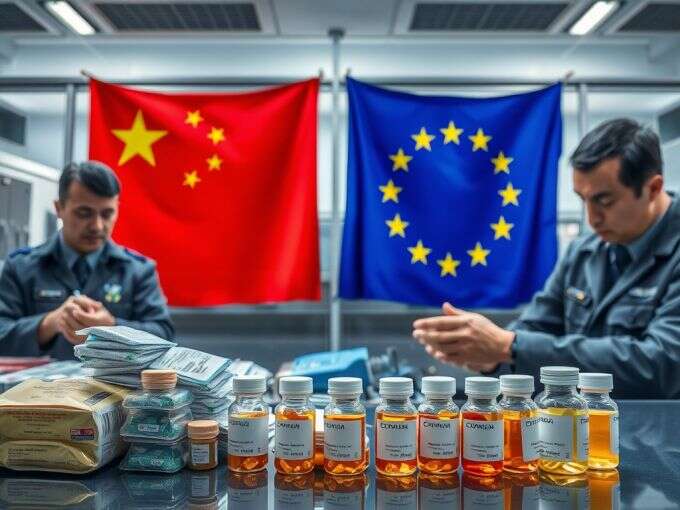
Even more ominous is the rapidly deteriorating external environment. In recent years, surging chemical exports served as a critical pressure valve for domestic overcapacity. But this escape route is slamming shut. The U.S., EU, Japan, and others are aggressively launching anti-dumping investigations, imposing local content rules, and erecting “green barriers” like carbon tariffs. Global buyers’ perception of Chinese chemicals has shifted from “cheap and reliable” to “risky and unwelcome.” Qiu warns: “2026 will bring even more trade friction and market access restrictions.”
Ironically, amid this gloom, bright spots do exist—demand for new energy-related materials remains robust. Specialty chemicals for EVs, solar panels, batteries, and high-performance fibers grew over 8% in 2025. This should be China’s golden path to transformation. Yet danger looms: these “new tracks” are repeating the old mistakes at breakneck speed.
“The capacity expansion in new chemical materials is extremely aggressive,” Qiu cautions. “Without strict—even punitive—government measures to curb blind investment, this sector will soon drown in overcapacity too.” History is repeating itself with eerie precision: yesterday it was base chemicals; today it’s battery materials. Capital’s profit-chasing instinct ensures every opportunity quickly becomes a bloodbath.
To grasp the depth of this crisis, one must look beyond China’s borders. Take Europe: on Christmas Eve 2025, Belgium’s Domo Chemicals filed for insolvency of its three German subsidiaries—a shockwave through the industry. While high energy costs were the official culprit, the real killer was relentless pressure from low-priced Chinese imports. European phenol and acetone prices collapsed by 49% and 61.5% respectively over 20 months, while production costs remain 45% higher than in the Middle East. China, leveraging coal-based chemistry, massive scale, and ultra-low input costs, has waged an asymmetric war.
The table below starkly illustrates the cost chasm across the global nylon value chain:
| Region | Caprolactam Production Cost (USD/ton) | Energy Cost Share | Primary Feedstock Route | Carbon Cost Pressure |
|---|---|---|---|---|
| Northwest China | ~1,050 | 18% | Coal-based | Low |
| Middle East | ~980 | 12% | Natural Gas | Very Low |
| U.S. Gulf Coast | ~1,150 | 22% | Ethane Cracking | Medium |
| Europe | ~1,650 | 35%+ | Naphtha Cracking | Very High |
This table reveals a brutal truth: Europe’s agony is the mirror image of China’s advantage. While Europe pays a premium for decarbonization, China’s coal-driven model undercuts global markets. But this edge is becoming a double-edged sword—the world is now redefining China’s “low cost” as “unfair competition” through trade remedies and green regulations.
Back home, the real solution isn’t just “cutting a little output”—it’s “choosing a different path.” The industry’s gravest misconception is equating “high-end” with merely “making new materials.” True high-end means technological moats, patent fortresses, and irreplaceable solution capabilities. Yet many so-called “advanced projects” are just rebranded capacity expansions with zero core innovation.
A deeper structural flaw is fragmentation. China has countless chemical firms—but none with the scale and integration of BASF or Dow. SMEs, fighting for survival, are trapped in price wars and lack resources for long-term R&D. Without consolidation, there’s no pricing power; without pricing power, the industry remains stuck in a low-end trap forever.
The future is already here—and it’s hostile. In 2026, China’s chemical sector faces a triple squeeze: weak domestic demand, blocked exports, and relentless new capacity. Without decisive action—using market mechanisms to cull zombie firms and state-backed support to build globally competitive champions—the “anti-overcapacity” drive will remain hollow political theater.
This capacity inferno is burning not just corporate profits, but the entire industry’s future. Only through fire can rebirth occur—but first, someone must dare to switch off the reactors that never stop running.

You May Interested In


High Quality β-Nicotinamide adenine dinucleotide CAS 53-84-9 NADwith ready stock and best price
$3E+1/UNIT FOB


2026-10-27
Trade Alert
Delivering the latest product trends and industry news straight to your inbox.
(We'll never share your email address with a third-party.)

Related News
-
Kemira Acquires AquaBlue
-
Uzbekistan Bets $17 Billion on Chemical Industry Upgrade
-
US MDI Supply Squeeze Triggers Price Hikes
-
ADNOC Reroutes Naphtha via Oman to Bypass Hormuz Risk
-
Tinci Materials Calls Off 2.65 Billion Yuan Project as Electrolyte Giant Shifts Strategy
-
Eastern Shenghong Projects First-Half Profit of 5 Billion Yuan – A Collective Turnaround for the Four Major Private Refiners? Is the Chemical Sector Rebounding?
-
End of an Era: KDC/One to Close 150-Year-Old Somerset Cosmetics Factory as Production Shifts to Scotland
-
Phillips 66 Locks Out 385 Workers at 275,000-bpd Bayway Refinery
-
SK Chemicals Partners with China’s Kelinle to Build Its Own Waste-Plastic Supply Network
-
BASF Raises European NPG and HDO Prices by Up to €300/Tonne as Costs Climb
Recommend Reading
-
![Japan Extends Bisphenol A Anti-Dumping Probe, Prolonging Uncertainty for Korean and Taiwanese Suppliers]()
Japan Extends Bisphenol A Anti-Dumping Probe, Prolonging Uncertainty for Korean and Taiwanese Suppliers
-
![Toxic Ammonia Leak Prompts Emergency Response in Mississippi]()
Toxic Ammonia Leak Prompts Emergency Response in Mississippi
-
![EU Blocks Entry of Chinese Food Supplement Due to Unauthorized Ingredient]()
EU Blocks Entry of Chinese Food Supplement Due to Unauthorized Ingredient
-
![Lanxess Reports Challenging Third Quarter Amid Weak Global Demand and Geopolitical Uncertainty]()
Lanxess Reports Challenging Third Quarter Amid Weak Global Demand and Geopolitical Uncertainty
-
![Sika Undertakes Structural Adjustments Amid Weak Markets]()
Sika Undertakes Structural Adjustments Amid Weak Markets
-
![Monthly Drop Nears 5%! Acrylic Acid Prices Fall Below Average, Decline Officially Confirmed]()
Monthly Drop Nears 5%! Acrylic Acid Prices Fall Below Average, Decline Officially Confirmed
-
![Glycopyrronium: Pharmaceutical Applications, Mechanism, and Chemical Specs]()
Glycopyrronium: Pharmaceutical Applications, Mechanism, and Chemical Specs
-
![US-Iran Signals Easing, Plasticizer Supply Chain Stabilizes]()
US-Iran Signals Easing, Plasticizer Supply Chain Stabilizes
-
![Both Costs and Consumption Weak, ABS Continues to Decline]()
Both Costs and Consumption Weak, ABS Continues to Decline
-
![Returning to Fundamentals: Ethylene Glycol Prices in April Show Volatile and Weak Trends]()
Returning to Fundamentals: Ethylene Glycol Prices in April Show Volatile and Weak Trends