“Shutdown Equals Price Hike”: TDI Market Enters a New Era of “Scarcity Games”
At the start of 2026, what appeared to be routine equipment glitches are quietly reshaping the power dynamics of the global polyurethane value chain. Korea’s Hanwha halted its 150,000-ton-per-year TDI plant on January 2 due to raw material shortages; Wanhua Chemical’s Xinjiang facility in China experienced unexpected operational fluctuations, forcing an emergency shutdown for about a week; and Covestro’s massive 310,000-ton Shanghai plant has already been offline since early December 2025 for an extended maintenance cycle. These seemingly minor operational hiccups—once confined to internal corporate affairs—are now triggering domino effects, pushing TDI prices to their highest levels in nearly three years: from around RMB 13,600/ton in late November to over RMB 14,500/ton by early January. This is not merely a temporary supply-demand mismatch—it’s a structural rally fueled by capacity concentration, supply chain fragility, and self-fulfilling market expectations.
TDI (Toluene Diisocyanate) is a cornerstone raw material in the polyurethane industry, essential for flexible and rigid foams, coatings, adhesives, and elastomers. It functions as both the “nerve ending” of advanced manufacturing and the “invisible backbone” of consumer markets. Yet over the past decade, the global TDI landscape has undergone dramatic consolidation and geographic shift. The once-decentralized production model dominated by Europe, the U.S., and Japan is now being overtaken by super-scale capacity centered in China. As of late 2025, global TDI capacity stood at approximately 7.5 million tons per year, with China accounting for over 45%. Wanhua Chemical alone commands nearly 15% of global capacity. In such a “one-superpower, few-strong” structure, any single plant disruption can send shockwaves across the entire market.

The current price surge is a direct manifestation of this reality. When three of the world’s top five producers simultaneously face unplanned outages or scheduled turnarounds, panic-driven restocking becomes inevitable. Even more critical is that these shutdowns are not isolated—they compound a months-long backdrop of deliberate capacity rationalization.
Tracing back, the global TDI market entered a destocking phase as early as Q3 2025. In Europe, while Covestro’s Dormagen plant has resumed full operations, the company’s long-term strategy indicates a gradual exit from certain legacy businesses over the next two years. In the Americas, BASF’s Louisiana and Texas plants remain stable, but the parent company has clearly redirected investment toward high-performance materials. Meanwhile, smaller players in India (GNFC), Japan (MCNS), and Saudi Arabia (Bandarlima) have either cut runs or operated at minimal load. Behind this trend lies a collective strategic pivot among global chemical giants toward “lean operations”—prioritizing margin optimization over volume expansion.
Against this backdrop, China stands as the only region still adding net capacity. But ironically, this “incremental supply” has not eased tightness; instead, intensified internal competition has driven down overall operating rates. For instance, Wanhua’s Fujian complex—nominally 720,000 tons/year—has consistently run below 80% utilization due to environmental constraints, fragmented downstream demand, and internal coordination challenges. The Xinjiang Jili 200,000-ton plant, meanwhile, suffers chronic logistical bottlenecks and inadequate raw material integration. When an unplanned outage hits, the entire northwestern supply network collapses instantly.
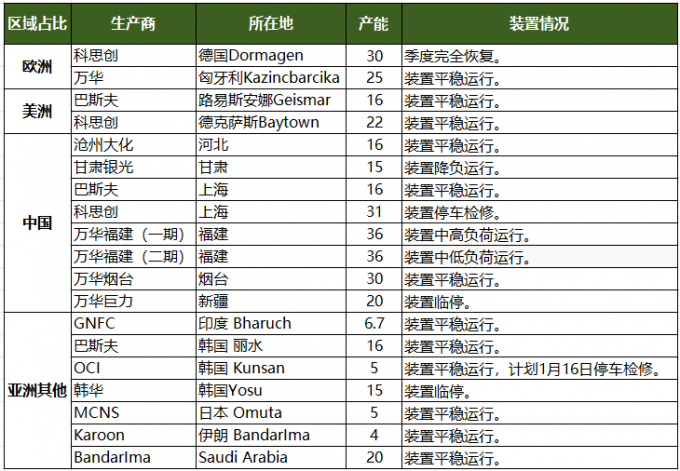
This table reveals a startling truth: the “availability” of effective global TDI capacity is rapidly declining. Despite massive nominal capacity, only a handful of plants reliably deliver consistent output. In Asia especially, the market hinges on just a few key facilities—Wanhua Fujian, BASF Shanghai, and Covestro Shanghai. Any hiccup among them triggers immediate price spikes.
More profoundly, TDI pricing is shifting from a “cost-plus” model to a “supply-plus-expectation” model. Historically, TDI prices were driven primarily by feedstock costs (aniline and toluene), adjusted for marginal profit. Today, with highly concentrated capacity and most plants integrated into large complexes, producers increasingly manipulate operating rates to shape market sentiment. For example, throughout Q4 2025, Wanhua repeatedly announced “unplanned maintenance”—ostensibly technical, but effectively stress-testing the market’s sensitivity to supply tightness. Once prices rose, it swiftly resumed operations, creating a “ramp-up–pullback–ramp-up again” cycle.
This strategy works because of two key conditions: first, downstream customers lack viable alternatives; second, international buyers remain deeply dependent on Chinese supply. Data shows China’s TDI exports surged 18% year-on-year in 2025, accounting for 32% of global trade volume. This means even as domestic prices soar, overseas buyers still accept premiums—especially in Southeast Asia, the Middle East, and Africa, where Chinese products dominate on cost-performance.
Moreover, a striking new dynamic is emerging: robust exports are exacerbating domestic tightness. In H2 2025, as inflation eased in the West and automotive/appliance sectors recovered, Chinese TDI export orders surged. Trading firms report widespread pre-booking and vessel slot locking by overseas clients. This not only depletes inventories meant for domestic distribution but also forces producers to prioritize export shipments, further squeezing local availability.
Thus, we witness a paradoxical scene: on one side, domestic end-users complain they “can’t find product”; on the other, container yards at ports overflow with TDI waiting for export. This “domestic-export inversion” exposes the structural contradictions of global supply chains under stress.
Looking ahead, can balance return to the TDI market? It hinges on three factors: first, whether Wanhua Xinjiang and Hanwha resume on schedule; second, whether Covestro Shanghai’s turnaround extends; third, whether any new capacity comes online. Currently, no new projects are imminent, and restart timelines remain uncertain—especially as Hanwha plans another routine turnaround on January 16. Any delay would deepen market anxiety.
More importantly, this “shutdown-equals-price-hike” game is reshaping industry behavior. Downstream players are reassessing supply chain resilience, considering strategic stockpiling or alternative chemistries. Upstream producers, meanwhile, are prioritizing “controllability” over scale—and even engineering “scarcity” to maintain pricing power.
The future TDI market will no longer be a simple price tug-of-war, but a multidimensional contest over information transparency, operational flexibility, and global coordination capability. Whoever masters rhythm amid uncertainty will command influence. And for buyers still hoping for “cheap deals,” they may have already missed the last window of the bargain era.
When every shutdown becomes a reason to raise prices, and every factory a barometer of market sentiment, the world of TDI is no longer a product of chemical reactions—but a chessboard of capital and control.

You May Interested In


Glow70/KLOW80 99% China Peptides Warehouse Direct Delivery Lyophilized Powder in Stock
$169/UNIT FOB


2026-10-24
Trade Alert
Delivering the latest product trends and industry news straight to your inbox.
(We'll never share your email address with a third-party.)

Related News
-
COSMAX Acquires 51% Stake in Keminova, Establishes First European Production Base
-
Can the Manufacturing Sector Withstand Dow’s April Polyethylene Price Doubling?
-
Merck to Lay Off 150 Workers at US Gardasil Plant Amid Sales Weakness
-
BASF Launches Global Expansion Plan for Aroma Ingredients
-
BASF Launches Global Expansion Plan for Aroma Ingredients
-
Shell Polymers Explosion Caused About $95 Million in Damage, U.S. CSB Finds
-
Wanhua Chemical Establishes a RMB 1.488 Billion New Energy Materials Company in Weifang, Further Integrating Green Power and Battery Materials Businesses
-
Indorama Secures RMB 2.4 Billion Loan to Expand Urea Capacity in Anyang
-
Supply Chain Resilience Reshapes Chemical Competition: What Lies Behind BASF’s Stable Outlook
-
Beiersdorf Launches Eucerin Skincare Brand in Japan
Recommend Reading
-
![Geopolitical Conflict Drives Up Chemical Costs: The Industry Signal Behind DuPont’s Upgraded Outlook]()
Geopolitical Conflict Drives Up Chemical Costs: The Industry Signal Behind DuPont’s Upgraded Outlook
-
![BASF's Intensified Moves from May to June: Plant Closures, Divestitures, and Transformation in Sync]()
BASF's Intensified Moves from May to June: Plant Closures, Divestitures, and Transformation in Sync
-
![China-Saudi Gulei RMB 44.8 Billion Petrochemical Project to Start Production Soon]()
China-Saudi Gulei RMB 44.8 Billion Petrochemical Project to Start Production Soon
-
![BASF Prepared to Preserve Evonik Jobs and German Sites Until 2032 in Potential Takeover]()
BASF Prepared to Preserve Evonik Jobs and German Sites Until 2032 in Potential Takeover
-
![Huajin Aramco RMB 83.7 Billion Project Enters Sprint Toward Trial Commissioning]()
Huajin Aramco RMB 83.7 Billion Project Enters Sprint Toward Trial Commissioning
-
![Cost-Driven Acrylonitrile Prices Oscillate While Reaching Higher Levels]()
Cost-Driven Acrylonitrile Prices Oscillate While Reaching Higher Levels
-
![Acetic Acid Market Prices Show Narrow Upward Trend]()
Acetic Acid Market Prices Show Narrow Upward Trend
-
![Business Society September 29, 2026 Iso-octanol Trend Analysis: Volatile and Bearish]()
Business Society September 29, 2026 Iso-octanol Trend Analysis: Volatile and Bearish
-
![Business Society October 13, 2026 Polyester Staple Fiber Trend Analysis: Volatility]()
Business Society October 13, 2026 Polyester Staple Fiber Trend Analysis: Volatility
-
![Cost Collapse and Increased Supply Lead to a Sharp Drop in Bottle Chip Prices Today]()
Cost Collapse and Increased Supply Lead to a Sharp Drop in Bottle Chip Prices Today