Ethylene Oxide Prices Drop Sharply in Early June
June 5 news
In early June 2026, the price of ethylene oxide in China saw a significant adjustment.
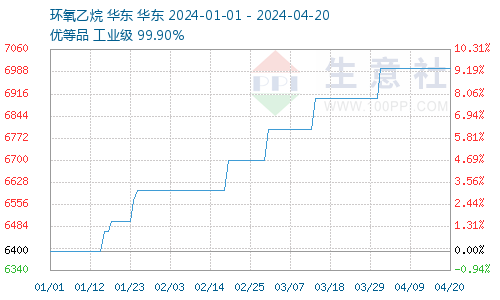
In June 2026, the price of ethylene oxide was reduced. According to the data, as of June 5th, the average market price of ethylene oxide in China was 6,800 CNY/ton, a decrease of 10.53% from the beginning of the month (June 1st) when the average market price was 7,600 CNY/ton.
On June 5, 2026, the ex-factory listed prices for ethylene oxide in various regions of China are as follows: In the East China region, the market price for ethylene oxide is 6800 CNY/ton; in the South China region, the listed price for ethylene oxide is 6700-6800 CNY/ton; in the North China region, the listed price for ethylene oxide is 6650 CNY/ton; in the Central China region, the listed price for ethylene oxide is 6800-7600 CNY/ton.
Analysis of the Reasons for the Significant Price Adjustment of Ethylene Oxide in June 2026 in China
In early June 2026, the significant drop in ethylene oxide prices in China was driven by the convergence of five key factors: cost collapse, supply recovery, weakened demand during the off-season, inventory reduction at high prices, and macroeconomic sentiment.
I. Cost Side: High Premiums for Crude Oil + Ethylene Decline, Breaking Down the Hard Support for Production Costs
70% of the cost of ethylene oxide feedstock comes from ethylene. Ethylene prices are anchored to international crude oil prices and overseas markets in Northeast Asia. The root cause of this round of sharp decline is the complete unwinding of the geopolitical premium for the Middle East, which had been driven up in March. In late May, the U.S. and Iran reached a framework agreement, easing tensions in the Middle East. As a result, Brent crude oil prices rapidly fell from $112 per barrel to a range of $85–90 per barrel, bringing an end to the geopolitical speculation-driven rally. Consequently, crude oil has dragged down naphtha and ethane prices across the board. Northeast Asia’s CFR ethylene price dropped from $1,050 per ton on March to $720–750 per ton by June. Meanwhile, China’s spot ethylene price fell from 7,700 CNY per ton to around 6,200 CNY per ton. As a result, the production cost of EO per ton decreased by 1,100–1,300 yuan, leaving producers with little incentive to hold prices steady and forcing them to passively follow the downward trend in listed prices. Meanwhile, U.S. ethane costs have remained persistently low, leading to increased exports of ethylene and EO. Moreover, arbitrage-based import supplies are putting pressure on China’s spot pricing ceiling, further suppressing Chinese quotations.
Supply Side: Staged Resumption of Maintenance + Ample Supply in Non-Maintenance Areas Overall Supply Shifts from Tight to Loose
In June, ethylene oxide (EO) showed a pattern of localized maintenance and overall supply relaxation, which offset the reduction in supply due to maintenance. The availability of spot goods increased, and inventories accumulated. The main EO facilities of Silianbang, Lianhong New Material, Sichuan Petrochemical, and Denan Chemical, which underwent concentrated maintenance in May, resumed production in early June, significantly increasing the supply in the core production area of East China. Although some individual facilities, such as Taixing Jin Yan, newly entered maintenance, the increase from resuming production was greater than the decrease from maintenance. The overall industry operating rate rose from 48% in May to around 70% in June. In Northwest and North China, EO units with refining and chemical integration maintained high operating rates, continuously supplying goods to the East China and South China markets, narrowing regional price differences and making the overall market supply more relaxed. Inventories that factories had built up during the high-price period in March and April were concentrated for delivery in June. Major private factories of Sinopec and CNPC continuously lowered their ex-factory prices and offered discounts to sell, leading to a continuous decline in market quotations.
III. Demand Side: Traditional downstream sectors have fully entered the seasonal low season, and end-user rigid demand has sharply weakened.
70% of downstream demand from EO is used for ethylene glycol, polycarboxylate superplasticizer monomers, and nonionic surfactants. In June, multiple seasonal factors combined with industry headwinds led to a sharp decline in downstream operating rates; downstream producers are now only placing small, on-demand orders without engaging in any concentrated restocking. Specific details are as follows:
1. Polycarboxylic acid water-reducing agent monomer (largest rigid demand downstream in China)
New construction starts in the real estate sector and infrastructure projects fell short of expectations, causing the operating rate of China’s commercial concrete enterprises to decline by 15% month-on-month. Coupled with June’s prolonged rainy season in southern China, nationwide suspensions of middle- and high-school exams, and the peak farming season in northern China—resulting in widespread construction site shutdowns—the utilization rate of water-reducing agent factories dropped to just 25.5% (down 3.27 percentage points month-on-month). Moreover, procurement volumes of the raw material EO declined by more than 30% year-on-year.
2. Non-ionic surfactants (for daily chemicals, textiles)
The textile industry is in the off-season, and the daily chemical industry is entering the traditional consumption off-season. The operating rate of surfactant factories has dropped to 42.5%. Factories are strictly controlling raw material inventories to avoid the risk of further price declines, adopting a wait-and-see attitude, pressuring for lower prices, and purchasing in batches. Large-scale procurement has basically come to a halt.
3. Ethylene glycol supporting facilities have weakened in China.
Polyester and chemical fiber are in the off-season, and ethylene glycol spot prices have fallen in tandem. The profits from converting self-produced EO to ethylene glycol in integrated plants have decreased, leading to an increase in the external sales of EO, which further increases the circulation of commercial EO in China.
4. Downstream buyers buy on rising prices but not on falling prices.
Prices are in a sustained downward cycle, and the entire industrial chain is holding cash and adopting a wait-and-see approach. Downstream players are avoiding stockpiling to prevent losses, opting instead to purchase goods as needed. As a result, the market lacks speculative demand for inventory accumulation to provide support.
Four, the early profit-taking from the surge leads to a concentrated exit, and the market pricing logic reverses.
The speculative capital that had been driven by geopolitical tensions in March and April gradually withdrew in May. By June, pessimistic expectations had spread, prompting traders to proactively lower prices and sell off spot goods, thus triggering a negative spiral of price cuts → wait-and-see attitude → further price reductions. In the earlier phase, when prices were high, the market was uniformly bullish. However, after both cost pressures and demand faced headwinds in June, the industry abruptly shifted from “holding prices and reluctant to sell” to “cutting prices to reduce inventories.” Leading refining and chemical companies were the first to adjust their prices, while smaller and medium-sized manufacturers passively followed suit with price cuts.
V. Macro and Industry Long-term Overcapacity Suppresses Rebound Space
In recent years, China’s EO industry has seen a continuous ramp-up of integrated refining and petrochemical production capacities (with capacity expansions by Hengli, Shenghong, and Zhejiang Petrochemical gradually coming online). As a result, overcapacity has become the new normal in the industry, with the capacity-to-consumption ratio approaching 190%. Demand growth is far outpaced by new capacity additions, leaving prices lacking solid medium- to long-term fundamental support. Consequently, bearish factors intensify during the off-season, amplifying price corrections.
Future Market Forecast
Currently, the epoxy ethane market is rising due to geopolitical factors, cost increases, and short-term supply tightening. It is falling due to the easing of geopolitical tensions, a collapse in costs, a drop in demand during the off-season, and an increase in supply. The June correction is a return to valuation following the sharp rise in March and April. The fundamental reason for this deep decline is the simultaneous realization of three negative factors: a prior breakdown in costs, the onset of the off-season leading to weaker demand, and a shift from tight to loose supply. It is expected that the market will mainly experience a weak and volatile trend in the short term.

You May Interested In


2026-09-30
Trade Alert
Delivering the latest product trends and industry news straight to your inbox.
(We'll never share your email address with a third-party.)

Related News
-
Business Society’s Ethyl Acetate Trend Analysis for September 17, 2026: Moderate Pullback
-
Strong Cost Support Drives Acrylonitrile Market to Rebound After a Drop
-
Cost-Driven Acrylonitrile Market Halts Decline and Stabilizes
-
In August, the maleic anhydride market in China continued to decline
-
Strong Supply and Weak Demand & Cost Regression: PC Prices First Decline Then Rise in July in China
-
Dow Swings from an $801 Million Loss to an $802 Million Profit as Hormuz Disruption Lifts Polyethylene Prices
-
Insufficient Spot Buying Momentum, Acrylonitrile Market Continues to Weaken in China
-
Supply Boosts Consumption, But Demand Contracts—PC Prices Drop in Early June
-
Supply-Demand Mismatch: Acrylonitrile Market Stagnant and Relatively Weak in May
-
In-depth Analysis of the Reasons for the Decrease in Ethylene Glycol Prices in May 2026 in China
Recommend Reading
-
![Business Society’s Market Outlook for Styrene Butadiene Rubber on August 14, 2026: Short-Term Bullish Factors Support the Market]()
Business Society’s Market Outlook for Styrene Butadiene Rubber on August 14, 2026: Short-Term Bullish Factors Support the Market
-
![Supply Excess, Acrylonitrile Market Weakens in China]()
Supply Excess, Acrylonitrile Market Weakens in China
-
![Business Society’s Aniline Market Outlook on August 14, 2026: Continuing the Upward Trend]()
Business Society’s Aniline Market Outlook on August 14, 2026: Continuing the Upward Trend
-
![Supply and Demand Pressures Combine, PVC Prices Surge and Then Retreat This Week]()
Supply and Demand Pressures Combine, PVC Prices Surge and Then Retreat This Week
-
![Business Society’s Market Outlook for Epichlorohydrin on August 14, 2026: Clearly Downward]()
Business Society’s Market Outlook for Epichlorohydrin on August 14, 2026: Clearly Downward
-
![EAEU Initiates Review of Anti-Dumping Measures on Chinese Titanium Dioxide, Suspends Duties During Investigation]()
EAEU Initiates Review of Anti-Dumping Measures on Chinese Titanium Dioxide, Suspends Duties During Investigation
-
![Premium Global Chemical Sourcing Requests (29 Nov - 3 Dec 2025)]()
Premium Global Chemical Sourcing Requests (29 Nov - 3 Dec 2025)
-
![Dicalcium Phosphate: Properties, Uses, and Applications]()
Dicalcium Phosphate: Properties, Uses, and Applications
-
![Flavin Adenine Dinucleotide (FAD): Functions and Applications]()
Flavin Adenine Dinucleotide (FAD): Functions and Applications
-
![Magnesium Chloride (MgCl₂): Properties, Uses, and Applications]()
Magnesium Chloride (MgCl₂): Properties, Uses, and Applications