




Under the Game of Multiple Factors, the PTA Market Enters a Phased Correction
March 26th, News
Under the complex interplay of weakening costs, shrinking supply, and weak demand, the PTA market has entered a phase of temporary correction since mid-March. According to the commodity market analysis system, as of March 26, the spot price of PTA in the East China region stood at 6,740 CNY per ton, down 2.77% from March 17.
On March 23, New York time, international crude oil futures collapsed across the board. At the close, NYMEX May crude oil futures plunged by $10.10, a price decrease of 10.28%, settling at $88.13 per barrel; ICE May Brent crude oil plummeted by $12.25, with a price decrease of 10.9%, closing at $99.94 per barrel and falling below the $100 mark; June Brent crude oil also dropped by 9.9% simultaneously, ending at $95.92 per barrel. Stimulated by news from the U.S., oil prices briefly plunged nearly 15% during trading hours. Subsequently, after Iranian officials denied any dialogue with the U.S., the price decline narrowed slightly. The battle between bulls and bears reached an extreme level on the market, and PTA cost support weakened.
From the perspective of supply and demand, in 2026, the PTA industry in China is in a capacity vacuum period, with no new capacity being added. Coupled with the compression of processing fees, PTA producers are actively reducing loads and undergoing maintenance. Among them, Yisheng New Materials' 7.2 million tons PTA facility plans to reduce its load by 30% starting from April 1st. Due to severe cost fluctuations, after the spot processing margin for PTA was significantly compressed, there has been an increase in production cuts and shutdowns in Chinese facilities. Currently, the industry's operating rate is only 77%, and the contraction in the supply side is supporting price increases.
On the demand side, after PTA prices surged to high levels, downstream polyester and weaving enterprises saw a sharp drop in their willingness to purchase raw materials at these elevated prices, leading to sluggish production and sales and insufficient support from high-priced demand. Additionally, factors such as a shortage of overseas orders and rising inventories of finished polyester products further dampened the recovery momentum of terminal demand, serving as a key driver behind the PTA market’s pullback.
Analysts believe that with PTA maintenance plans exceeding 8,000,000 tons in the second quarter, the logic of supply contraction remains unchanged, and PTA processing fees are still at a low level, limiting the downward space. However, constraining factors still exist. The trends in crude oil and PX prices, as well as the evolution of geopolitical conflicts, directly determine the direction of costs. At the same time, the recovery strength of terminal demand is questionable. The shortage of overseas orders and high inventory levels in enterprises may continue to affect purchasing sentiment, and short-term fluctuations in the financial market may also exacerbate market volatility.

You May Interested In


Glow70/KLOW80 99% China Peptides Warehouse Direct Delivery Lyophilized Powder in Stock
$169/UNIT FOB


2026-10-19
Trade Alert
Delivering the latest product trends and industry news straight to your inbox.
(We'll never share your email address with a third-party.)

Related News
-
Weak Demand Drags Down the Chinese TDI Market (10.12-10.16)
-
Business Society, October 16, 2026: Rubber Market Outlook—Short-Term Prices Likely to Trade Sideways at High Levels
-
Business Society October 13, 2026 Epoxy Chloropropane Trend Analysis: Volatility
-
Business Society, October 13, 2026: Rubber Market Outlook—Short-Term Prices Likely to Remain Strong at High Levels
-
Business Society October 10, 2026 BDO Trend Analysis: Volatile Consolidation
-
Business Society September 29, 2026 Iso-octanol Trend Analysis: Volatile and Bearish
-
Business Society September 28, 2026 Phthalic Anhydride Trend Analysis: Weakly Bearish
-
Business Society PVC Trend Analysis for September 24, 2026: Weakness and Volatility
-
Recent Polyethylene Prices Remain Under Pressure Amid High-Level Fluctuations
-
Business Society’s PTA Market Outlook on September 10, 2026: Volatile
Recommend Reading
-
![Sodium Metabisulfite Prices Rise This Week (Jan. 19–23)]()
Sodium Metabisulfite Prices Rise This Week (Jan. 19–23)
-
![Supply and Demand Both Weak, Butadiene Market Operates Weakly in October]()
Supply and Demand Both Weak, Butadiene Market Operates Weakly in October
-
![Multiple Positive Factors Support a Strong Rise in Styrene]()
Multiple Positive Factors Support a Strong Rise in Styrene
-
![October Aniline Market Stably Rises in China]()
October Aniline Market Stably Rises in China
-
![Business Society’s September 16, 2026 Caustic Soda Trend Analysis: Relatively Strong Fluctuations]()
Business Society’s September 16, 2026 Caustic Soda Trend Analysis: Relatively Strong Fluctuations
-
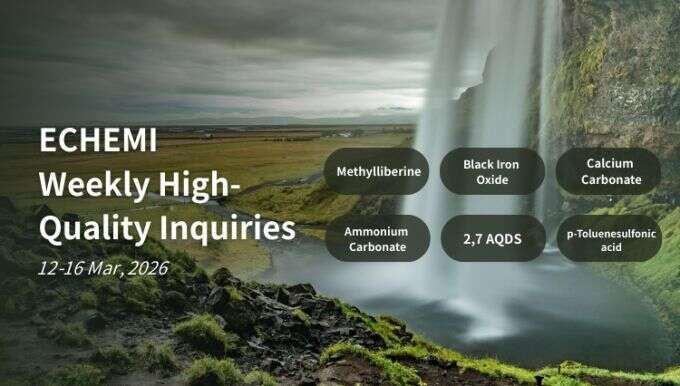
![Premium Global Chemical Sourcing Requests (12 - 16 Mar, 2026)]()
Premium Global Chemical Sourcing Requests (12 - 16 Mar, 2026)
-
![Vanillin: Properties, Uses, and Safety]()
Vanillin: Properties, Uses, and Safety
-
![Sodium Chloride (NaCl): Food Grade vs Industrial Grade Uses & Safety Data]()
Sodium Chloride (NaCl): Food Grade vs Industrial Grade Uses & Safety Data
-
![Premium Global Chemical Sourcing Requests (25-29 Oct 2025)]()
Premium Global Chemical Sourcing Requests (25-29 Oct 2025)
-
![Chemical Raw Materials: How to Source Quality Suppliers & Understand Grades]()
Chemical Raw Materials: How to Source Quality Suppliers & Understand Grades








- Hot Searches
- reta weight loss where to buy
- 2cb for sale
- lithium hydrozide
- msds sodium bicarbonate
- polyethylene oxide powder
- nantong guangyuan chemical gyc
- formic acid price
- fluocinolone acetonide oil
- fipronil cockroach bait
- dicalcium phosphate supplier
- reta peptides where to buy
- holmium oxide price 2025