




Turmeric Becomes a Super Food of Mankinds Daily Diets in the New Year

The list informs industry about substances that are inappropriate for cosmetic use, are restricted in some way, or require hazard labelling. It was last updated in 2015.
The government is proposing adding the substance to the list of restricted substances, limiting concentration levels to 3%, due to "potential health concerns at previously reported concentration levels". The notice said the levels currently being used in product formulations are below the proposed limit. Other proposed changes include:
expanding the prohibited listing for chloramine T to include "related compounds" that "are currently prohibited under the sulfonamides entry";
expanding the ban on OLEANDRIN to include nerium oleander, its extracts and glycosides;
amending the restrictions on Boric Acid to bar its use in "products for use on or around mucous membranes" and in those intended for children; and
altering restrictions on methylisothiazolinone. Due to "risk of sensitisation", the agency is considering prohibiting its use in leave-on products and reducing the maximum allowed concentration in these to 0.0015%, similar to the current restriction on the combination of methylisothiazolinone and methylchloroisothiazolinone. In addition, this restriction would be amended to clarify that the mixture cannot be used in the same product as methylisothiazolinone on its own.
The notice sent to stakeholders on 29 June says Health Canada is trying out a new process for updating the hotlist, "which may become the standard process".
It is a "pre-consultation", sent approximately three months before the start of a formal consultation. Stakeholders are invited to submit comments and additional information.
Once the proposed updates are posted on Health Canada's website, a formal 60-day comment period will open. The consultation document may include information on specific concentration limits, suggested wording for cautionary labelling or proposals to ban substances.
Health Canada will respond to comments before publishing the final revised list, which the agency expects to do five months after the end of the consultation period.

You May Interested In


High Quality β-Nicotinamide adenine dinucleotide CAS 53-84-9 NADwith ready stock and best price
$3E+1/UNIT FOB


2026-10-22
Trade Alert
Delivering the latest product trends and industry news straight to your inbox.
(We'll never share your email address with a third-party.)

Related News
-
New application trend of curcumin in food and beverage markets
-
When medical innovation enters the 'inflection point', the 'break' and 'establishment' of AstraZeneca CICC Medical Industry Fund
-
Worse than Sugar and Salt? The WHO Calls for the Discontinuation of the Use of Trans Fats
-
Short and Breif Analysis of the Lutein
-
Can the Market Continue To Go Higher As The Cost Of Planting Huang Lian Increases?
-
Review of Top 10 Hot Plant Extracts for 2021-Turmeric, Lutein, Stevia Extract, Menthol, Quercetin, Aronia, Ginkgo Biloba Extract, Ashwagandha Ayurvedic Extract, Capsaicin, Saw Palmetto Extract
-
Free dual-priced vaccination on the way
-
Recently Wanhua Chemical had 1 large transaction with a transaction amount of 4,689,000 Yuan!
-
World's largest cotton spinner successfully develops bio-based PLA, PHBV range of fabrics!
-
Allergic rhinitis is back! Experts remind: early prevention and standardized treatment
Recommend Reading
-
![Kemira Acquires AquaBlue]()
Kemira Acquires AquaBlue
-
![$530 Million Lawsuit Unheard, $76 Million Counterclaim Filed: Is Qicai Chemical’s ‘Reputation Defense’ a Desperate Last Stand or a Calculated PR Gambit?]()
$530 Million Lawsuit Unheard, $76 Million Counterclaim Filed: Is Qicai Chemical’s ‘Reputation Defense’ a Desperate Last Stand or a Calculated PR Gambit?
-
![Alipay, Baidu, and iFlytek Win Big—As the Government Spends $1.1 Billion on AI Healthcare, Is This a Lifeline or a Feeding Frenzy for Tech Giants?]()
Alipay, Baidu, and iFlytek Win Big—As the Government Spends $1.1 Billion on AI Healthcare, Is This a Lifeline or a Feeding Frenzy for Tech Giants?
-
![Arkema's New Singapore Plant Commences Operations, Tripling Polyamide Capacity]()
Arkema's New Singapore Plant Commences Operations, Tripling Polyamide Capacity
-
![Snack Tests Put Red 40, Titanium Dioxide and BHT Back Under Pressure]()
Snack Tests Put Red 40, Titanium Dioxide and BHT Back Under Pressure
-
![Business Society September 15, 2026 Ethyl Acetate Trend Analysis: Volatile]()
Business Society September 15, 2026 Ethyl Acetate Trend Analysis: Volatile
-
![Business Society October 20, 2026 Isooctanol Trend Analysis: Bullish Signals]()
Business Society October 20, 2026 Isooctanol Trend Analysis: Bullish Signals
-
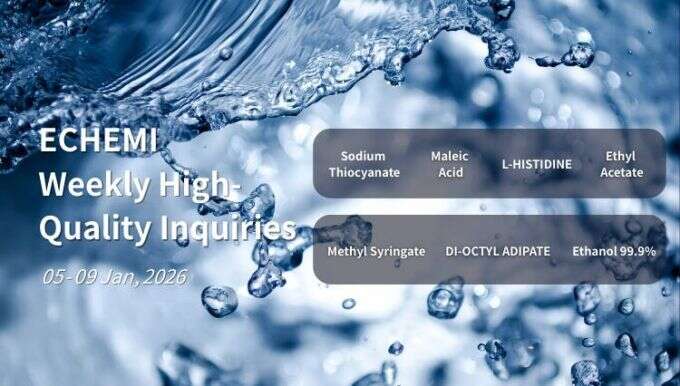
![Premium Global Chemical Sourcing Requests (5-9 Jan, 2026)]()
Premium Global Chemical Sourcing Requests (5-9 Jan, 2026)
-
![Business Society’s September 14, 2026, Petroleum Coke Trend Analysis: Volatile]()
Business Society’s September 14, 2026, Petroleum Coke Trend Analysis: Volatile
-
![Business Society October 20, 2026 Epoxy Chloropropane Trend Analysis: Volatility]()
Business Society October 20, 2026 Epoxy Chloropropane Trend Analysis: Volatility





- Hot Searches
- gl biochem ltd
- fladrafinil buy
- raw testosterone powder
- calcium ammonium nitrate for sale
- can you buy sulfur hexafluoride
- polylactic acid cost
- retatrutide peptide supplier
- chemsynthesis chemical database
- retatrutide peptide buy usa price
- methyl ethyl ketone peroxide mekp
- anhydrous ammonia for sale
- buy lignin