Europe acetone gains kick start industry's 2020 phenol planning phase

The yawning gap between upstream feedstock propylene costs and acetone spot prices – not far off the more-than-three-year lows hit in May - has narrowed significantly in Europe in recent days, bringing some welcome relief in a vexing year for phenol/acetone producers as they sketch out plans for 2020.
While European propylene contract prices for September, assessed on Friday last week, declined by €50 to €860/tonne on a free delivered (FD) basis in northwest Europe (NWE), acetone spot prices firmed by €20-30/tonne to €440-500 FD NWE.
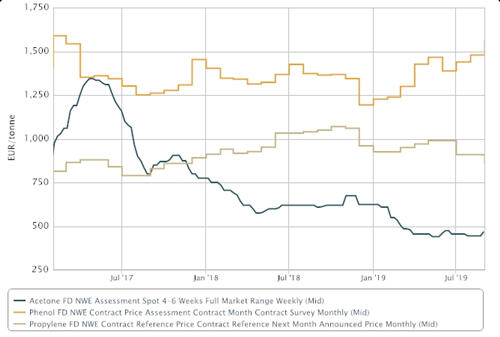
Propylene costs have been higher than acetone spot prices since late 2017, and acetone now sells for around half the price of propylene, forcing European producers to subsidise acetone with sales of co-product phenol.
This arrangement has been regarded as complicated and unsustainable by the industry, and higher margins on both products have been sought for some time.
Phenol is largely sold on a contractual basis in Europe as spot demand and supply has largely dried up this year, limiting producers' wiggle room to rebalance the market through price adjustments. Contracts are adjusted monthly based on feedstock benzene contract price movements, and an adder fee that is adjusted quarterly.
The next round of contract adder fee talks are due to begin this week, while the industry also begins its planning phase for 2020, and profitability is expected to feature in these discussions.
“We've been swallowing [low] acetone margins and [high] benzene prices for the whole of this year,” one producer said, referring to the approaching period of negotiations for the fourth quarter and planning for 2020. "We're not going to be looking for poor prices in Q4."
Producers' efforts to increase prices and improve margins have been undermined this year by weaker demand, particularly as a result of weaker performance of the automotive sector, which is a major recipient of phenol and acetone’s downstream products bisphenol-A (BPA) and methyl methacrylate (MMA).
Tough competition from an increasing flow of cheaply priced downstream product imports from Asia has complicated matters further. Global economic uncertainties and trade disruptions in 2019, including the ongoing trade battle between the US and China, have also affected trade with both the US and China imposing antidumping duties on phenol and acetone this year.
The latest firming of acetone prices may have been driven in part by a one-week delay in the restart of the 108,000 tonnes/year Seqens plant in Peage, France.
Feedback on firmer prices also pointed to a reduction of import material and spot availability, resulting from lower run rates by European and Asian producers and higher prices in Asia, coupled with an uptick in demand and stock enquiries.
Asian producers facing similar downstream demand erosion have been reducing output and prices there rebounded in early August, closing the arbitrage from Asia to Europe for acetone.
There were anecdotal reports of less acetone spot volume entering Europe, and reduced output ahead of China’s 70th anniversary preparations in October. Others, however, said material was still plentiful and saw no changes in pricing.
Several European producers referred to lower spot availability over the past week, and said they were considering further reductions in output going forward given the recent poor profitability of the phenol/acetone pair.
"[Producers] are in a desperate situation so they are insisting on [increasing] adders or they won't supply, because with every tonne of acetone they are losing," a distributor said.
The world’s biggest phenol and acetone producer, INEOS Phenol, was said to have exhausted its spot market supplies of acetone in July and August and was expected to do the same again in September. It was also considering a significant reduction in output from its European units in 2020, market sources said.
“We're really short on acetone,” another European producer said.
But as the end of the year usually sees producers and buyers destocking, it is unclear how long the latest rebalancing will last.
Several participants were betting that the days of cheap acetone were not over, and said they were prepared to wait.
“I believe the buyers’ market will remain for the time being,” one buyer said.

You May Interested In


High Quality β-Nicotinamide adenine dinucleotide CAS 53-84-9 NADwith ready stock and best price
$3/UNIT FOB


2026-10-15
Trade Alert
Delivering the latest product trends and industry news straight to your inbox.
(We'll never share your email address with a third-party.)

Related News
-
ECHEMI High Quality Inquiries (30 Aug-4 Sep)
-
Mitsui Chemical decided to close the Phenol production line at its Ichihara plant in Japan
-
How to Convert Phenol to Picric Acid?
-
The European cumene market continues to be weak
-
The domestic phenol market may bottom out
-
INNEX acquires Mitsui Singapore Phenol for $330 million
-
$330 Million! INEOS Acquires Mitsui Phenol Singapore
-
Tight Prices Rise, the Domestic Phenol Market Rises Again
-
LG Chem Exports Bio-based Phenol and Acetone
-
The Factory has Been Raised, and the Phenol Market has Continued to Rise.
Recommend Reading
-
![Chevron Opens Oilfield Chemical Technology to Rivals]()
Chevron Opens Oilfield Chemical Technology to Rivals
-
![What Can $3.4 Billion Buy? Shin-Etsu Chemical’s Answer: Upstream Control of PVC]()
What Can $3.4 Billion Buy? Shin-Etsu Chemical’s Answer: Upstream Control of PVC
-
![FDA Dye Phase-Out Push Opens a Bigger Window for Natural Color Solutions]()
FDA Dye Phase-Out Push Opens a Bigger Window for Natural Color Solutions
-
![U.S. API Dependence Turns Pharmaceutical Ingredients Into a National Security Issue]()
U.S. API Dependence Turns Pharmaceutical Ingredients Into a National Security Issue
-
![Glyphosate Faces New UK Pressure as EU Trade Alignment Returns to the Debate]()
Glyphosate Faces New UK Pressure as EU Trade Alignment Returns to the Debate
-
![Sodium Metabisulfite Prices Rise This Week (March 9–13)]()
Sodium Metabisulfite Prices Rise This Week (March 9–13)
-
![Styrene-butadiene rubber prices continue to decline, remaining weak and volatile in the short term]()
Styrene-butadiene rubber prices continue to decline, remaining weak and volatile in the short term
-
![November urea market trends fluctuate and rise in China]()
November urea market trends fluctuate and rise in China
-
![BDO Market Trends Continue to Rise]()
BDO Market Trends Continue to Rise
-
![Rising Costs Drive Up Phosphate Market Prices in China (6.1-6.11)]()
Rising Costs Drive Up Phosphate Market Prices in China (6.1-6.11)