| | Pyrrole Chemical Properties | | Melting point | -23 °C (lit.) | | Boiling point | 131 °C (lit.) | | density | 0.967 g/mL at 25 °C (lit.) | | vapor density | 2.31 (vs air) | | vapor pressure | 8.7 hPa (20 °C) | | refractive index | n20/D 1.508(lit.) | | FEMA | 3386 | PYRROLE | | Fp | 92 °F | | storage temp. | Store at +2°C to +8°C. | | solubility | 60g/l | | pka | 15(at 25℃) | | form | Liquid | | color | Clear almost colorless to brownish | | PH | >6 (10g/l, H2O, 20℃) | | Odor | at 0.10 % in propylene glycol. sweet warm nutty ethereal | | Odor Type | nutty | | biological source | synthetic | | explosive limit | 3.10-14.8%(V) | | Water Solubility | 60 g/L (20 ºC) | | Sensitive | Air & Light Sensitive | | Merck | 14,8014 | | JECFA Number | 1314 | | BRN | 1159 | | Henry's Law Constant | 5.5×10⁻¹ mol/(m3Pa) at 25℃, Hawthorne et al. (1985) | | Dielectric constant | 7.5(17℃) | | Stability: | Stable. Incompatible with strong acids, strong oxidizing agents. Combustible. | | Major Application | flavors and fragrances | | InChI | 1S/C4H5N/c1-2-4-5-3-1/h1-5H | | InChIKey | KAESVJOAVNADME-UHFFFAOYSA-N | | SMILES | c1cc[nH]c1 | | LogP | 0.85 | | Surface tension | 36.6mN/m at 20°C | | CAS DataBase Reference | 109-97-7(CAS DataBase Reference) | | NIST Chemistry Reference | Pyrrole(109-97-7) | | EPA Substance Registry System | 1H-Pyrrole (109-97-7) | | Hazard Codes | T | | Risk Statements | 10-20-25-41 | | Safety Statements | 26-37/39-45-39-24-16 | | RIDADR | UN 1992 3/PG 3 | | WGK Germany | 2 | | RTECS | UX9275000 | | F | 8-10-23 | | Autoignition Temperature | 550 °C | | TSCA | TSCA listed | | HazardClass | 3 | | PackingGroup | III | | HS Code | 29339900 | | Storage Class | 3 - Flammable liquids | | Hazard Classifications | Acute Tox. 3 Oral
Acute Tox. 4 Inhalation
Eye Dam. 1
Flam. Liq. 3 | | Hazardous Substances Data | 109-97-7(Hazardous Substances Data) | | Toxicity | LD50 orally in Rabbit: 137 mg/kg |
| | Pyrrole Usage And Synthesis | | Heterocyclic compound | Pyrrole is a five-membered heterocyclic compound which contains one nitrogen atom, it is colorless liquid at room temperature, naturally presents in coal tar and bone oil, turns black color quickly in the air, it has significant irritant odor. The relative density is 0.9691, the boiling point is 130~131℃, freezing point is-24℃. It is almost insoluble in water and dilute alkali solution, soluble in alcohol, ether, benzene and mineral acid solution. It is very stable for alkali, it easily polymerizes into dark red resin trimer in the presence of small amount of inorganic acid, when it is stored, it exposes to light or air will cause resinification. Pyrrole vapor meets loose pieces which moistened with hydrochloric acid can show red, this is called loose piece reaction (pine flakes reaction; pine splint test), it can be used to identify pyrrole. 5 atoms on the pyrrole ring are sp2 hybrid, they are in the same plane, one pair not shared electrons of the nitrogen atom occupy the p-orbital, four carbon atoms and p-orbital are parallel and overlapping, forming 5 atoms, 6 π electrons closed conjugated system, it has aromatic character, prone to electrophilic substitution reactions. Thus, alkalinity of nitrogen atom in pyrrole is small (pKb13.6); On the contrary, combination of hydrogen on the nitrogen atom is weak acid. In addition, pyrrole ring with benzene and other aromatic compounds are same, it can conduct nitration, sulfonation, diazo coupling reaction, Friedel-Crafts type acylation. This reaction can get 2-substituted compound.
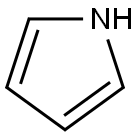
Nitrogen atom of pyrrole molecule is sp2 hybridized, unshared electron pair occupys p-orbitals, p-orbitals with parallel 4 sp2 hybridized carbon atoms overlap to form a six-electron conjugated system, it has aromatic character, electrophilic substitution reactions can occur.
Unshared electron pairs of pyrrole nitrogen atoms involve in the conjugated ring system, and binding capacity with H + is very weak, it is not showing alkaline. Since the electron density on the nitrogen atom is relatively lower, the hydrogen atom attached to the nitrogen atom can leave in the form of positive ions, thus pyrrole has faintly acid. Ionization constant Ka = 10-15, it can react with solid potassium hydroxide to form a salt.
Many pyrrole derivatives are important drugs and have strong physiologically active substances, such as chlorophyll, heme.
Pyrrole is basic structural unit of heme, chlorophyll, bile pigments, some amino acids, several alkaloids and some enzymes, these compounds have strong physiological activity and drugs functional. Vitamin B12, glycopyrrolate, kainic acid (drive roundworm medicine), clindamycin (antibiotic) drugs contain hydrogenated pyrrole ring structure. Since 1979, it found that flexible conductive polymer film can be obtained by electrochemical oxidation of pyrrole, the conductivity is 104S/m, and it had good stability. | | Chemical Properties | It is colorless to yellowish liquid, long-term storage in the process is easy to expose the action of light and the polymerize to turn brown. It has warm sweet fruity of nuts and esters. Boiling point is 130 ℃ (decomposition), a flash point is 39 ℃, a melting point is-24 ℃. It is soluble in alcohol, ether, benzene, acid and most of the non-volatile oil, insoluble in water and dilute alkali. | | Uses | (1) Spices. The main type use is the preparation of fruit and spice flavors.
(2) It is used for the synthesis of pharmaceuticals and fine chemicals such as perfume
(3) Its derivatives are widely used in organic synthesis, pharmaceuticals, pesticides, spices, rubber vulcanization accelerator, epoxy curing agents of raw materials
(4) It is used as chromatographic analysis standard material, it is also used in organic synthesis and pharmaceutical industry.
(5) It can be used for the pharmaceutical, perfume and other synthetic intermediates.
(6) It is widely used in the synthesis of pharmaceuticals, pesticides and dyes. In the pharmaceutical industry can be used for synthesis of Barossa Star (Irloxacin), meters pyrrole acid (Piromidic), pyrrole pentanone (Pyrovalerone), pyrrole Cain (Pyrrocaine) and set off disease (TMT) and the like.
(7) It can be used to test gold selenite and silicic acid. Determination of chromate, gold, iodine salt, mercury, selenious acid, silicon and vanadium. | | Production methods | 1, furan and ammonia is as raw materials, γ-alumina is as catalyst, the gas-phase catalytic reaction can get it.
2, After total heat fractionation of the bones oil and sulfuric acid, it converts into its potassium salt (C4H4NK), it is washed with ether and treated with water and then dried, fractionation can derive.It can be obtained by pyrolysis of galactose ammonium in glycerol or mineral oil from pyrolysis. | | Hazards & Safety Information | Category: Flammable liquid
Toxicity grading: Highly toxic
Intraperitoneal acute toxicity-mouse LD50: 98 mg/kg; Oral-rabbit LDL0: 147 mg/kg
Flammability hazard characteristics: it is flammable when in case of fire, heat, oxidants; combustion produces toxic fumes of nitrogen oxides
Storage characteristics: Treasury ventilation low-temperature drying; it should be stored separately with oxidants.
Extinguishing agent: Dry powder, dry sand, carbon dioxide, foam, 1211 fire extinguishing agent. | | Physical properties | Pyrrole is a colorless to brown liquid that has a sweet, warm-ethereal smell, similar to chloroform. It dissolves in ethanol, ether, benzene, dilute acids, and most non-volatile oils but does not dissolve in water or dilute alkalis. When stored for extended periods, it tends to aggregate and become brown due to the influence of light. | | Chemical Properties | Six π-electrons are distributed over the five ring atoms of pyrrole. Delocalization of these electrons stabilizes the ring and the lone pair of electrons on the nitrogen atom, which is responsible for the usual basicity of nitrogen compounds, is involved in the electron cloud, and is not available for sharing. Hence, pyrrole is an extremely weak base and the pyrrolic nitrogen is not readily susceptible to electrophilic enzymic attack (Damani, 1985). There is a high electron density, however, at all positions of the ring, which causes pyrrole to be reactive toward electrophilic substitution. In general, electrophilic substitution reactions on the neutral molecule occur preferentially at the C-2 or C-5 positions (Jones and Bean, 1977; Damani and Crooks, 1982). | | Occurrence | The pyrrole ring is the basic unit of the porphyrin system which occurs, for example, in chlorophyll and in hemoglobin. Other pyrrole-based natural products include pigments such as bilirubin and biliverdin, which are degradative products from porphyrins (Sundberg, 1984).
Pyrrole has been found in surface waters and in filtrates from cultures of the blue-green algae, Anabaenaflos aquae. The presence of pyrrole and other organic nitrogen compounds in natural waters is of environmental concern because they may exert significant chlorine demand. Pyrrole is also a precursor to trihalomethane formation (Ram and Morris, 1980).
At ambient temperature, pyrrole can be volatilized from shale oil wastewaters. Concentrations of approximately 3 g/m3 have been measured indoors in air at an oil shale wastewater facility (Hawthorne and Sievers, 1984). Pyrrole has been identified in tobacco smoke, although not in tobacco itself (Johnstone and Plim-mer, 1959); in cigarette smoke (Schumacher et al 1977); in cigar butt aroma (Peck et al 1969); and in Cannabis smoke condensate (Jones and Foote, 1975).
Pyrrole was found to be naturally occurring in foods; in fact, it is on the Food and Drug Administration GRAS (Generally Recognized As Safe) list, with an average usage level of 3 p.p.m. in flavoring formulations (Maga, 1981). Pyrrole is a volatile constituent of roasted coffee (Gianturco et al 1966), roasted peanuts (Walradt et al 1971), and fried chicken (Tang et al 1983). It has also been identified in beef aroma (MacLeod and Coppock, 1976) and is a constituent of cocoa aroma (Marion et al 1967). It should be noted that all the foods listed have undergone some degree of thermal treatment; pyrrole was not present in the fresh, raw foods. In model system studies, pyrrole was among the resulting compounds when hydroxyproline and glucose were heated under nitrogen at temperatures ranging from 120° to 200°C. Large amounts of pyrrole were found, as well, when casein and collagen were pyrolyzed and when proline underwent high temperature pyrolysis (Maga, 1981). | | Uses | Pyrrole plays a major role in synthesis of drugs, spices, agrochemicals, dyes, photographic chemicals and perfumes. It plays an important role in the electropolymerisation of macroporous conducting polymer films. It acts as a catalyst for polymerization process; as a standard substance in chromatographic analysis; as corrosion inhibitors and preservatives and as solvents for resins and terpenes. It is utilized to study the hydrogen-bond mediated coupling of 1,2,3-triazole to pyrrole and in the preparation of 1-(4-Chloro-benzoyl)-pyrrole by reacting with 4-Chloro-benzoyl chloride. In Ciamician-Dennstedt rearrangement, It is used to prepare 3-chloropyridine by reacting with dichlorocarbene. | | Preparation | By fractional distillation of bone oil (bone oil is obtained by destructive distillation of animal bone) and subsequent purification via the corresponding potassium salt; by thermal decomposition of ammonium mucate in glycerol or mineral oil. | | Production Methods | Pyrrole may be made (1) by reaction of succinimide with zinc and acetic acid, or with hydrogen in the presence of finely divided platinum heated, (2) by reaction of ammonium saccharate or mucate COONH4·(CHOH)4·COONH4 with glycerol at 200 °C by loss of carbon dioxide, ammonia, and water. When pyrrole is treated with potassium (but not with sodium) or boiled with solid potassium hydroxide, potassium pyrrole C4H4NK is formed, which is the starting point for N-derivatives of pyrrole, since reaction of the potassium with halogen of organic compound and with carbon dioxide, readily occurs. | | Production Methods | Pyrrole originally was prepared industrially by fractional distillation of coal tar, bone oil or other protein material, and purified through formation of its potassium derivative (Runge, 1834; Michelman, 1925). Later it was produced by heating ammonium mucate with glycerol or mineral oil (Blicke and Powers, 1927; McElvain and Bollinger, 1941). It is now manufactured by addition of ammonia to either acetylene or butadiene. Good yields of pyrrole also may be obtained from the reaction of ammonia with the corresponding heterocyclic compound (furan) in a vapor-phase process at 480° to 500°C, using alumina as a catalyst (Thompson, 1972) or by catalytic reaction of furan with ammonia over a molybdenum or vanadium oxide catalyst at 350-400°C (Bishop and Denton, 1950). | | Definition | ChEBI: 1H-pyrrole is a tautomer of pyrrole that has the double bonds at positions 2 and 4. It is a pyrrole and a secondary amine. It is a tautomer of a 2H-pyrrole and a 3H-pyrrole. | | Aroma threshold values | Detection: 20 to 49.6 ppm | | General Description | Pyrrole is one of the flavor compounds that is formed in thermally processed foods due to the Maillard reaction. | | Hazard | Moderate fire risk. Toxic by ingestion and inhalation. | | Health Hazard | Pyrrole is harmful if swallowed, inhaled, or absorbed through the skin. Its vapor or mist is irritating to the eyes, mucous membranes and upper respiratory tract (Lenga, 1985; Sax, 1984). Although no cases of occupational disease due to pyrrole have been reported, it has a depressant action on the central nervous system and, in severe intoxication, it is injurious to the liver. Tests indicate that it has moderate cumulative toxicity (Parmegianni, 1983). | | Health Hazard | The toxicity data on pyrrole are scant. Itis moderately toxic on test animals. Theroutes of exposure are inhalation of vapors,ingestion, and skin absorption. Vapors arean irritant to the eyes and respiratory tract.The lethal doses in rabbits by oral anddermal routes are within the range 150 and250 mg/kg, respectively. | | Fire Hazard | Combustible liquid; flash point (closed cup) 39°C (102°F); vapor forms explosive mixtures with air; LEL and UEL values are not available. Heating with strong oxidizers can be violent. | | Industrial uses | Pyrrole is a five-member nitrogen heterocyclic ring that contains two carbon-carbon double bond configurations which gives the solvent a pronounced aromatic character. Pyrrole is an intermediate in the synthesis of a variety of commercial chemical derivatives. Pyrrole has only limited solubility in water but are miscible with many organic solvents.Pyrrole when freshly distilled is a colorless liquid, but the solvent can rapidly acquire a brown coloration due to air oxidation. Prolonged standing in the air will promote slow polymerization of the pyrrole to give a dark brown polymer. Pyrrole has a viscosity of 1.31 centipoise and a medium surface tension value of 37.1 dynes/cm.
pyrrole is used as a chemical intermediate in the preparation of electrically conducting polypyrrole by means of an electrochemical polymerization process. Pyrrole has few other industrial uses. | | Industrial uses | Pyrrole is used to a limited extent as a solvent for polymeric esters, but its primary value lies in its function as a chemical intermediate. It is used in the synthesis of non-heterocyclic compounds (Kozikowski, 1984) and its derivatives have been used in the manufacture of dyes, herbicides, perfumes, and as cross-linking agents for curing resins (Thompson, 1972). Derivatives of pyrrole are utilized in pharmaceutical applications, particularly as anti-inflammation drugs and drugs with central nervous system activity, including antihypertensive effects (Sundberg, 1984); and as antimicrobial agents (Freeman, 1975), such as fungicides (Zirngibl, 1983) and bactericides (Bailey and Johnson, 1973; Bailey et al 1973; Sundberg, 1984). Polymers of pyrrole have been used in the preparation of photoconductive materials. The main utility of poly(pyrrole) has been for the modification of electrode surfaces, although numerous other applications can be envisioned (Heilmann and Rasmussen, 1984). | | Safety Profile | Poison by ingestion, subcutaneous, and intraperitoneal routes. Flammable liquid when exposed to heat or flame; can react with oxilzing materials. To fight fire, use foam, CO2, dry chemical. Violent reaction with 2-nitrobenzaldehyde. When heated to decomposition it emits highly toxic fumes of NOx. | | Metabolism | Reports concerning the metabolites formed following administration of pyrrole have been somewhat confusing. Saccardi (1919a, 1920) observed that administration of pyrrole orally and by injection resulted in the formation of melanin in the urine of rabbits, but not of dogs. Unchanged pyrrole was also found in the urine of rabbits after injection of pyrrole (Saccardi, 1919b). Shimizu (1921) isolated methylpyridine from the urine of rabbits and dogs given pyrrole and suggested that pyrrole could be converted to pyridine derivatives in vivo. The transformations in the body and the excretion products in the urine are, however, in question (Fairhall, 1969). Novello (1927) injected rabbits subcutaneously with 0.5 g doses of pyrrole hydrochloride and attempted to detect acetyl or methyl derivatives, but was unsucessful. Approximately 40-50% of the nitrogen of the injected pyrrole was excreted as urea. By the process of elimination, Novello (1927) concluded that the nitrogen not accounted for as urea nitrogen was excreted as unchanged pyrrole. It did not appear that the pyrrole was oxidized to a secondary or tertiary alcohol because there was no rise in ethereal sulfate or conjugated glucuronic acid excretion. Kusui (1935) injected frogs with pyrrole and noted that although the urine smelled of pyrrole, no free base could be isolated. Damani and Crooks (1982) have suggested that pyrrole may be a likely substrate for hydroxylation at C-2 and C-5, leading to ring opened products. They have not, however, studied the biotransformation of pyrrole, but based their hypothesis on studies of the metabolism of indole.
Pyrrole may affect the biotransformation of other compounds. Bernheim et al (1938) observed that pyrrole acted as a catalyst for the oxidation of amines and certain non-natural amino acids and catalyzed the formation of methemoglobin from hemoglobin. On the other hand, pretreatment of rats with 100 mg/kg pyrrole inhibited markedly the metabolism of dimethylnitrosamine in terms of both C02 excretion and decline in blood dimethylnitrosamine concentration (Phillips et al 1982). | | Purification Methods | Dry pyrrole with NaOH, CaH2 or CaSO4. Fractionally distil it under reduced pressure from CaH2. Store it under nitrogen as it turns brown in air. Redistil it immediately before use. The picrate forms orange-red crystals with m 69o(dec). [Beilstein 20 H 4, 20 I 3, 20 II 3, 20 III/IV 61, 20/5 V 3.] |
| | Pyrrole Preparation Products And Raw materials | |










 Uzbekistan