Product
Supplier
Encyclopedia
Inquiry
Home > Inorganic Chemistry > Inorganic Salts > Boron tribromide for Sale > Boron tribromide10294-33-4BBr3
Boron tribromide10294-33-4BBr3 buy - large image1
Boron tribromide10294-33-4BBr3 buy - image1
Boron tribromide10294-33-4BBr3 buy - image2
Boron tribromide10294-33-4BBr3 buy - image3
Boron tribromide10294-33-4BBr3 buy - image4
Boron tribromide10294-33-4BBr3 buy - image5
Boron tribromide10294-33-4BBr3 buy - image6

Boron tribromide10294-33-4BBr3

3 Inquiries

Unit Price:

$33-34/MT FOB

Get Latest Price
CAS No.:

10294-33-4

Grade:

Industrial Grade

Content:

99.5%

Port:

上海

Brand:

OORENT

Packaging:

Vial/Bottle/Bag/Carton

Price valid (until):

2026-07-17

Company Type:
Trader
Location:
China
Qualification:
Main Products:

pharmaceutical intermediates,peptides,electronic chemicals

  • Product Description

  • Seller Information

  • Inquiry History

  • Description

    Product Detail

    Boron tribromide Basic information
    General Description Physical and Chemical Properties Boron trichloride Toxicity Uses Production method
    Product Name: Boron tribromide
    Synonyms: Boron tribromide, 1M solution in methylene chloride, AcroSeal;Boron tribroMide, 1M soln. in heptane;BORON TRIBROMIDE FOR SYNTHESIS;BorontribroMide , 99% BBr3;Boron tribroMide, 1.0 M solution in CH2Cl2;Boron tribroMide, 1.0 M solution in heptane, SpcSeal;Boron tribroMide, 1.0 M solution in Methylene chloride, SpcSeal;Boron Tribromide (29% in Heptane, ca. 1mol/L)
    CAS: 10294-33-4
    MF: BBr3
    MW: 250.52
    EINECS: 233-657-9
    Product Categories: metal halide;Piperazine derivates;Inorganics;Deprotecting Reagents;Others;Protection and Derivatization;bc0001
    Mol File: 10294-33-4.mol
    Shop Boron tribromide10294-33-4BBr3-Detailed Image 1

    Boron tribromide Chemical Properties
    Melting point  −46 °C(lit.)
    Boiling point  ~90 °C
    density  2.60 g/mL at 20 °C(lit.)
    vapor density  8.6 (vs air)
    vapor pressure  40 mm Hg ( 14 °C)
    refractive index  1.4340
    Fp  30 °F
    storage temp.  Poison room
    solubility  Miscible with ethanol and carbon tetrachloride.
    form  Solution
    color  colorless
    Specific Gravity 2.65
    Water Solubility  Reacts with water.
    Sensitive  Moisture Sensitive
    Merck  14,1347
    Dielectric constant 2.6(0℃)
    Stability: Stable, but reacts violently with water.
    InChI 1S/BBr3/c2-1(3)4
    InChIKey ILAHWRKJUDSMFH-UHFFFAOYSA-N
    SMILES BrB(Br)Br
    CAS DataBase Reference 10294-33-4(CAS DataBase Reference)
    EPA Substance Registry System Boron tribromide (10294-33-4)

    Safety Information
    Hazard Codes  T+,C,F,N
    Risk Statements  14-26/28-35-40-62-11-67-65-50/53-37-51/53-48/20
    Safety Statements  9-26-28-36/37/39-45-23-33-16-62-61-60
    OEL Ceiling: 1 ppm (10 mg/m3)
    RIDADR  UN 2692
    WGK Germany  3
    RTECS  ED7400000
    10-21
    TSCA  TSCA listed
    HazardClass  8
    PackingGroup  I
    HS Code  28129090
    Storage Class 6.1A - Combustible acute toxic Cat. 1 and 2
    very toxic hazardous materials
    Hazard Classifications Acute Tox. 2 Inhalation
    Acute Tox. 2 Oral
    Carc. 2
    Eye Dam. 1
    Skin Corr. 1A
    STOT SE 3
    Hazardous Substances Data 10294-33-4(Hazardous Substances Data)
    MSDS Information
    Provider Language
    SigmaAldrich English
    ACROS English
    ALFA English

    Boron tribromide Usage And Synthesis
    General Description Boron tribromide is commercially available and is a strong Lewis acid. It is an excellent demethylating or dealkylating agent for ethers, often in the production of pharmaceuticals.
    Shop Boron tribromide10294-33-4BBr3-Detailed Image 2
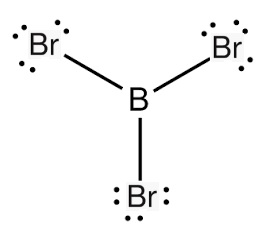
    boron tribromide lewis structure
    Additionally, it also finds applications in olefin polymerisation and in Friedel–Crafts chemistry as a Lewis acid catalyst. The electronics industry uses boron tribromide as a boron source in pre-deposition processes for doping in the manufacture of semiconductors. Boron tribromide is a colourless, fuming liquid compound containing boron and bromine. It is usually made by heating boron trioxide with carbon in the presence of bromine: this generates free boron that reacts vigorously with the bromine. Boron tribromide is used extensively in industries associated with pharmaceutical manufacturing, image processing, semiconductor doping, plasma etching, and photovoltaic manufacturing and as a reagent for different chemical processes.
    Physical and Chemical Properties Fuming colorless viscous liquid with a strong irritant, toxic. Melting point is-46 ℃, the boiling point is 91.3 ℃. It was dissolved in carbon tetrachloride. Easily decomposed by water, alcohol. light or thermal decomposition, heated to explode. It can react with the phosphorus, nitrogen, oxygen, sulfur, halogens, ammonia, alkali, phosphorus halides, phosphines, and many substituents of ammonia. A strong corrosive. Strong irritative to Skin, eye or mucous membrane. Approximate toxicity of hydrogen bromide. United States provides operating maximum allowable concentration of boron tribromide in environment Air is 1ppm (10mg/m3). It is obtained in laboratory by Aluminum tribromide reacting with boron trifluoride, then distillation. can be used as a source of doped semiconductor silicon, but also for the preparation of high purity boron and organic boride.
    Other related chemical reactions involved by boron tribromide:
    In hydroiodic, at 300~400 ℃ continuously fed in boron tribromide, obtained mixture of BIBr2 and BI2Br, BI3, and then separated by distillation, derived dibromo iodide boron.
    Boron tribromide reacts with adamantine, generates 1-bromo-adamantane.
    The above information is edited by the chemicalbook of Yan Yanyong.
    Boron trichloride Boron trifluoride, boron trichloride, boron tribromide and boron triiodide are four kinds of common boron halides, the last three kinds of halogenated boron can be made in the presence of carbonaceous reducing agent by the high-temperature oxidation reduction of halogens and diboron trioxide, the reaction equation is as follows: B2O3 + 3C + 3Cl2 = 2BCl3 + 3CO, boron trifluoride is obtained by interaction of hydrogen fluoride (fluorspar with concentrated sulfuric acid) and diboron trioxide. Boron halide are all covalent molecules, in the vapor state existing in a planar triangles single molecule. Boron atoms using sp2 hybrid orbitals, p orbital of boron atoms filled of electron in the vertical plane perpendicular to the empty p orbital plane of a halogen atom can form large π bond π64. Experimental results show that the measured bond length (such as B-Cl bond length is 173pm) is shorter than a single bond (single bond B-Cl bond length is 187pm), indicating the presence of large π bond. The melting points of all these four kinds of halides are low, boron trifluoride is the lowest, and the boiling point increases with the increase of atomic number of halogen, indicating four kinds of halide are covalent halide molecules, intermolecular attraction is van der Waals forces. In 4 kinds of halides, stability is declined from boron trifluoride in turn to boron triiodide. Boron halides are easily hydrolyzed to produce boric acid.
    Toxicity Boron tribromide has a strong stimulating effect on human tissue, and its vapor is highly toxic, strong corrosive. Wear masks, gloves and protective clothing during operation. Steam inhalation is strictly prohibited. Immediately sent to hospital for treatment after poisoning.
    Uses as the major chemical raw material of the production of caustic soda, soda ash, widely used in alkali industry.
    As a semiconductor silicon doping source, it can be used for preparation of high purity boron and organic boron compound.
    Trona is mainly used for making soda ash, caustic soda, soda, and other products. Soda ash is an important industrial raw material, widely used in glass, chemicals, light industry, textile, dyeing, metallurgy, petroleum processing, pharmaceuticals, food and so on. Caustic soda is mainly used for rayon, paper, dyes, soap, plastics, pharmaceuticals, agricultural chemicals and so on. Baking soda is mainly used in food, plastics, rubber, pharmaceutical, printing and dyeing, tanning, soaking seeds and other areas.
    As a dopant materials of semiconductor, catalyst, intermediate and brominated agent of organic synthesis, It is a raw material for producing high purity boron and other organic boron compound.
    Used in organic synthesis and preparation for high purity boron.
    As catalyst, intermediates and Brominating agents for organic synthesis, raw materials for manufacturing high purity boron and other organic boron compound.
    Production method Direct synthesis is putting the dried powder of boron into the reaction tube of a tubular reactor, to make the reaction can be carried out sufficiently, a certain amount of filler should be placed in the reaction tube, the filler material is the same as the inner wall of the reaction tube. The reaction tube was heated to 850 ℃, also bromine in the bromine vessel was heated to a boil, then poured into reaction tube. The boron tribromide liquid produced with activated carbon, zinc and aluminum scrap together in debromination vessel heated to reflux until boron bromide produced is a colorless, and then by crude distillation, distillation, obtained completely colorless bromide boron products. 2B + 3Br2 → 2BBr3
    Salt Lake alkaline mineral general uses open-pit mining, ancient alkaline mineral general uses underground dissolution mining law. Mining process
    1. open-pit mining 2. underground dissolution method
    Description Boron tribromide is a colorless, fumingliquid. Molecular weight=250.57. Boiling point=90℃;Freezing/Melting point=-46℃; Vapor pressure=53 hPaat 14℃. Hazard Identification (based on NFPA-704 MRating System): Health 3, Flammability 0, Reactivity 2.Soluble in water; dangerous reaction.
    Chemical Properties clear to amber liquid with a pungent odour
    Chemical Properties Boron tribromide is a colorless, fuming liquid.
    Uses Boron Tribromide is used as a reagent in the synthesis of 8-hydroxyquinolato compounds used as electron transport materials in EL devices. It is also used in the demethylation of aryl methyl ethers by boron tribromide.
    Uses manufacture of diborane; ultra high purity boron. Reagent for cleavage of ethers, amines, thiols; addition of allenes and alkynes.
    Uses Catalyst in manufacture of diborane, ultrahigh-purity boron, and semiconductors
    Application The primary use of boron tribromide is as an initiator for the polymerization of olefins and as a catalyst in other organic reactions. It is also used in the electronics industry as a source of bromine for ion implantation in semiconductors, and for plasma etching in semiconductor device manufacturing.
    General Description A colorless, fuming liquid with a pungent odor. Boiling point 194°F. Freezing point -51°F. Very toxic by inhalation. Corrosive to metals and tissue.
    Reactivity Profile Boron tribromide strongly attacks wood and rubber with generation of flammable hydrogen gas. Reacts exothermically and violently with water. Mixing tungsten trioxide and Boron tribromide caused an explosion when the reaction was not cooled in an ice bath.
    Hazard Corrosive to tissue. May explode when heated. Upper respiratory tract irritant.
    Health Hazard Inhalation causes severe irritation of mucous membranes. Ingestion causes burns of mouth and stomach. Contact with eyes or skin causes severe burns.
    Fire Hazard Special Hazards of Combustion Products: Toxic fumes of the chemical or hydrogen bromide may form in fires.
    Potential Exposure Boron tribromide is highly toxic and corrosive, it is used as a catalyst in organic synthesis, making diborane, high purity boron, and semiconductors.
    First aid If this chemical gets into the eyes, remove anycontact lenses at once and irrigate immediately for at least15 min, occasionally lifting upper and lower lids. Seekmedical attention immediately. If this chemical contactsthe skin, remove contaminated clothing and wash immediately with soap and water. Seek medical attention immediately. If this chemical has been inhaled, remove fromexposure, begin rescue breathing (using universal precautions,including resuscitation mask) if breathing hasstopped and CPR if heart action has stopped. Transferpromptly to a medical facility. When this chemical hasbeen swallowed, get medical attention. If victim is conscious,administer water or milk. Do not induce vomiting.Medical observation is recommended for 24 48 h after breathing overexposure, as pulmonary edema may bedelayed. As first aid for pulmonary edema, a doctor orauthorized paramedic may consider administering a corticosteroidspray.
    storage (1) Color Code—White: Corrosive or ContactHazard; Store separately in a corrosion-resistant location.(2) Color Code—Blue: Health Hazard/Poison: Store in asecure poison location. Before entering confined spacewhere boron tribromide may be present, check to makesure that an explosive concentration does not exist.Store in airtight, unbreakable containers in a cool wellventilated area away from water, steam, potassium,sodium, alcohol, and other incompatible materials. Metalcontainers involving the transfer of this chemical should begrounded and bonded. Where possible, automatically pumpliquid from drums or other storage containers to processcontainers. Drums must be equipped with self-closingvalves, pressure vacuum bungs, and flame arresters. Useonly nonsparking tools and equipment, especially whenopening and closing containers of this chemical. Sourcesof ignition, such as smoking and open flames, are prohibited where this chemical is used, handled, or stored in amanner that could create a potential fire or explosionhazard.
    Shipping UN2692 Boron tribromide, Hazard class: 8; Labels: 8—Corrosive materials, 6.1—Poison Inhalation Hazard, Inhalation Hazard Zone B.
    Incompatibilities Reacts violently and explosively with water, steam, or alcohols, forming toxic, corrosive, and potentially explosive hydrogen bromide gas. Mixtures with potassium or sodium can explode on impact. Incompatible with oxidizers, strong bases. Attacks some metals, rubbers, and plastics.

    Shop 3-Chloro-1-propene107-05-1-Detailed Image 2 Shop 3-Chloro-1-propene107-05-1-Detailed Image 3 Shop 3-Chloro-1-propene107-05-1-Detailed Image 4 Shop 3-Chloro-1-propene107-05-1-Detailed Image 5 Shop 3-Chloro-1-propene107-05-1-Detailed Image 6 Shop 3-Chloro-1-propene107-05-1-Detailed Image 7


    Basic Info
    Product Name:

    Boron tribromide

    Other Name:

    Borane,tribromo-;Boron bromide (BBr3);Tribromoborane;Boron bromide;Boron tribromide;Tribromoboron;Boron(III) bromide;5967-37-3

    CAS No.:

    10294-33-4

    Molecular Formula:

    BBr3

    InChIKeys:

    InChIKey=ILAHWRKJUDSMFH-UHFFFAOYSA-N

    Molecular Weight:

    250.52

    Exact Mass:

    250.52

    EC Number:

    233-657-9

    UNII:

    A453DV9339

    ICSC Number:

    0230

    UN Number:

    2692

    DSSTox ID:

    DTXSID4065028

    Color/Form:

    Colorless, fuming liquid

    HScode:

    28129090

    Categories:

    Inorganic Salts

    Characteristics
    PSA:

    0

    XLogP3:

    3.61

    Appearance:

    colorless Solution

    Density:

    2.6431 g/cm3 @ Temp: 18.4 °C

    Melting Point:

    -46.0 °C

    Boiling Point:

    90 °C

    Flash Point:

    30 °F

    Refractive Index:

    1.434

    Water Solubility:

    Reacts with water.Miscible with ethanol and carbon tetrachloride.

    Storage Conditions:

    Poison room

    Vapor Pressure:

    40 mm Hg ( 14 °C)

    Vapor Density:

    8.6 (vs air)

    Flammability characteristics:

    Decomposes toxic bromide and boride gas in contact with water or heat

    Explosive limit:

    May explode in moist air

    Odor:

    Sharp, irritating odor

    Experimental Properties:

    Decomposes on contact with alcohol. This produces toxic and corrosive fumes of hydrogen bromide. Reacts with water. This produces hydrogen bromide gas.|Decomposed by water or alcohol|Vapor (gas) specific gravity: 8.64; ratio of specific heats of vapor (gas): 1.140; heat of fusion: 2.9 cal/g|Critical volume: 272 cu cm/mol|For more Other Experimental Properties (Complete) data for BORON TRIBROMIDE (7 total), please visit the HSDB record page.

    Air and Water Reactions:

    Fumes in air, evolving hydrobromic acid. Reacts vigorously with water or explosively [Mellor 5:124 1946-47]. Borob Tribromide reacts vigorously with water to generate gaseous HBr. Based on a scenario where the chemical is spilled into an excess of water (at least 5 fold excess of water), half of the maximum theoretical yield of Hydrogen Bromide gas will be created in 0.18 minutes. Experimental details are in the following: "Development of the Table of Initial Isolation and Protective Distances for the 2008 Emergency Response Guidebook", ANL/DIS-09-2, D.F. Brown, H.M. Hartmann, W.A. Freeman, and W.D. Haney, Argonne National Laboratory, Argonne, Illinois, June 2009.

    Reactive Group:

    Halogenating Agents

    Reactivity Alerts:

    Water-Reactive

    Reactivity Profile:

    BORON TRIBROMIDE strongly attacks wood and rubber with generation of flammable hydrogen gas. Reacts exothermically and violently with water. Mixing tungsten trioxide and boron tribromide caused an explosion when the reaction was not cooled in an ice bath.

    Ionization Potential:

    9.70 eV

    Flammable Limits:

    Noncombustible Liquid

    Physical Dangers:

    The vapour is heavier than air.

    Corrosivity:

    Strongly attacks metals and wood|Corrosive to rubber and bakelite|Corrosive to tissue

    Heat of Vaporization:

    30.5 kJ/mol at 91 °C

    Critical Temperature & Pressure:

    Critical temperature: 581 K (308 °C)

    Hazard Identification

    Classification of the substance or mixture

    Acute toxicity - Category 2, Oral

    Skin corrosion, Sub-category 1A

    Acute toxicity - Category 2, Inhalation

    GHS label elements, including precautionary statements

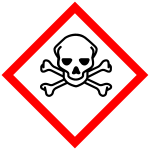
    Pictogram(s)
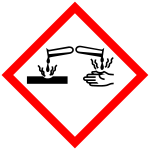
    Signal word

    Danger

    Hazard statement(s)

    H300 Fatal if swallowed

    H314 Causes severe skin burns and eye damage

    H330 Fatal if inhaled

    Precautionary statement(s)
    Prevention

    P264 Wash ... thoroughly after handling.

    P270 Do not eat, drink or smoke when using this product.

    P260 Do not breathe dust/fume/gas/mist/vapours/spray.

    P280 Wear protective gloves/protective clothing/eye protection/face protection/hearing protection/...

    P271 Use only outdoors or in a well-ventilated area.

    P284 [In case of inadequate ventilation] wear respiratory protection.

    Response

    P301+P316 IF SWALLOWED: Get emergency medical help immediately.

    P321 Specific treatment (see ... on this label).

    P330 Rinse mouth.

    P301+P330+P331 IF SWALLOWED: Rinse mouth. Do NOT induce vomiting.

    P363 Wash contaminated clothing before reuse.

    P304+P340 IF INHALED: Remove person to fresh air and keep comfortable for breathing.

    P316 Get emergency medical help immediately.

    P305+P351+P338 IF IN EYES: Rinse cautiously with water for several minutes. Remove contact lenses, if present and easy to do. Continue rinsing.

    P320 Specific treatment is urgent (see ... on this label).

    Storage

    P405 Store locked up.

    P403+P233 Store in a well-ventilated place. Keep container tightly closed.

    Disposal

    P501 Dispose of contents/container to an appropriate treatment and disposal facility in accordance with applicable laws and regulations, and product characteristics at time of disposal.

    Other hazards which do not result in classification

    no data available

    Handling and Storage

    Precautions for safe handling

    NO contact with water or steam. NO contact with hot surfaces. Handling in a well ventilated place. Wear suitable protective clothing. Avoid contact with skin and eyes. Avoid formation of dust and aerosols. Use non-sparking tools. Prevent fire caused by electrostatic discharge steam.

    Conditions for safe storage, including any incompatibilities

    Separated from incompatible materials. See Chemical Dangers. Cool. Dry. Ventilation along the floor.Separate from alkalies, oxidizing materials, alcohols, ethers, alkali metals, phosphorus, wood. Store in a cool, dry, well-ventilated location.

  • Seller Information
    Business Type:

    Trader

    Main Products:

    pharmaceutical intermediates,peptides,electronic chemicals

    Location:

    Room 102, 1st Floor, East Office Building, No. 45 Pengwan Road, Qianwan Bonded Port Area, Qingdao Zone, China (Shandong) Pilot Free Trade Zone

    Payment Terms:

    100% TT in advance

    Average lead Time:

    10

    Total Annual Revenue:

    $10 million-$25 million

    Total Employees:

    51-100

    Year of Establishment:

    2024

    A reliable supplier is like insurance.

    We are mainly specilized in supply of pharmaceutical intermediates, electronic chemicals,food additives, and other fine chemical products.
    Integrity is the foundation, quality is life. We would like to work together with you to build a greener and brighter future.

    Website: orientchem.cc
    Email: scarlett@orientchem.cc
    WhatsApp: +86 17753254221

  • Inquiry History
    3 Inquiries
    Country Product Purchase Quantity Date Posted
    Canada

    Boron tribromide

    1 KG Jul 5, 2024
    Norway

    Boron Tribromide

    2 L Jan 14, 2025
    Estonia

    Boron tribromide 99%

    21 KG Apr 12, 2024
    Post an enquiry for this product
pic ×

Scan the QR Code to Share

All products displayed on this website are only for non-medical purposes such as industrial applications or scientific research, and cannot be used for clinical diagnosis or treatment of humans or animals. They are not medicinal or edible.

According to relevant laws and regulations and the regulations of this website, units or individuals who purchase hazardous materials should obtain valid qualifications and qualification conditions.

The information shown above is provided by the enterprise itself, and the authenticity, accuracy and legitimacy of the content are the responsibility of the publishing company. ECHEMI does not bear any guarantee responsibility for this. Please be aware that risks in internet transactions objectively exist.

Feedback & Suggestions
Send Message

Thank you for your feedback. If you require further assistance, please contact us by email at info@echemi.com or call us at +86-532-55729510.