Product
Supplier
Encyclopedia
Inquiry
2,4,7,9-Tetramethyl-5-decyne-4,7-diol126-86-3 buy - large image1
2,4,7,9-Tetramethyl-5-decyne-4,7-diol126-86-3 buy - image1
2,4,7,9-Tetramethyl-5-decyne-4,7-diol126-86-3 buy - image2
2,4,7,9-Tetramethyl-5-decyne-4,7-diol126-86-3 buy - image3
2,4,7,9-Tetramethyl-5-decyne-4,7-diol126-86-3 buy - image4
2,4,7,9-Tetramethyl-5-decyne-4,7-diol126-86-3 buy - image5
2,4,7,9-Tetramethyl-5-decyne-4,7-diol126-86-3 buy - image6

2,4,7,9-Tetramethyl-5-decyne-4,7-diol126-86-3

1 Inquiries

Unit Price:

$33-34/MT FOB

Get Latest Price
CAS No.:

126-86-3

Grade:

Pharmaceutical Grade

Content:

99.5%

Port:

上海

Brand:

OORENT

Packaging:

Vial/Bottle/Bag/Carton

Price valid (until):

2026-07-18

Company Type:
Trader
Location:
China
Qualification:
Main Products:

pharmaceutical intermediates,peptides,electronic chemicals

  • Product Description

  • Seller Information

  • Inquiry History

  • Description

    Product Detail

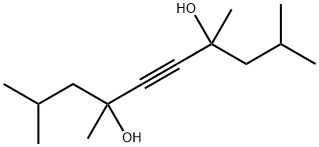
    2,4,7,9-Tetramethyl-5-decyne-4,7-diol Basic information
    Product Name: 2,4,7,9-Tetramethyl-5-decyne-4,7-diol
    Synonyms: 5-DECYNE-4,7-DIOL-2,4,7,9-TETRAMETHYL;4,7-DIHYDROXY-2,4,7,9-TETRAMETHYL-5-DECYNE;TIMTEC-BB SBB008941;TETRAMETHYL DECYNEDIOL;SURFYNOL TG;1,4-diisobutyl-1,4-dimethylbutynediol;2,4,7,9-TETRAMETHYL-5-DECYN-4,7-DIOL;2,4,7,9-TETRAMETHYL-5-DECYNE-4,7-DIOL
    CAS: 126-86-3
    MF: C14H26O2
    MW: 226.35
    EINECS: 204-809-1
    Product Categories: Aliphatics;Miscellaneous Reagents;Acetylenes;Acetylenic Alcohols & Their Derivatives;Nonionic Surfactants;NonionicSelf-Assembly Materials;Polymer Additives;Surfactants;Surfactant
    Mol File: 126-86-3.mol
    Shop 2,4,7,9-Tetramethyl-5-decyne-4,7-diol126-86-3-Detailed Image 1

    2,4,7,9-Tetramethyl-5-decyne-4,7-diol Chemical Properties
    Melting point  42-44 °C(lit.)
    Boiling point  255 °C(lit.)
    density  0,89 g/cm3
    vapor pressure  0.66Pa at 20℃
    refractive index  1.4560 (estimate)
    Fp  >230 °F
    storage temp.  2-8°C
    solubility  Chloroform (Slightly), Methanol (Slightly)
    form  Solid
    pka 12.92±0.29(Predicted)
    color  White to Off-White
    Water Solubility  1.7g/L at 20℃
    BRN  1724053
    Hydrophilic-Lipophilic Balance (HLB) 4
    Cosmetics Ingredients Functions CLEANSING
    SURFACTANT - CLEANSING
    InChI 1S/C14H26O2/c1-11(2)9-13(5,15)7-8-14(6,16)10-12(3)4/h11-12,15-16H,9-10H2,1-6H3
    InChIKey DCAZNTOSTOZBEI-UHFFFAOYSA-N
    SMILES CC(C)CC(C)(O)C#CC(C)(O)CC(C)C
    LogP 2.8 at 22℃
    CAS DataBase Reference 126-86-3(CAS DataBase Reference)
    EPA Substance Registry System 2,4,7,9-Tetramethyl-5-decyne-4,7-diol (126-86-3)

    Safety Information
    Hazard Codes  Xi
    Risk Statements  36-52/53
    Safety Statements  26-37/39-61-39-37/29
    RIDADR  3077
    WGK Germany  3
    TSCA  TSCA listed
    PackingGroup  III
    HS Code  29053990
    Storage Class 13 - Non Combustible Solids
    Hazard Classifications Aquatic Chronic 3
    Eye Dam. 1
    Skin Sens. 1
    Hazardous Substances Data 126-86-3(Hazardous Substances Data)
    MSDS Information
    Provider Language
    2,4,7,9-Tetramethyl-5-decyne-4,7-diol English
    ACROS English
    SigmaAldrich English
    ALFA English

    2,4,7,9-Tetramethyl-5-decyne-4,7-diol Usage And Synthesis
    Chemical Properties 2,4,7,9-Tetramethyl-5-decyne-4,7-diol is white to pale yellow low melting mass
    Uses 2,4,7,9-Tetramethyl-5-decyne-4,7-diol is an acetylene glycol derivative used in water-based coatings and has both antifoaming and surfactant properties. It is highly toxic and have been found in acrylic adhesives used for food packaging multilayers manufacturing.
    Uses 2, 4, 7, 9-tetramethyldec-5-yne-4,7-diol may be used to dope poly[9,9-bis(6′-(diethanolamino)hexyl)-fluorene],that acts as an interfacial layer in a heterojunction solar cell.
    General Description 2, 4, 7, 9-tetramethyldec-5-yne-4,7-diol is a well-known acrylic adhesive. It has amphiphilic characteristics. It is used a dopant in a heterojunction solar cell, it assists in the formation of a homogeneous interfacial layer over the photoactive layer. Doping results in decreasing the absorption of photons in the underneath photoactive layer, thereby in enhancing the photocurrent density.
    Hazard In vivo experiments have shown that 2,4,7,9-Tetramethyl-5-decyne-4,7-diol induced lethargy in a lethal dose inhalation study in rats; tremors and convulsions were induced in a feeding study in dogs. It is an irritant to human skin and eyes, as well as a neurotoxic hazard to the rest of the central nervous system.
    Flammability and Explosibility Non flammable
    Synthesis
    Shop 2,4,7,9-Tetramethyl-5-decyne-4,7-diol126-86-3-Detailed Image 2

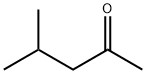
    108-10-1


    Shop 2,4,7,9-Tetramethyl-5-decyne-4,7-diol126-86-3-Detailed Image 3

    74-86-2


    Shop 2,4,7,9-Tetramethyl-5-decyne-4,7-diol126-86-3-Detailed Image 4

    126-86-3

    1. the concentrated alkali solution from Example 1 was dehydrated under reduced pressure to obtain 14 g of paste. 2. the paste was mixed with 10 g of the novel coordination catalyst, 100 g of methyl isobutyl ketone, 40 g of cyclohexane and 31 g of divinyl ether. 3. The mixture was placed in a 500 mL autoclave, the air was replaced with nitrogen and the temperature was controlled at 40~45°C. 4. Acetylene was introduced into the reaction system, keeping the system pressure not higher than 0.1 MPa. When 11.7 g of acetylene was introduced, the pressure of the system was kept for 10 minutes and did not decrease any further, and the reaction was stopped. At this time, the reaction time was 5.5 hours. 5. After cooling to room temperature, the reaction solution in the autoclave was transferred to a 500 mL beaker, 10 g of deionized water was added, and the system was stratified. 6. 26 g of concentrated lye solution containing the lower layer of lye was isolated and transferred to a 250 mL beaker. 7. The organic layer was neutralized with 20% phosphoric acid solution to pH 6-7, and the brine layer was separated to give 190g of organic phase. 8. The organic phase was transferred to a 250mL three-necked flask and 17g of the semi-finished ethynediol product of Example 1 was added. 9. 37 g of cyclohexane was distilled at atmospheric pressure followed by a reduced pressure distillation. 10. 1.5 g of low boiling point material was collected at 60 °C under vacuum at -0.098 MPa, 31 g of pre-fraction was collected at 60-90 °C, and 28 g of diethylene glycol divinyl ether was collected at 90-120 °C. 11. 120 g of ethynediol semi-finished product was obtained at 120-150 °C and 85.5 g of ethynediol product was collected at 150-155 °C. 12. The heating was stopped, cooled to room temperature and 2 g of high boiling point residue remained in the beaker. 13. The yield of acetylene diol (relative to acetylene) was calculated to be 84.1%. 14. 20 g of potassium hydroxide and 200 g of diethylene glycol divinyl ether were weighed in a 500 mL three-necked flask and the reaction was heated to 60° C. with stirring until the potassium hydroxide was completely dissolved. 15. Weigh the above-prepared complexation catalyst, mix it with 100g methyl isobutyl ketone and 50g cyclohexane, put it into a 500mL autoclave, and replace the air with nitrogen. 16. Control the temperature at 40-45°C, pass acetylene into the reaction system, keep the system pressure not higher than 0.1 MPa. 17. When 10.4 g of acetylene was passed, the pressure of the system was maintained for 10 minutes and did not decrease any further, and the reaction was stopped. At this point, the reaction time was 6 hours. 18. After cooling to room temperature, the reaction solution was transferred to a 500 mL beaker, 10 g of deionized water was added, and the system was stratified. 19. 23 g of concentrated alkaline solution containing the lower layer of oxime was isolated and transferred to a 250 mL beaker. 20. The organic layer was neutralized with 20% phosphoric acid solution to pH 6-7 and the brine layer was separated to give 185g of organic phase. 21. The organic phase was transferred to a 250mL three-necked flask, 46g of cyclohexane was added, and the cyclohexane was distilled out at atmospheric pressure, followed by distillation under reduced pressure. 22. 1 g of low boiling point material was collected at 60 °C, 18 g of pre-fraction was collected at 60-90 °C and 31 g of diethylene glycol divinyl ether was collected at 90-120 °C at a pressure of -0.098 MPa. 23. 17 g of ethynediol semi-finished product was obtained at 120-150 °C and 69 g of ethynediol product was collected at 150-155 °C. 24. The heating was stopped, cooled to room temperature and 3 g of high boiling point residue remained in the beaker. 25. The yield of ethynediol (relative to acetylene) was calculated to be 76.3%.

    Toxics Screening Level The Initial threshold Screening Level (ITSL) is 70μg/m3 based on annual averaging.
    References [1] Patent: CN107963960, 2018, A. Location in patent: Paragraph 0058; 0059

    2,4,7,9-Tetramethyl-5-decyne-4,7-diol Preparation Products And Raw materials
    Raw materials 4-Methyl-2-pentanone-->Acetylene-->Potassium hydroxide-->Cyclohexane

    Shop 3-Chloro-1-propene107-05-1-Detailed Image 2 Shop 3-Chloro-1-propene107-05-1-Detailed Image 3 Shop 3-Chloro-1-propene107-05-1-Detailed Image 4 Shop 3-Chloro-1-propene107-05-1-Detailed Image 5 Shop 3-Chloro-1-propene107-05-1-Detailed Image 6 Shop 3-Chloro-1-propene107-05-1-Detailed Image 7


    Basic Info
    Product Name:

    2,4,7,9-Tetramethyl-5-decyne-4,7-diol

    Other Name:

    5-Decyne-4,7-diol,2,4,7,9-tetramethyl-;2,4,7,9-Tetramethyl-5-decyne-4,7-diol;Surfynol 104;Surfynol 104A;Surfynol 104E;1,4-Diisobutyl-1,4-dimethylbutynediol;Surfynol TG;Surfynol 104H;Surfynol 104PA;Olfine STG-E;Surfynol CT 111;Surfynol 104BC;NSC 5630;Olfine AK 02;2,4,7,9-Tetramethyl-5-decyn-4,7-diol;Acetylenol E 00;Olfine PD 301;PD 301;104E;Zetasperse 1200;Surfynol PG 50;LA-W 1092;Olfine PD 001;104H;Surfadol 541;TMDDO;TMDD;GS 850PA;Tuyile FS 204;Surfynol DF 104E;PD 001;104BC;8043-35-4;37211-43-1;61879-19-4;149079-55-0;166737-17-3;170006-53-8;171023-04-4;504414-59-9;845642-79-7;867273-13-0;872345-61-4;2414315-97-0

    CAS No.:

    126-86-3

    Molecular Formula:

    C14H26O2

    InChIKeys:

    InChIKey=LXOFYPKXCSULTL-UHFFFAOYSA-N

    Molecular Weight:

    226.35500

    Exact Mass:

    226.35

    EC Number:

    204-809-1

    UNII:

    B9Y126NY8K

    NSC Number:

    5630

    DSSTox ID:

    DTXSID7027041

    HScode:

    2905399090

    Characteristics
    PSA:

    40.46000

    XLogP3:

    2.7

    Appearance:

    Liquid

    Density:

    0.89

    Melting Point:

    56-60 °C

    Boiling Point:

    153-157 °C @ Press: 20 Torr

    Flash Point:

    97.3ºC

    Refractive Index:

    1.479

    Storage Conditions:

    Keep in a cool, dry location in a tightly sealed container.

    Vapor Pressure:

    0.00296mmHg at 25°C

    Experimental Properties:

    WAXY OR POWDERED SOLIDS OR LIQUIDS; NONFOAMING, NONIONIC /SURFYNOL/

    Hazard Identification

    Classification of the substance or mixture

    Skin sensitization, Sub-category 1B

    Serious eye damage, Category 1

    Hazardous to the aquatic environment, long-term (Chronic) - Category Chronic 3

    GHS label elements, including precautionary statements

    Pictogram(s)

    Signal word

    Danger

    Hazard statement(s)

    H317 May cause an allergic skin reaction

    H318 Causes serious eye damage

    H412 Harmful to aquatic life with long lasting effects

    Precautionary statement(s)
    Prevention

    P261 Avoid breathing dust/fume/gas/mist/vapours/spray.

    P272 Contaminated work clothing should not be allowed out of the workplace.

    P280 Wear protective gloves/protective clothing/eye protection/face protection/hearing protection/...

    P273 Avoid release to the environment.

    Response

    P302+P352 IF ON SKIN: Wash with plenty of water/...

    P333+P317 If skin irritation or rash occurs: Get medical help.

    P321 Specific treatment (see ... on this label).

    P362+P364 Take off contaminated clothing and wash it before reuse.

    P305+P354+P338 IF IN EYES: Immediately rinse with water for several minutes. Remove contact lenses, if present and easy to do. Continue rinsing.

    P317 Get medical help.

    Storage

    none

    Disposal

    P501 Dispose of contents/container to an appropriate treatment and disposal facility in accordance with applicable laws and regulations, and product characteristics at time of disposal.

    Other hazards which do not result in classification

    no data available

    Handling and Storage

    Precautions for safe handling

    Handling in a well ventilated place. Wear suitable protective clothing. Avoid contact with skin and eyes. Avoid formation of dust and aerosols. Use non-sparking tools. Prevent fire caused by electrostatic discharge steam.

    Conditions for safe storage, including any incompatibilities

    Store the container tightly closed in a dry, cool and well-ventilated place. Store apart from foodstuff containers or incompatible materials.

  • Seller Information
    Business Type:

    Trader

    Main Products:

    pharmaceutical intermediates,peptides,electronic chemicals

    Location:

    Room 102, 1st Floor, East Office Building, No. 45 Pengwan Road, Qianwan Bonded Port Area, Qingdao Zone, China (Shandong) Pilot Free Trade Zone

    Payment Terms:

    100% TT in advance

    Average lead Time:

    10

    Total Annual Revenue:

    $10 million-$25 million

    Total Employees:

    51-100

    Year of Establishment:

    2024

    A reliable supplier is like insurance.

    We are mainly specilized in supply of pharmaceutical intermediates, electronic chemicals,food additives, and other fine chemical products.
    Integrity is the foundation, quality is life. We would like to work together with you to build a greener and brighter future.

    Website: orientchem.cc
    Email: scarlett@orientchem.cc
    WhatsApp: +86 17753254221

  • Inquiry History
    1 Inquiries
    Country Product Purchase Quantity Date Posted
    India

    SRFYNOL 106

    1.00 KG Dec 1, 2025
    Post an enquiry for this product
pic ×

Scan the QR Code to Share

All products displayed on this website are only for non-medical purposes such as industrial applications or scientific research, and cannot be used for clinical diagnosis or treatment of humans or animals. They are not medicinal or edible.

According to relevant laws and regulations and the regulations of this website, units or individuals who purchase hazardous materials should obtain valid qualifications and qualification conditions.

The information shown above is provided by the enterprise itself, and the authenticity, accuracy and legitimacy of the content are the responsibility of the publishing company. ECHEMI does not bear any guarantee responsibility for this. Please be aware that risks in internet transactions objectively exist.

Feedback & Suggestions
Send Message

Thank you for your feedback. If you require further assistance, please contact us by email at info@echemi.com or call us at +86-532-55729510.