




Arbekacin
-
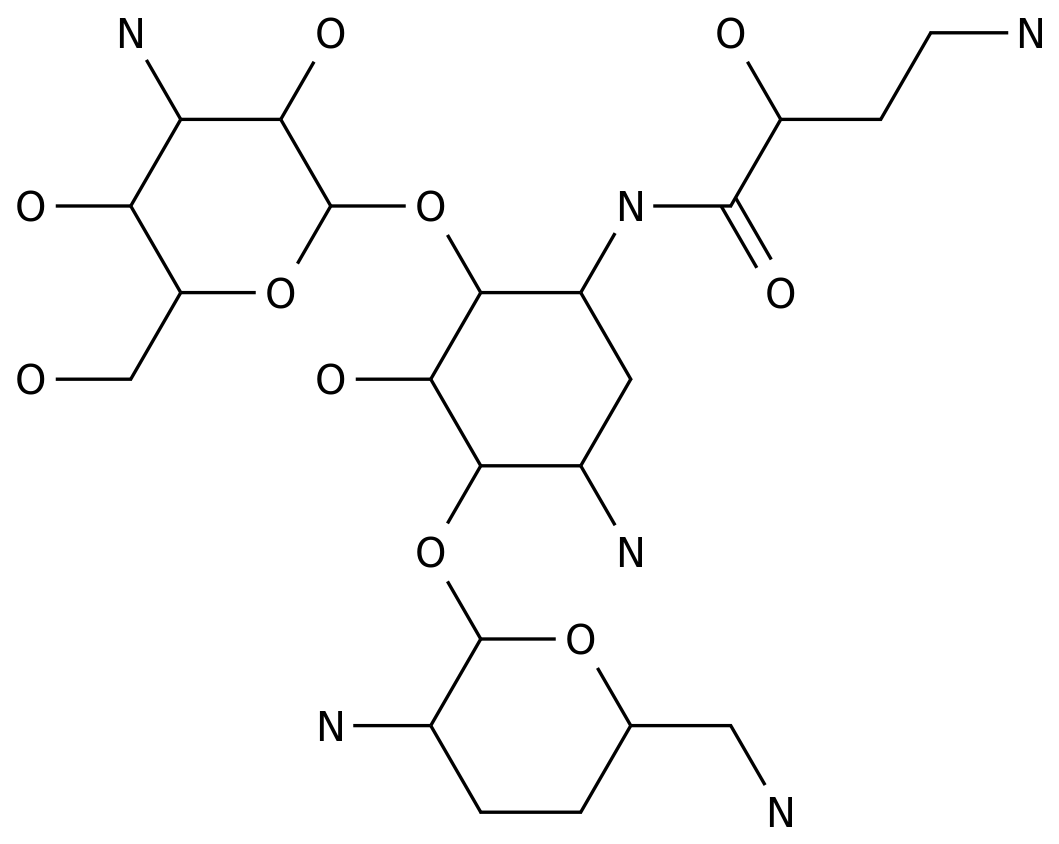
Arbekacin
structure -
-
CAS No:
51025-85-5
-
Formula:
C22H44N6O10
-
Chemical Name:
Arbekacin
-
Synonyms:
D-Streptamine,O-3-amino-3-deoxy-α-D-glucopyranosyl-(1→6)-O-[2,6-diamino-2,3,4,6-tetradeoxy-α-D-erythro-hexopyranosyl-(1→4)]-N1-[(2S)-4-amino-2-hydroxy-1-oxobutyl]-2-deoxy-;O-3-Amino-3-deoxy-α-D-glucopyranosyl-(1→6)-O-[2,6-diamino-2,3,4,6-tetradeoxy-α-D-erythro-hexopyranosyl-(1→4)]-N1-[(2S)-4-amino-2-hydroxy-1-oxobutyl]-2-deoxy-D-streptamine;1-N-[(S)-4-Amino-2-hydroxybutyryl]-3′,4′-dideoxykanamycin B;Arbekacin;HBK;1665RB;HABA-DKB;AHB-DKB;Arbecacin;ME 1100;ME1100
- Categories:
-
CAS No:
Description
ChEBI: A kanamycin that is kanamycin B bearing an N-(2S)-4-amino-2-hydroxybutyryl group on the aminocyclitol ring.
Solid
Arbekacin is a kanamycin that is kanamycin B bearing an N-(2S)-4-amino-2-hydroxybutyryl group on the aminocyclitol ring. It has a role as an antimicrobial agent, a protein synthesis inhibitor, an antibacterial agent and an antibacterial drug. It is a member of kanamycins and an aminoglycoside. It derives from a kanamycin B.|An semisynthetic aminoglycoside antibiotic. Often used for treatment of multi-resistant bacterial infection such as methicillin-resistant Staphylococcus aureus (MRSA).|Arbekacin is a semisynthetic aminoglycoside antibiotic derived from dibekacin with activity against both gram-positive and gram-negative bacteria. Arbekacin is most commonly used in the treatment of multi-resistant bacterial infections.
Arbekacin Basic Attributes
552.62
552.62
G7V6SLI20L
DTXSID8048319
C76145
J - Antiinfectives for systemic use
Characteristics
297
-4.00
1.5±0.1 g/cm3
178 °C
904.0±65.0 °C at 760 mmHg
500.5±34.3 °C
1.635
4.10e+01 g/L
Toxicity
Patients with renal impairment or those taking ototoxic and nephrotoxic drugs are at the highest risk for ototoxicity and nephrotoxicity associated with aminoglycoside use. Normal duration of IM or IV aminoglycoside therapy is 7-10 days. Although a longer duration may be necessary in some cases, toxicity is more likely to occur when aminoglycoside treatment is continued for longer than 10 days.
3-12%
Drug Information
Arbekacin is used for the short term treatment of multi-resistant bacterial infections, such as methicillin-resistant Staphylococcus aureus (MRSA).
Arbekacin is an aminoglycoside. Aminoglycosides function by binding to bacterial 30S ribosomal subunits, causing t-RNA misreads, and preventing the production of proteins. Anaerobes are less susceptible to aminoglycosides because they do not spend as much energy as aerobes on taking up chemicals like aminoglycosides. Aminoglycosides are useful primarily in infections involving aerobic, gram-negative bacteria, such as Pseudomonas, Acinetobacter, and Enterobacter.
Substances that prevent infectious agents or organisms from spreading or kill infectious agents in order to prevent the spread of infection. (See all compounds classified as Anti-Infective Agents.)
Aminoglycosides are not well absorbed from the gastrointestinal tract. Their absorption is markedly improved by parenteral administration.
3 hours
Arbekacin irreversibly binds bacterial 30S and 16S ribosomal subunits inhibiting protein synthesis. Arbekacin binds to 4 nucleotides of the 16S subunit and 1 amino acid of protein S12 to interfere with the decoding site around nucleotide 1400 in the 16S subunit. Interference with the decoding site interferes with its interaction with the wobble base of tRNA. This hindered interaction causes mRNA to be misread and the incorrect amino acids are inserted into protein. These error filled proteins are not able to function or may even be toxic.
1-N-((S)-4-amino-2-hydroxybutyryl)dibekacin
Arbekacin Use and Manufacturing
3', 4'-dideoxykanamycin B and equivalent tert-butoxycarbonyl azide, in a mixed solution of water, pyridine and triethylamine (10:10:1), react at room temperature for 18h . Then use Amberlite CG50 (NH4+) column chromatography to obtain 6'-N-tert-butoxycarbonyl-3', 4'-dideoxykanamycin B with a yield of 49% and a melting point of 136~140℃ (decomposition). [α] {D}^26+112°(C=1.0, water). At the same time, 36% of unreacted 3', 4'-dideoxykanamycin B was recovered. 6'-N-tert-butoxycarbonyl-3', 4'-dideoxykanamycin B (1.1g, 2.0mmo1) and tert-butoxycarbonyl azide (320mg, 2.2mmo1) under the same conditions as above The next reaction yielded 1.41 g of yellow powder. Without purification, dissolve in 20ml water and 10ml dimethoxyethane, and use (S)-4-tert-butoxycarbonylamino-2-hydroxybutyric acid (N-hydroxysuccinimide) ester (696mg, 2.2mmo1) ) A solution in 10ml of dimethoxyethane, acylation at room temperature for 20h. React with 10ml 90% trifluoroacetic acid at room temperature for 40min, and remove the tert-butoxycarbonyl group. The reaction solution was concentrated until it was chromatographed with Amberlite CG50 (NH4+) column, eluted with water and 0.5 mol/L ammonia, and then eluted with 0.75 mol/L ammonia. 162 mg of arbekacin dicarbonate was obtained, the yield was 12%, the melting point was 178°C (decomposition), [α]{D}^24+87°(C=0.77, water).
It has strong antibacterial activity against kanamycin, gentamicin and amikacin-resistant bacteria. Used for sepsis and pneumonia caused by sensitive bacteria.
Computed Properties
Molecular Weight:552.6
XLogP3:-6.8
Hydrogen Bond Donor Count:11
Hydrogen Bond Acceptor Count:15
Rotatable Bond Count:10
Exact Mass:552.31189162
Monoisotopic Mass:552.31189162
Topological Polar Surface Area:297
Heavy Atom Count:38
Complexity:757
Defined Atom Stereocenter Count:14
Covalently-Bonded Unit Count:1
Compound Is Canonicalized:Yes
Recommended Suppliers of Arbekacin
-
![China]() CN
CN
8 YRS
Business licensed Certified factoryManufactory Supplier of Biochemicals Ingredients,Vitamin Amino Acid Ingredients,Cosmestic Ingredients,Pharma Chemicals,Organic Fine Chemicals,Food Nutrient Ingredients,Natural Plant Ingredients,APIS Intermidiates,Daily Chemicals,Agricultural Chemicals,Surfactant Chemicals,Ultraviolet Absorbents,Antioxidant Ingredients,Scientific Research Chemical,Flavors and Fragrances ChemicalsInquiryCAS No.: 51025-85-5Grade: Pharmaceutical GradeContent: 99%

Learn More Other Chemicals
-
Arbekacin sulfate
104931-87-5
-
Oseltamivir phosphate
204255-11-8
-
Imidazole salicylate
36364-49-5
-
5H-Pyrazolo[1,2-a][1,2,4]triazol-4-ium, 6,7-dihydro-6-mercapto-, chloride (1:1) Formula
153851-71-9
-
Cefminox Formula
75481-73-1
-
Clindamycin Formula
18323-44-9
-
Bacitracin Zinc Structure
1405-89-6
-
Spectinomycin hydrochloride Structure
21736-83-4
-
What is Isoconazole nitrate
24168-96-5
-
What is α-Solanine
20562-02-1