




Permethrin

-
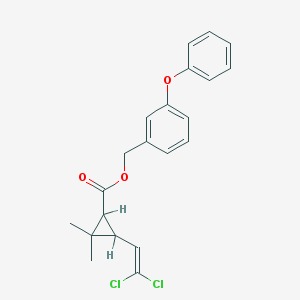
Permethrin
structure -
-
CAS No:
52645-53-1
-
Formula:
C21H20Cl2O3
-
Chemical Name:
Permethrin
-
Synonyms:
(+-)-,(cis,trans)-yleste;(3-phenoxyphenyl)methyl3-(2,2-dichlorethenyl)-2,2-dimethylcyclopropanecarbox;(3-Phenoxyphenyl)methyl-3-(2,2-dichloroethenyl)-2,2-dimethylcyclopropanecarboxylate;(3-phenoxyphenyl)methyl3-(2,2-dichloroethyl)-2,2-dimethylcyclopropane-carboxy;(3-phenoxyphenyl)methyl-3-(2,2-dichlorovinyl)-2,2-dimethylcyclopropane-carboxy;-1-carboxylate;3-(2,2-dichloroethenyl)-2,2-dimethylcyclopropanecarboxylicacid(3-phenoxyphen;SPARTAN
- Categories:
-
CAS No:
Description
Permethrin (NRDC-143) is an insecticide, acaricide, and insect repellent; functions as a neurotoxin, affecting neuron membranes by prolonging sodium channel activation.
Yellow-brown to brown liquid, which sometimes tends to crystallize at room temperature (technical grade).Permethrin, a pyrethroid insecticide with little mammalian toxicity, has been marketed as a tick repellent. Permethrin is the only synthetic pyrethroid that is used worldwide for head lice. The spray formulation is the most widely available form. Once applied to clothing, it is stable through several wash cycles. It is also suitable for treating sleeping bags, tents, and fabric used for insect screening. A liquid concentrate has been used to impregnate fabric for as long as the life of the garment. Permethrin is particularly helpful in the prevention of tick and chigger bites. These crawling arthropods must travel across the treated fabric, whereas flying insects tend to be attracted directly to exposed skin. The combination of a DEET-containing repellent and permethrin-treated clothing is generally highly ffective against a wide range of biting arthropods.
Crystalline Solid
ChEBI: A cyclopropanecarboxylate ester in which the esterifying alcohol is 3-phenoxybenzyl alcohol and the cyclopropane ring is substituted with a 2,2-dichlorovinyl group and with gem-dimethyl groups.
Pale brown liquid. Relatively water insoluble. Used as an insecticide.
Characteristics
35.5
6.5
Permethrin is a pale brown liquid. Relatively water insoluble. Used as an insecticide.
1.19
34-35°C
bp0.05 220°
10 °C
1.6500 (estimate)
insoluble
0-6°C
7×10⁻⁵Pa (20 °C)
Acute oral LD50for rats: 430-4,000 mg/kg (cis:trans ca. 40:60); ca. 6,000 mg/kg (cis:trans ca. 20:80)
Solvent flammable
5.3×100mol/(m3Pa) at 25℃, Duchowicz et al. (2020)
Insoluble in water.
A pyrethroid derivative.
0-6°C
Safety Information
III
6
UN12303/PG2
3
Xn,N,T,F
13-24-36/37/39-60-61-45-36/37-16-7-26
GZ1255000
Xn,N,T,F
Treasury is ventilated, low temperature and dry; stored and transported separately from oxidant
Solvent vapor can be explosive when mixed with air
Stable. Incompatible with strong oxidising agents.
P210-P273-P280-P305 + P351 + P338
20/22-43-50/53-39/23/24/25-23/24/25-11-51/53-36-20/21/22
UN1230 3/PG 2
Pyrethroids, also called pyrethrinoids, are neurotoxic synthetic compounds used as insecticides, with irritant properties. Cypermethrin and fenvalerate have been reported as causing positive allergic patch tests, but only fenvalerate was relevant in an agricultural worker.
Toxicity
highly toxic
Soil.Permethrin biodegraded rapidly via hydrolysis yielding 3-(2,2-dichloroethenyl)- 2,2-dimethylcyclopropanecarboxylic acid and 3-phenoxybenzyl alcohol (Kaufman et al., 1981). The reported half-life in soil containing 1.3–51.3% organic matter and pH 4.2–7.7 is <38 days (Worthing and Hance, 1991)In lake water, permethrin degraded more rapidly than in flooded sediment to transand cis-(dichlorovinyl)dimethylcyclopropanecarboxylic acid. The cis isomer was more stable toward biological and chemical degradation than the trans isomer (Sharom and SolomPlant.Metabolites identified in cotton leaves included trans-hydroxypermethrin, 2′- hydroxypermethrin, 4′-hydroxypermethrin, dichlorovinyl acid, dichlorovinyl acid conjugates, hydroxydichlorovinyl acid, hydroxydichlorovinyl acid conjugates, pheDislodgable residues of permethrin on cotton leaves 0, 24, 48, 72 and 96 hours after application (1.1 kg/ha) were (cis:trans): 0.26:0.38, 0.24:0.34, 0.22:0.32, 0.16:0.24 and 0.15:0.21 μg/m2, respectively (Buck et al., 1980).Photolytic.Photolysis of permethrin in aqueous solutions containing various solvents (acetone, hexane and methanol) under UV light (λ >290 nm) or on soil in sunlight initially resulted in the isomerization of the cyclopropane moiety and ester cl
Permethrin Use and Manufacturing
The action of trichloroacetaldehyde and isobutene gives (I) (II) two trichloroenol isomers. The reaction is carried out at a low temperature using aluminum trichloride as a catalyst. In the presence of hydrogen chloride, acetonitrile interacts with absolute ethanol to form iminoether ether hydrochloride, which further reacts with absolute ethanol to generate triethyl orthoacetate (III). In the presence of catalyst p-toluenesulfonic acid, it is heated to 114-118°C and reacted for 3 hours to convert (I) to (II). The transposition product is reacted with triethyl orthoacetate, the catalyst is isobutyric acid, the reaction temperature is increased from 110℃ to 150℃, about 12h, the reaction is performed at 150~155℃ for 7~8h, and the pre-distillate is distilled off under the pressure of 0.08MPa, 3, 3-Dimethyl-4, 6, 6-trichlorohexene-[5]-acid ethyl ester (V) is accompanied by (VI). (VI) is subjected to a ring-opening reaction in a hydrogen chloride-ethanol solution to obtain (V). (V) In the presence of sodium ethoxide, react at 40~45℃ for 5h, cyclize to produce ethyl 2, 2-dimethyl-3-(2, 2-dichlorovinyl)-cyclopropanecarboxylate (VII) After rectification, ethyl permethrin is obtained with higher purity. In the presence of alkaline solution, (VII) was refluxed for 3 hours to saponify to obtain the corresponding sodium salt (VIII). (VIII) React with m-phenoxybenzyl triethylamine chloride to produce permethrin (IX). The reaction process is as follows: The synthesis of permethrin can be found in [5].
For the treatment of infestation with Sarcoptes scabiei (scabies).
Permethrin is a synthetic pyrethroid active against lice, ticks, mites, and fleas. It acts on neural cellmembranes, delaying repolarization and causing paralysis. The compound has no reported adverse properties, is heat and light stable, has 70% to 80% ovicidal activity, and leaves an active residue on the scalp. Permethrin is 26 times less toxic than lindane and 3 times less toxic than pyrethrins. A 1% permethrin cream rinse (Nix) preparation with a single application was determined to be more effective than treatment with RID. Permethrin-treated military uniforms are effective against human body lice. Apply the cream rinse for 10 minutes and rinse off with water. Localized pruritus may be reported with use of this product.
Labelled Permethrin (P288500). Synthetic pyrethroid insectide, more stable to light and at least as active as the natural pyrethrins and with low mammalian toxicity.
Drug Function and Efficacy
Sodium channel blocker, acts on the nervous system of insects causing paralysis and death
Registered Holders
-
SRIKEM LABORATORIES PVT LTD
Active![United States]() United States
United States
-
BIOPHORE INDIA PHARMACEUTICALS PVT LTD
Active![United States]() United States
United States
-
Dr. Reddy's Laboratories(EU) Ltd
Active![South Korea]() South Korea
South Korea


Recommended Suppliers of Permethrin
-
![China]() CN
CN
YRS
Business licensed Certified factoryManufactory Supplier of Cosmetics raw materials,Pesticide intermediate,Photoelectric material,pharmaceutical intermediates,Raw materials for food and health products,Polymer materials,Fine Chemicals,Synthetic customization -
![China]() CN
CN
YRS
Business licensedTrader Supplier of vitaminInquiryUnit Price: nullnull /null nullCAS No.: 52645-53-1Grade: Food gradeContent: 99% -
![China]() CN
CN
YRS
Business licensed Certified factoryManufactory Supplier of Calcium polystyrene sulfonate,Megestrol Acetate,Eperisone Hydrochloride -
![China]() CN
CN
YRS
Business licensedTrader Supplier of API,Antibiotics,Anti cancer categoryInquiryUnit Price: nullnull /null nullCAS No.: 52645-53-1Grade: Pharmaceutical GradeContent: 99% -
![China]() CN
CN
YRS
Business licensedTrader Supplier of PVC resin,pvc paste resin,melamineInquiryUnit Price: nullnull /null nullCAS No.: 52645-53-1Grade: Industrial GradeContent: 99%

Learn More Other Chemicals
-
Carbosulfan
55285-14-8
-
trans-4-Hydroxycinnamic acid
501-98-4
-
Oxamyl
23135-22-0
-
Flufenoxuron Formula
101463-69-8
-
Prallethrin Formula
23031-36-9
-
Silafluofen Formula
105024-66-6
-
Fenpropathrin Structure
39515-41-8
-
Resmethrin Structure
10453-86-8
-
What is (-)-trans-Phenothrin
26046-85-5
-
What is Cyphenothrin
39515-40-7