After 20 years of failure, Is there Hope for targeted Aβ therapy for AD?
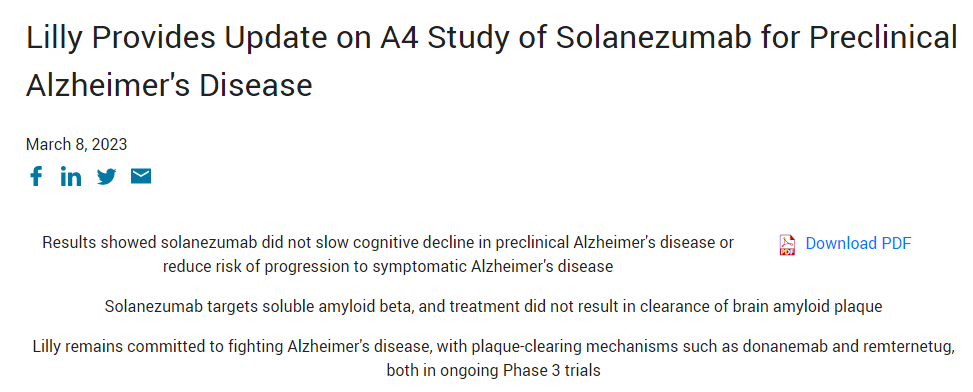
Lilly announced that the Phase III A4 study of Solanezumab in patients with Alzheimer's disease did not meet the primary and key secondary endpoints, namely, that Solanezumab did not slow cognitive decline caused by Alzheimer's disease (AD) or reduce the risk of progression to symptomatic AD, nor did it clear plaque or prevent amyloid buildup. This news, to the battered AD treatment has cast a shadow.
More than a century after its discovery, there is still no cure
Alzheimer's Disease (AD) was first reported in 1906 by Alois Alzheimer, a German psychiatrist and pathologist. A neurodegenerative disease named in 1910 by Emil Kraeplin.
At the South-western German Symposium on Mental Disorders, held in November 1906, Professor Alzheimer first reported the clinical phenomena and pathological anatomical results of the brain observed in his patient, Mrs. Auguste Deter, These features became known as neuronal fiber entanglement caused by tau hyperphosphorylation, extracellular plaques caused by Aβ protein precipitation, and glial cell hyperplasia. The most common clinical manifestations are memory impairment, which is characterized by comprehensive decline in cognitive, behavioral, language and other brain functional activities. AD accounts for about two-thirds of all dementia cases. AD patients in the middle and late stages are prone to multiple complications, patients need long-term comprehensive care, and bring heavy economic burden to the family and society.
The incidence of AD is 4% in people under 65 years of age, 15% in people 65 to 74 years of age, 44% in people 75 to 84 years of age, and 58% in people 85 years of age and older. With the decline of fertility rates worldwide and the increase of population aging, AD will cause a huge economic burden worldwide. China has 209 million people aged 65 or above, accounting for 14.9 percent of the country's population, according to data released by the National Bureau of Statistics in 2020. High incidence means a vast market. For decades, pharmaceutical companies and biotechnology companies have invested a lot of manpower and resources into the development of AD drugs.
However, since the pathogenesis of AD has not been fully understood, most drugs are developed based on the theory of central cholinergic system damage, Aβ theory and tau protein hyperphosphorylation theory. To date, drugs used to treat AD, such as acetylcholinesterase inhibitors (represented by Donepezil and Riversmine) and n-methyl-D-aspartic acid receptor antagonists (represented by memantine), have only been able to consolidate memory and partially improve symptoms for a limited time, without stopping or reversing disease progression. In recent years, the vast majority of drugs in development target the proteins Aβ and tau. Solanezumab is A prime example of a drug that targets Aβ.
Lilly's 20-plus years of experience in AD
Solanezumab is A humanized monoclonal IgG1 antibody targeting the intermediate domain of amyloid-β (β-amyloid, Aβ). Eli Lilly started developing Solanezumab in 2000. But in 2012, two Phase III trials of Solanezumab, EXPEDITION 1 and EXPEDITION 2, failed.
The Phase III trial, dubbed A4, was launched in 2013, driven by the belief among Aβ advocates that drugs targeting AB do not work well because they are treated too late, with Aβ deposits occurring significantly earlier than AD symptoms in most patients. More than 1,100 subjects with PET images of amyloid plaque deposits and no clinical symptoms of AD were enrolled. Unexpectedly, finally ushered in failure.
In addition to Solanezumab, Lilly has two other Alzheimer's drugs in its pipeline, Donanemab and Remternetug, currently in Phase III trials.
Donanemab works by clearing amyloid beta-amyloid (Aβ) plaques from patients' brains. The confirmatory Phase 3 trial, TRAILBLAZER-ALZ 2, is ongoing and top-line data is expected to be available in the second quarter of 2023, based on which the company will file its traditional BLA application. But on Jan. 19, the FDA denied accelerated approval because it believed the NDA application was based on a limited number of patients receiving the drug for at least 12 months in clinical trials. Remternetug has a slightly different biological mechanism. It is a new type of small molecule compound that acts on TAAR1 (Trace Amine-Associated Receptor 1), a G-protein-coupled receptor on the surface of neurons.
Is targeting Aβ the Hope for A future AD cure?
Aβ protein deposition is A typical pathological feature of AD patients. Aβ is an amyloid substance that is cleared in the normal brain. The Aβ hypothesis holds that in the process of human brain aging, due to some reasons leading to the breakdown of Aβ, these amyloid substances into insoluble amyloid fibraments, with the increase of insoluble amyloid fibraments, form diffuse plaques, and gradually excessive deposition of Aβ in the brain leads to the death of nerve cells, resulting in the impairment of cognitive function, thus leading to AD.
Based on this hypothesis, pharmaceutical giants have conducted a lot of research. However, while these trial therapies successfully reduced A-beta levels or eliminated beta-amyloid deposits in the brain, they did not help patients with cognitive decline, casting doubt on the beta-amyloid hypothesis.
In 2012, Johnson & Johnson/Pfizer's monoclonal drug bapineuzumab failed miserably in Phase III trials;
In 2017, Merck Pharmaceutical Co., Ltd. failed to develop Verubecestat, a small molecule drug for the treatment of AD.
In November 2022, Roche announced the failure of a Phase 3 clinical study of its ongoing Alzheimer's drug, Gantenerumab.
In June 2021, the FDA accelerated approval of Aduhelm, a drug used in the treatment of early-stage Alzheimer's disease (AD). Aduhelm, whose mechanism is the "Aβ" hypothesis, was released by the FDA despite insufficient evidence for its use in the treatment of Alzheimer's disease. Three experts on the FDA advisory committee even resigned in protest. The EMA refused to approve the drug for marketing in the EU in December 2021.
Aduhelm is also the first new drug approved by the FDA to treat Alzheimer's disease since 2003. The arrival of this drug gives hope to Donanemab, which has the same mechanism, as well as to the field of AD therapy, which has been dormant for many years.
But even so, the academic "amyloid hypothesis" has continued to be questioned. In the face of experts' doubts, Aduhelm, which has only been on the market for two years, may not be able to give an accurate answer. It is hoped that the efficacy of this drug in the real world can bring hope to the majority of AD patients and their families.

You May Interested In


High Quality β-Nicotinamide adenine dinucleotide CAS 53-84-9 NADwith ready stock and best price
$3/UNIT FOB


2026-10-18
Trade Alert
Delivering the latest product trends and industry news straight to your inbox.
(We'll never share your email address with a third-party.)

Related News
-
With a $10 billion market and a clinical shortage, the first 'Snoring medicine' is expected to hit the market
-
Eli Lilly's GIPR/GLP-1R Dual Agonist Tirzepatide Patent Layout
-
EFSA Confirms Safety of Triacylglycerol Lipase for Expanded Food Uses
-
EFSA Finds L-Cysteine Feed Additives Safe for All Animal Species
-
Singapore Suspends Poultry Imports from Avian Flu-Affected Areas in Japan
-
UK Proposes Sharp Increase in MRL for Flubendiamide in Tea
-
Canada Launches Re-Evaluation of Herbicide Iodosulfuron-Methyl-Sodium
-
EFSA Approves Cellulase from GM Aspergillus Niger with Low Allergy Risk
-
EFSA Renews Authorisation of Inositol for Use in Fish and Crustacean Feed
-
EFSA Reports Avian Influenza Situation in Europe and Human Cases in Asia
Recommend Reading
-
![India Strengthens Drug Approval Oversight with Expanded CDSCO Powers]()
India Strengthens Drug Approval Oversight with Expanded CDSCO Powers
-
![EU Authorises Propionic Acid and Its Salts as Feed Additives Until 2035]()
EU Authorises Propionic Acid and Its Salts as Feed Additives Until 2035
-
![Strides Pharma Reports Strong Q2 as Net Profit Surges 82%]()
Strides Pharma Reports Strong Q2 as Net Profit Surges 82%
-
![When SWIFT Goes On-Chain: A New 24/7 Order for Cross-Border Payments]()
When SWIFT Goes On-Chain: A New 24/7 Order for Cross-Border Payments
-
![Lilly Eyes Fast-Track Approval for Oral Weight-Loss Drug in U.S.]()
Lilly Eyes Fast-Track Approval for Oral Weight-Loss Drug in U.S.
-
![U.S. Finds Methionine Dumping Could Recur, With Japan Margin Up to 76.50%]()
U.S. Finds Methionine Dumping Could Recur, With Japan Margin Up to 76.50%
-
![Price Cuts and Weak Demand Create Tension as October PC Prices Rise, Then Retreat]()
Price Cuts and Weak Demand Create Tension as October PC Prices Rise, Then Retreat
-
![EU PIC Amendment Adds Over 30 Chemicals to Control List and Bans 3 POPs Exports]()
EU PIC Amendment Adds Over 30 Chemicals to Control List and Bans 3 POPs Exports
-
![Fundamental Factors Fail to Deliver Positive Momentum; October ABS Prices Gradually Decline]()
Fundamental Factors Fail to Deliver Positive Momentum; October ABS Prices Gradually Decline
-
![Business Society October 8, 2026 PP (Fiber) Trend Analysis: Volatility]()
Business Society October 8, 2026 PP (Fiber) Trend Analysis: Volatility