Global Coatings Situation is Grim This Year - Scale Fell to US$195 Billion, Growth Will Be Stronger Next Year
International consulting company Orr&Boss provides a global coatings market report for 2023-2024. The report states that the global coatings market has been struggling to achieve sales growth this year. In the wake of the COVID-19 pandemic, the global economy is facing some headwinds that are impacting the coatings market more than other markets around the world.
The report believes that the main problems facing the coatings industry are the inflationary pressure accumulated in the global economy and the need for central banks around the world to raise interest rates. Rising interest rates have led to a decline in construction activities, resulting in slower growth in the coatings industry. Despite this year's poor performance, analysts are relatively optimistic that sales will resume growth next year and will be even stronger in 2025 and beyond.
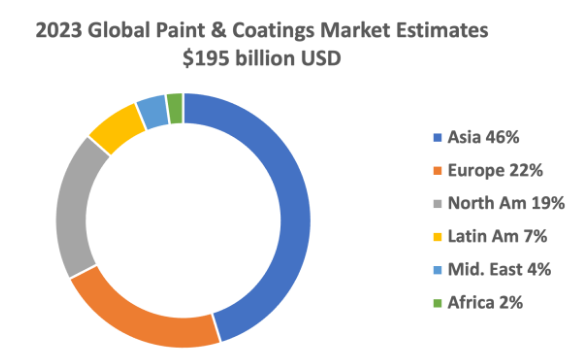
According to the report, the global coatings industry is expected to reach US$195 billion in 2023. Asia is the world's largest market, accounting for 46% of the market. Followed by Europe and North America, accounting for 22% and 19% of the global market respectively. In addition, Latin America accounts for 7%, the Middle East accounts for 4%, and Africa accounts for 2%.
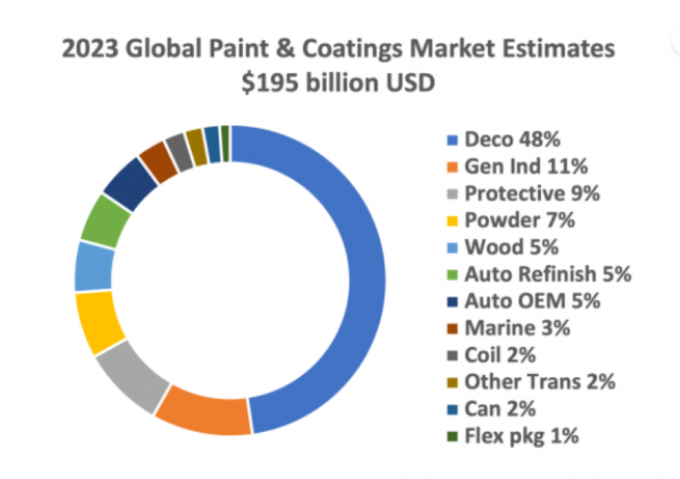
As mentioned above, this has been a slow year for growth due to rising global interest rates and their impact on construction activity.
But analysts expect 2024 to be more positive, with sales growth higher than this year in all regions. The assumption behind the forecast for 2024 is that central banks around the world will pause on raising interest rates. The figure below provides estimated sales growth of the market by region in 2023 and 2024.
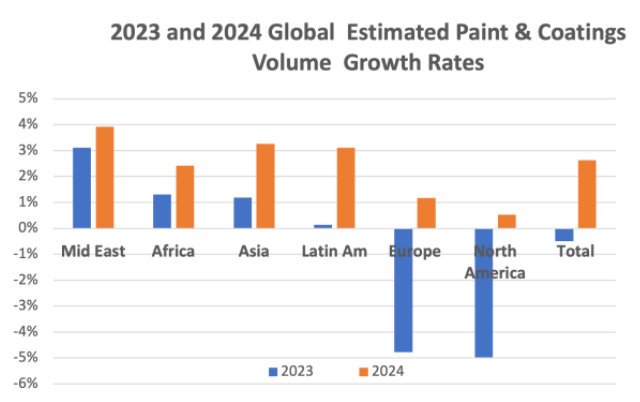
As the chart shows, global sales growth has been declining. This is mainly the result of negative growth in Europe and North America. In Europe, construction activity and industrial activity have fallen almost every month since February 2022. Uncertainty caused by the Russia-Ukraine conflict, the 2022 energy crisis and the European Central Bank's interest rate hikes in 2023 have all impacted on the slowdown in construction and manufacturing activity. On top of these factors, economic growth is driven by services such as tourism and entertainment, which has also influenced the slowdown in oil paint demand. Recently, there have been signs that the recession in Europe's construction and manufacturing sectors has leveled off. Therefore, we believe that the European market will see moderate sales growth in 2024.
In North America, demand fell as rising interest rates led to lower construction activity. Existing home sales fell 23% year over year, and new home construction fell 13%. The good news is that most of the decline in North America has already occurred. By 2024, we expect housing to start declining, but not as much as in 2023. For existing home sales, we expect 2024 to be roughly the same as 2023.
In the rest of the world, we expect the Middle East to perform well. Ongoing large-scale infrastructure projects in the region will stimulate the development of coatings. Latin America has had a mediocre year. The largest markets in Latin America are Brazil and Mexico, with a total of US$8.4 billion, accounting for 60% of the Latin American coatings market. Brazil's economy has been slowing, and sales in the coatings market are estimated to fall by 2% this year. Sales in Mexico are expected to increase this year. With production in Brazil down slightly and production in Mexico up slightly, they almost cancel each other out, with the end result being flat Latin American production this year.
In Asia, the market is also growing slower than expected this year, but there is still some growth in South Asia. Because the Asian market is so large, the market is divided into several sub-regions. The total Asian coatings market size will be US$88 billion in 2023. Greater China is the largest coatings market in Asia, accounting for 55% of the region; in addition, Japan and South Korea account for 15%, South Asia accounts for 15%, Southeast Asia accounts for 9%, Australia and New Zealand account for 4%, and Central Asia accounts for 2%.

Factors affecting growth in the region are similar to those elsewhere, with rising interest rates leading to a slowdown in construction activity. This, coupled with China's post-pandemic economic growth not being as fast as previously thought, another factor affecting some markets in Asia is that inflation issues over the past two years have led consumers to either buy lower-cost paint or delay projects.
The coatings market in Central Asia is growing. The overall economic growth of these markets is faster than other markets in the world, which results in better growth. Examples include Kazakhstan, Tajikistan, Uzbekistan, Kyrgyzstan, Turkmenistan, Afghanistan, Mongolia, Georgia, Azerbaijan and Armenia.
Southeast Asian countries have favorable economic and demographic trends and the coatings market is expected to perform well in the long run. This year, these countries have been affected by rising interest rates and reduced paint purchases by consumers and contractors.

Forecast 2024-2028
The long-term growth forecast for the global coatings market is more optimistic. Global coatings sales are expected to grow at an annual rate of 4%. Orr & Boss believes that by 2025, interest rate hikes will be a thing of the past and pent-up demand will lead to global GDP growth slightly better than total growth. Asia and the Middle East should be the best markets.

In Asia, the markets with the best long-term trends are South Asia, Southeast Asia and Central Asia.

Orr & Boss believes that the coatings market will grow stronger next year than this year. This forecast assumes interest rates remain stable. If prices rise further, the construction industry is likely to be affected. On the contrary, if interest rates decrease, demand may rebound. In either case, we are optimistic about the demand for coatings products in the coming year. We expect most of Asia to do well in global markets, as well as the Middle East.

You May Interested In


High Quality β-Nicotinamide adenine dinucleotide CAS 53-84-9 NADwith ready stock and best price
$3E+1/UNIT FOB


2026-10-25
Trade Alert
Delivering the latest product trends and industry news straight to your inbox.
(We'll never share your email address with a third-party.)

Related News
-
The global coatings market will reach $167.04 billion in 2022
-
Egypt’s Chemical Surge: $9.4 Billion Export Boom Signals Industrial Powerhouse Rise
-
Glenmark’s $1 Billion Cancer Bet: Oncology Revolution Set to Ignite in FY28
-
“Milk Sugar 2.0” Cleared for Takeoff: EU Greenlights Next-Gen Human-Identical Oligosaccharide for Infant Nutrition
-
Continental Tires Out, Franchise Power In: Continental Group Spins Off French Retail Arm to ASC in Strategic Pivot
-
Afidopyropen: The Silent Assassin of Sap-Sucking Pests—Promise, Pitfalls, and the Path to Sustainable Deployment
-
Jiangsu Fengshan Biochem Gears Up for Strategic Expansion in Selective Herbicide Intermediates and Active Ingredients
-
Agrochemical Markets at a Crossroads: Winter Stockpiling Begins Amid Cost Pressures and Fragmented Demand
-
Middle East Crude Exports Rebound Sharply in September as Saudi Arabia Returns to Market at 5.4 Million bpd
-
Private Equity Firm Acquires Lyons Magnus for About $1 Billion as Beverage and Nutrition Ingredients Consolidate
Recommend Reading
-
![U.S.-Iran Détente Triggers Oil Price Plunge, Energy and Chemical Sectors Tumble]()
U.S.-Iran Détente Triggers Oil Price Plunge, Energy and Chemical Sectors Tumble
-
![Merck Wins Approval for the World’s First Oral PCSK9 Drug, with Potential Annual Sales of $5 Billion]()
Merck Wins Approval for the World’s First Oral PCSK9 Drug, with Potential Annual Sales of $5 Billion
-
![LG Chem Enters Semiconductor Stripper Market for the First Time, Cutting Process Time by 50%]()
LG Chem Enters Semiconductor Stripper Market for the First Time, Cutting Process Time by 50%
-
![Global Chemical Giants Accelerate Plant Closures and Layoffs as Industry Enters Structural Capacity Rationalization]()
Global Chemical Giants Accelerate Plant Closures and Layoffs as Industry Enters Structural Capacity Rationalization
-
![European Diesel Crack Spread Hits Record $74.66 per Barrel as Global Refinery Outages Mount]()
European Diesel Crack Spread Hits Record $74.66 per Barrel as Global Refinery Outages Mount
-
![Today, PET polyester bottle flakes rebound strongly (12.19)]()
Today, PET polyester bottle flakes rebound strongly (12.19)
-
![This Week's Styrene Market Weakens and Falls (12.15-12.19)]()
This Week's Styrene Market Weakens and Falls (12.15-12.19)
-
![Premium Global Chemical Sourcing Requests (24-27Sep.,2026)]()
Premium Global Chemical Sourcing Requests (24-27Sep.,2026)
-
![Market Calm, Acrylonitrile Market Fluctuates within a Range in China]()
Market Calm, Acrylonitrile Market Fluctuates within a Range in China
-
![China’s 15th Five-Year Plan Sets New Priorities for Pharmaceutical Innovation and Supply Chains]()
China’s 15th Five-Year Plan Sets New Priorities for Pharmaceutical Innovation and Supply Chains