Jotun Coatings Protect Norway Suspension Bridge
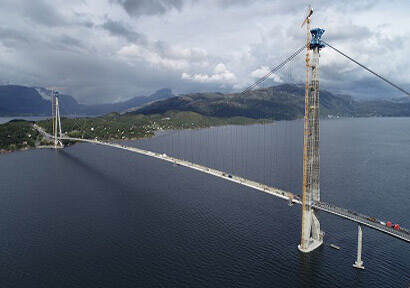
To help protect the Arctic Circle’s longest suspension bridge, Norwegian paints and coatings manufacturer Jotun (Sandefjord) provided its Jotamastic steel coating, which equips the structure with anticorrosion protection in a part of the world where temperatures can fluctuate 40 degrees throughout the course of the year.
Hålogaland Bridge, located in Narvik, Norway, was completed in the middle of December, a project that took five years to build.
Arctic Circle Suspension Bridge
The structure, spanning 1,533 meters (just over 5,000 feet) across Romsbak Fjord, cost 3.5 billion NOK to build ($418 million). Hålogaland Bridge was built in 30 sections, with 7,000 tons of bridge deck, according to Jotun. Hege Karset Bjorgum, Global Concept Director Infrastructure for the company, noted that Jotun worked with China Railway Shanhaiguan Bridge Group, coating all 30 sections in a 10-month period.
To help protect the Artic Circle’s longest suspension bridge, Norwegian paints and coatings manufacturer Jotun (Sandefjord) provided its Jotamastic steel coating, which equips the structure with anticorrosion protection in a part of the world where temperatures can fluctuate 40 degrees throughout the course of the year.
Bjorgum also added that Jotun executed a training program with the main contractors, while providing quality control oversight of surface application and finishing.
“This involved stringent technical inspections in China, as well as delivering on-site expertise during the actual installation process in Narvik," said Bjorgum.
“Hålogaland bridge carries the main national North-South roadway, the E6, over the [300-meter-deep] fjord waters, providing a direct connection that is central to regional development,” Bjorgum noted. “It is fundamentally important to the local populace, but also to Norway itself and, as such, demanded the highest standards of construction and protection.”
The structure features two A-shaped superstructure towers, each standing 179 meters above the water. The central suspended deck spans 1,145 meters. Over 900 workers worked on the project over the five-year build period.

You May Interested In


Glow70/KLOW80 99% China Peptides Warehouse Direct Delivery Lyophilized Powder in Stock
$169/UNIT FOB


2026-10-23
Trade Alert
Delivering the latest product trends and industry news straight to your inbox.
(We'll never share your email address with a third-party.)

Related News
-
China’s New Food-Contact Standards Take Effect, Resetting Compliance for Coatings and Silicone Rubber
-
BASF Coatings and Li Auto Cooperate to Develop Low-Carbon Automotive Coatings
-
Paints and Coatings Market Worth $212B by 2026: MarketsandMarkets
-
European Coatings Show 2023
-
Prices of coatings, titanium dioxide, and emulsions have risen across the board!
-
Analyze the reforms facing the development of coatings
-
Machine-Learning Research Could Help Develop Tougher Coatings
-
Optimised silica-based hybrid coatings for the protection of aluminum
-
BCF: shortage of raw materials may affect the availability of food packaging
-
2020 architectural waterproof coatings are developing in this direction
Recommend Reading
-
![Asahi Kasei, Mitsui Chemicals, and Mitsubishi Chemical Agree in Principle to Establish New Joint Venture to Restructure Ethylene Production in Western Japan]()
Asahi Kasei, Mitsui Chemicals, and Mitsubishi Chemical Agree in Principle to Establish New Joint Venture to Restructure Ethylene Production in Western Japan
-
![Henkel's Acquisition of Stahl Enters Regulatory Countdown: Will the €2.1 Billion Deal Go Through?]()
Henkel's Acquisition of Stahl Enters Regulatory Countdown: Will the €2.1 Billion Deal Go Through?
-
![“Hidden Champion” Swallowed Whole: PPG’s Acquisition of EMM Isn’t Just About Three Brands—It’s a Grab for the Next Decade’s Coating Authority]()
“Hidden Champion” Swallowed Whole: PPG’s Acquisition of EMM Isn’t Just About Three Brands—It’s a Grab for the Next Decade’s Coating Authority
-
![“Amputate to Survive, or Bleed to Feed the Vultures?”: Dow’s 4,500 Layoffs Reveal the Life-or-Death Battle in Global Chemicals]()
“Amputate to Survive, or Bleed to Feed the Vultures?”: Dow’s 4,500 Layoffs Reveal the Life-or-Death Battle in Global Chemicals
-
![“Europe’s Chemical Industry Is Bleeding”: 37 Million Tons of Capacity Shut Down in 4 Years—Is the Industrial Heartbeat Failing?]()
“Europe’s Chemical Industry Is Bleeding”: 37 Million Tons of Capacity Shut Down in 4 Years—Is the Industrial Heartbeat Failing?
-
![This Week's Caustic Soda Prices Consolidate (5.18-5.22)]()
This Week's Caustic Soda Prices Consolidate (5.18-5.22)
-
![Premium Global Chemical Sourcing Requests (26 - 30 Jan, 2026)]()
Premium Global Chemical Sourcing Requests (26 - 30 Jan, 2026)
-
![Supply-Demand Dynamics Drive Slight Rise in Toluene Market]()
Supply-Demand Dynamics Drive Slight Rise in Toluene Market
-
![Bottom-fishing and Replenishment Orders & Strong Raw Materials Drive Significant ABS Price Increase in January]()
Bottom-fishing and Replenishment Orders & Strong Raw Materials Drive Significant ABS Price Increase in January
-
![Since May, the natural rubber market has shown a pattern of initial strength followed by weakness, with prices fluctuating at high levels.]()
Since May, the natural rubber market has shown a pattern of initial strength followed by weakness, with prices fluctuating at high levels.