




Why are ripe fruits so expensive?

The promotional price is 19.9 yuan for a kilogram of Hainan Imperial concubine Mango, 24.9 yuan for a Xizhou honey No. 25 with a retail price of more than 1.1 kg, and 45 yuan for a ripe golden pineapple on a Taiwanese tree with a special price of about 3 kg. Recently, Xiaotao found that many fruits with the label "ripe on trees" appeared on the market. They are much more expensive than the similar fruits on the side.
What is "tree ripe" fruit? As a fresh purchaser of boxes and horses, Fu Rendong, a young man with the flower name "Zhengguo", has been stationed in a front-line fruit orchard all the year round. Recently, he has just made a trip to Hainan to find more suppliers of high quality "tree ripe" mango, pitaya fruit and Xizhou honey. He told Hangzhou that there was no uniform standard in the "tree ripening" industry, which generally refers to fruit picked after natural ripening of trees. This kind of fruit has a good taste and flavor.
In the impression of the owner of fruit stores, the first time I heard of "tree ripening" was Taiwan's tree ripening pineapple which began to be popular several years ago. "According to the grower, the pineapple will not be picked until the tree ripens naturally." In recent years, the concept of "tree ripening" has been repeatedly mentioned by fruit merchants, the landlord said. Since last year, more and more e-commerce companies have launched "tree ripening" marketing. Hangzhou eats goods in an e-commerce platform to search for "ripe trees", jumping out of nearly 5000 product links directly. Whether such "tree ripening" is just a cover, ordinary consumers are difficult to identify.
Faced with the aggressive "tree ripening" fruits, Shi Xinyou, general manager of Hangzhou Fruit Wholesale Co., Ltd., confessed that there are not many "tree ripening" fruits on the market: "In theory, naturally ripening fruits, regardless of their flavor and taste, should be very good. However, from a commercial point of view, this may mean a loss. He said that, like people traveling to Southeast Asia, they are more keen on eating local fresh fruits. They lack long-distance transportation links and eat fruits under fruit trees for the first time. They are fresh and delicious, and they certainly feel good. In the view of the industry, the main difficulty of "tree ripening" lies in preservation and transportation. The process of picking is also different. In the past, a tree was basically picked all at once, while "ripening on the tree" requires "ripening one and picking one". "Well-ripened mango, indeed, can not withstand the torment of land transport, some can only choose to fly, from the moment of picking to eating, the fastest can not exceed three days." Industry insiders said that the labor cost of "ripening trees" is higher. At present, many fruit bases in Hainan still tend to sell fruits.
Hangzhou food learned that the season of "ripe mango on trees" will soon pass, and immediately relay on the market is Xizhou honey, pitaya fruit and other seasonal fruits. However, in the interview, many fruit owners said that the popular "Hainan" fruits such as mango and pineapple are generally good in taste, and the price is very close to the people, so the greedy tasters might as well buy and taste them.

You May Interested In


High Quality β-Nicotinamide adenine dinucleotide CAS 53-84-9 NADwith ready stock and best price
$3E+1/UNIT FOB


2026-10-21
Trade Alert
Delivering the latest product trends and industry news straight to your inbox.
(We'll never share your email address with a third-party.)

Related News
-
South Africa produces over 70,000 tons of macadamia fruit, China overtakes US as' number one buyer '!
-
Economic diplomacy: Get more Vietnamese fruit into the Thai market
-
Professional safety reminder for buying and washing fruits during the epidemic
-
Haikou primary and secondary school food safety education is not systematic
-
Dozens of new fruits are on the market this autumn
-
Guarantee 12 kinds of vegetables and pork price reduction
-
Quanzhou Fruit Market Multi-price Falling Pork Price is expected to remain high
-
Fruit prices on the market in autumn dropped slightly
-
Summer and Autumn Fruit Competitive Grape Peach Quantity and Low Price
-
Fruit prices have been falling continuously.
Recommend Reading
-
![Wacker Under Global Cost Pressure: Dual-Track Restructuring Through Layoffs, Consolidation, and Strategic Repositioning]()
Wacker Under Global Cost Pressure: Dual-Track Restructuring Through Layoffs, Consolidation, and Strategic Repositioning
-
![“Oil Sheikhs” Buy Germany’s Chemical Crown: A €14.7 Billion Green Gamble or a Power Play in the Age of Carbon Neutrality?]()
“Oil Sheikhs” Buy Germany’s Chemical Crown: A €14.7 Billion Green Gamble or a Power Play in the Age of Carbon Neutrality?
-
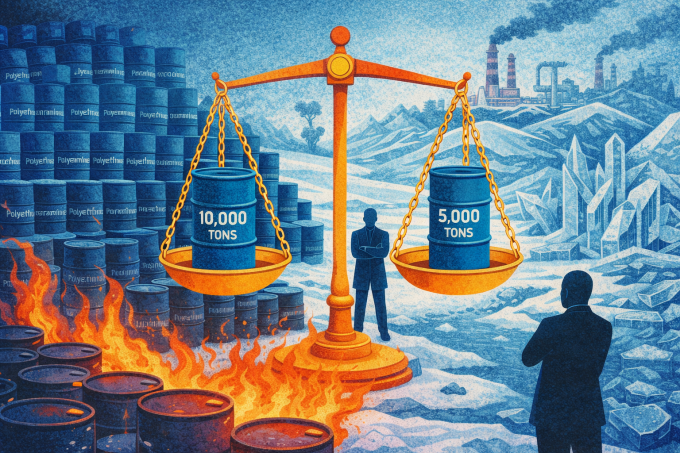
![From “10,000-Ton Bet” to “5,000-Ton Test”: Acore’s Polyetheramine Dilemma—Is This a Symptom of Industry Winter or the Prelude to Strategic Retreat?]()
From “10,000-Ton Bet” to “5,000-Ton Test”: Acore’s Polyetheramine Dilemma—Is This a Symptom of Industry Winter or the Prelude to Strategic Retreat?
-
![Behind Arkema’s ¥430 Million Claim: A Patent War Over Acrylic Acid Is Tearing Off the “Technical Fig Leaf” of China’s Chemical Giants]()
Behind Arkema’s ¥430 Million Claim: A Patent War Over Acrylic Acid Is Tearing Off the “Technical Fig Leaf” of China’s Chemical Giants
-
![EU Puts Chemicals on Its China De-Risking Watchlist]()
EU Puts Chemicals on Its China De-Risking Watchlist
-
![Business Society September 28, 2026 Acrylonitrile Trend Analysis: Volatility]()
Business Society September 28, 2026 Acrylonitrile Trend Analysis: Volatility
-
![Business Society September 28, 2026 Polyester Staple Fiber Trend Analysis: Volatility]()
Business Society September 28, 2026 Polyester Staple Fiber Trend Analysis: Volatility
-
![Business Society September 28, 2026 PTA Trend Analysis: Volatility]()
Business Society September 28, 2026 PTA Trend Analysis: Volatility
-
![Business Society September 28, 2026 ABS Market Outlook: Volatility]()
Business Society September 28, 2026 ABS Market Outlook: Volatility
-
![Sodium Pentothal: Medical Applications and Safety]()
Sodium Pentothal: Medical Applications and Safety








- Hot Searches
- where can i buy retatrutide near me
- chronic cervicitis with squamous metaplasia
- propylene prices
- dayquil vs nyquil ingredients
- pe film price
- buy magnesium-ascorbyl-phosphate
- xylene price
- trimethylamine
- urea futures price
- kero prices
- retatrutide peptide buy usa
- white petroleum mineral oil