The G20 Osaka Summit released eight main themes of economic and trade
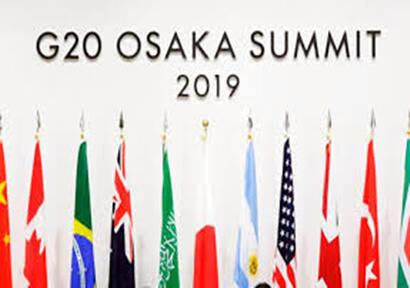
The Leaders'summit of the Group of Twenty (G20) will be held in Osaka, Japan, from 28 to 29 this month. According to Xinhua News Agency, the heads of state of the United States and China met in Osaka on the 18th. The website of the G20 Osaka Summit recently released eight major themes of the Summit, namely, global economy, trade and investment, innovation, environment and energy, employment, women's empowerment, sustainable development and national health.
The current global economic growth is weak. According to the relevant reports issued by the World Trade Organization, the United Nations and other multilateral organizations, the global economy lacks momentum in trade and investment. Under this background, can the G20 Osaka Summit bring new momentum and opportunities to the global economy? Is there any deficiency in the G20 mechanism and what role will it play in the future? Will the upcoming meeting of the heads of state of China and the United States during the summit reach a consensus and have a positive impact on the positive outcome of the summit? This series of problems has also attracted extensive attention from the international community. At present, the world is facing three major risks.
At present, the downward pressure of the world economy is not abating, globalization and free trade system are encountering resistance, uncertainties are increasing, and protectionism is still an important challenge facing the world. In this context, the upcoming G20 Osaka Summit has attracted worldwide attention.
According to the latest data released by the World Trade Organization (WTO), the world trade boom index in the second quarter of 2019 was 96.3, the lowest level since March 2010. The WTO also lowered its global trade growth forecast for this year from 3.7% to 2.6%, the lowest in three years.
In addition, the World Investment Report 2019 recently published by UNCTAD also shows that global transnational direct investment fell by 13% last year, only $1.3 trillion, the lowest level since the 2008 global financial crisis. In this context, in addition to the G20 members, 17 countries and international institutions were invited to attend. What topics will leaders of countries and multilateral organizations discuss at the G20 Osaka Summit? Can it bring new momentum and opportunities to the global economy? Zhang Yansheng, chief researcher of the China Center for International Economic Exchange, told Daily Economic News that the three major risks facing the world today are the worrying world economic situation, the imbalance of the world economy and the divergence of global governance concepts.
Zhang Yansheng told reporters that there is no effective coordination mechanism for macro-policies in the world at present. For the spillover effect of macro-policies, it is necessary to establish a set of mandatory policy mechanisms, otherwise it is difficult to have practical effects. He believes that the G20 mechanism and its own organizational form also have inherent defects, which are temporary, informal and unstable. For the theme of innovation, Huang Maoxing, Dean of the School of Economics, Fujian Normal University, believes that scientific and technological innovation cooperation provides a powerful impetus for global economic development, that the environment for scientific and technological innovation of G20 members is constantly optimized, and that laws, regulations, market environment and education have been significantly improved, which greatly promotes the cooperation and development of scientific and technological innovation.
Huang Maoxing said that the trend of international scientific and technological cooperation is increasing and the gap between emerging market countries and developed countries is narrowing. Although developed countries still gather most of the resources of scientific and technological innovation and occupy an absolute leading position in the field of scientific and technological innovation, their resource advantages are gradually shrinking, and emerging market countries have become an important force to promote global scientific and technological development.
G20 will be the most important platform for economic cooperation in the world today? What impact will it have on the global economy? Recently, Vice Minister of Commerce Wang Shouwen said that under the current situation, the international community expects the G20 Osaka Summit to continue to show cohesion and action, conduct frank, in-depth and constructive dialogue on important international economic and trade issues, and provide new guidance and ideas for world economic development under the new situation. Recently, He Yafei, former vice-minister of the Ministry of Foreign Affairs and senior researcher of Chongyang Institute of Finance, Renmin University of China, said that in recent years, the consensus of cooperation among big powers has decreased, the willingness to cooperate has also decreased, the game and competition among big powers have increased, and the contradiction between geopolitics and geoeconomy has intensified. The complication, sensitization or crisis of these international relations have weakened the basis for the normal operation of the G20. However, He Yafei stressed that no matter how the international situation changes, how the relations between big powers evolve and how difficult global governance is, China needs to persevere, overcome resistance and strive to support and promote the G20 as the primary platform for global economic governance. He also hoped that the United States would assume the responsibility of a global power and continue to work with China to promote the G20 so that global governance could truly enter a smooth track.
In this regard, World Trade Organization Director-General Roberto Azevido expressed optimism about the G20 Osaka Summit and believed that the meeting between the heads of state of China and the United States would help ease global tensions. He believes that the meeting between Chinese and American leaders during the G20 summit in Osaka will be a "gratifying sign". Luo Zhen, Executive Director of the Australian-Chinese Institute of Relations, said in an interview with the media that he had two expectations. First, he hoped that China and the United States would return to the track of active negotiations, maintain communication and find a way to solve the problem. Secondly, we expect the G20 parties to continue to support the rule-based trading system under international multilateralism.

You May Interested In


2026-10-16
Trade Alert
Delivering the latest product trends and industry news straight to your inbox.
(We'll never share your email address with a third-party.)

Related News
-
Total social retail sales from January to February amounted to RMB 242.73 billion in Beijing
-
Us Stocks Rally Strongly On Positive Economic Recovery As Jobless Number Hits 53-Year Low
-
The Amount of Non-cash Payments Nationwide During the Spring Festival Holiday was 14.9 Trillion Yuan
-
Chinese Catering Has Ushered in a New Track, and Listing Has Become a New Trend
-
U.S. Chemical Manufacturers: Supply Chain Disruptions Cause Serious Losses
-
China's transportation services speed up recovery in May
-
Most commodity prices to drop in 2020 amid pandemic: World Bank
-
The Q1 GDP data announcement, what is the situation of the paint industry?
-
Global economy 'suspends', chemical industry may face the worst demand crisis
-
Nineteen agencies forecast an average GDP growth rate of 6.1%
Recommend Reading
-
![“Fake Fame” in a Forgotten Dock: Chinese Authorities Bust $100,000 Counterfeit Building Materials Ring]()
“Fake Fame” in a Forgotten Dock: Chinese Authorities Bust $100,000 Counterfeit Building Materials Ring
-
![Asian Paints Dives Deeper into the Desert: Unveils Second UAE Plant to Dominate GCC Coatings Market]()
Asian Paints Dives Deeper into the Desert: Unveils Second UAE Plant to Dominate GCC Coatings Market
-
![From Rust to Recharge: Novonix Ignites America’s Graphite Independence with Twin Mega-Plants in Chattanooga]()
From Rust to Recharge: Novonix Ignites America’s Graphite Independence with Twin Mega-Plants in Chattanooga
-
![Sumitomo Reclaims Dunlop’s Throne in Southeast Asia—Full Brand Rights Snapped Up Across Malaysia, Singapore, and Brunei]()
Sumitomo Reclaims Dunlop’s Throne in Southeast Asia—Full Brand Rights Snapped Up Across Malaysia, Singapore, and Brunei
-
![Coal Price Surge Coupled with El Niño Drives Urea Up by RMB 100/Ton in a Single Day]()
Coal Price Surge Coupled with El Niño Drives Urea Up by RMB 100/Ton in a Single Day
-
![Business Society’s September 9, 2026 View on Isooctanol Market Trends: Clearly Downward]()
Business Society’s September 9, 2026 View on Isooctanol Market Trends: Clearly Downward
-
![Business Society’s DOP Market Outlook on August 20, 2026: Clearly Upward]()
Business Society’s DOP Market Outlook on August 20, 2026: Clearly Upward
-
![Both Supply and Demand Weak, Hydrogen Peroxide Prices Continue to Decline]()
Both Supply and Demand Weak, Hydrogen Peroxide Prices Continue to Decline
-
![Business Society’s Market Outlook for Epichlorohydrin on September 8, 2026: The Trend Is Volatile]()
Business Society’s Market Outlook for Epichlorohydrin on September 8, 2026: The Trend Is Volatile
-
![Premium Global Chemical Sourcing Requests (26 - 29 Mar, 2026)]()
Premium Global Chemical Sourcing Requests (26 - 29 Mar, 2026)