Half of US Gulf oil production shut in because of Barry
A little more than half of the current oil production in the Gulf of Mexico has been shut-in because of preparations for Tropical Storm Barry, a federal agency said on Thursday.
About 53% of the current oil production in the Gulf of Mexico has been shut-in, according to the Bureau of Safety and Environmental Enforcement (BSEE).
The agency added that approximately 44.5%of the Gulf’s natural gas production has also been shut-in.
The following summarises the shut-in production. Oil is listed in bbl/day. Gas is in millions of cubic feet/day.
| Total | Percentage of Gulf of Mexico | |
| Platforms Evacuated | 191 | 28.55% |
| Rigs Evacuated | 7 | 33.33% |
| DP Rigs Moved-off | 11 | 55% |
| Total shut-in | Percentage of Gulf Production | |
| Oil, Shut-in | 1,009,012 | 53.39% |
| Gas, Shut-in | 1,237.28 | 44.51% |
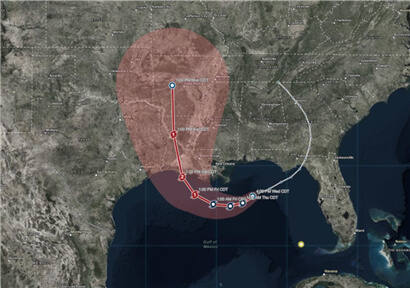
The preparations come as Barry heads for the Louisiana coast, expected to make landfall near the US state’s central or southeastern coast Friday night or Saturday, according to the National Hurricane Center (NHC).
A hurricane watch is in effect from the mouth of the Mississippi River to Cameron, Louisiana, near the Texas border about 54 miles (87 km) south of Lake Charles, Louisiana.
The NHC's latest map, shown below, shows the storm pointed at Louisiana. With sustained winds strengthening to 40 miles/hour (mph), Barry was about 95 miles south of the mouth of the Mississippi River and could become a hurricane late Friday or early Saturday, the NHC said.

Plaquemines Parish issued an evacuation order early Thursday that will affect approximately 8,000-10,000 people.
Parish officials said the evacuation order stems from federal and state officials who say the Mississippi River could breach the levee.
Also in Plaquemines, Phillips 66 began shutting its Alliance Refinery in Belle Chasse, Louisiana, a company source said. The plant is on the west bank of the Mississippi River.
“The [Mississippi River] is still so high with the months-long flood stage, so even a little storm surge would be a big deal,” the source said. “It’s been this high since [February]…that has to be a record.”
The city of New Orleans, Louisiana, braced for a worst-case scenario after heavy rain on Wednesday flooded the city, with parts of the metro area under an emergency flash flood warning on Thursday.
Louisiana governor John Bel Edwards declared a state of emergency there on Wednesday because of the low-pressure system bearing down on the state from the Gulf of Mexico.
Louisiana is home to several refineries and chemical plants, and Barry could threaten these directly by disrupting operations. Indirectly, floods could prevent plants from receiving feedstock or shipping out finished products - even if operations themselves were unaffected by Barry.
Power disruptions could also stop the plants from running.
Louisiana’s Port Fourchon, located on the Gulf of Mexico, issued recommended evacuations this morning. The evacuation includes all non-essential personnel in anticipation of water covering the main roadway below the floodgates.
Farther west in Louisiana, a source at Westlake Chemical, which produces styrene at its 260,000 tonne/year plant in Lake Charles, said the biggest concern now is that Barry could threaten their energy supply.
“Specifically, natural gas,” the source said. “We get most of our natgas from the Mississippi River side of Louisiana. If they start shutting down those wells, it could affect us.”
All Westlake plants in Louisiana are taking precautions for heavy rain and wind, but will operate through the storm, said Chip Swearngan, Westlake’s director of corporate communications and government relations.
Barry has also brought the shutting of flood gates in Louisiana, causing rail companies to detour traffic around New Orleans.
Norfolk Southern said it is working with interline partners to detour over alternative routes where possible. The rail line also is taking steps to prepare for any floods caused by the storm, with the company working with customers to identify switching needs.
Union Pacific will also reroute traffic moving through New Orleans and has placed embargoes for New Orleans and Avondale, the company said.
Kansas City Southern said it will shipments through detours if they are available.
Many petrochemical producers and refineries - such as ExxonMobil, Shell, BASF, the Louisiana Offshore Oil Port (LOOP) - said they are monitoring the storm and implementing severe weather plans but have not made any significant operational changes yet.
Shell said operations are stable for its refineries in Louisiana, but that it is preparing for high winds and heavy rains. Shell operates a 235,000 bbl/day refinery in Convent and a 238,000 bbl/day in Norco, Louisiana.

You May Interested In


High Quality β-Nicotinamide adenine dinucleotide CAS 53-84-9 NADwith ready stock and best price
$3E+1/UNIT FOB


2026-10-20
Trade Alert
Delivering the latest product trends and industry news straight to your inbox.
(We'll never share your email address with a third-party.)

Related News
-
U.S.-Iran Détente Triggers Oil Price Plunge, Energy and Chemical Sectors Tumble
-
DKSH Expands Distribution Partnership with Kahai in North America
-
Price increase! Raw materials soared 10%, price letter to the factory in advance!
-
EIA: The global oil supply landscape is changing
-
Nearly 200 billion dollars! The five oil giants made record profits last year
-
EIA Raises US Oil Production and Demand Forecast in 2023
-
BP increases investment in oil and gas in the United States
-
Eu evaluates the safety and effectiveness of ferulic oil as a feed additive for dogs and cats
-
What is cinnamon leaf oil composition and its use?
-
The trend of the international oil market is unpredictable
Recommend Reading
-
![Syngenta’s VIRESTINA Targets Resistant Weeds as Herbicide Innovation Regains Urgency]()
Syngenta’s VIRESTINA Targets Resistant Weeds as Herbicide Innovation Regains Urgency
-
![Dietary Supplement Listing Debate Puts Nutrition Ingredients Under a Brighter Spotlight]()
Dietary Supplement Listing Debate Puts Nutrition Ingredients Under a Brighter Spotlight
-
![New York’s Food Chemical Disclosure Bill Raises the Bar for GRAS Transparency]()
New York’s Food Chemical Disclosure Bill Raises the Bar for GRAS Transparency
-
![Jell-O Simply Shows Clean Label Reformulation Has Entered Legacy Brands]()
Jell-O Simply Shows Clean Label Reformulation Has Entered Legacy Brands
-
![GLP-1 API Route to U.S. Abruptly Narrows: FDA Heavily Penalizes U.S. Compounding Pharmacy and Bypasses Warning Letter to Ban Chinese Factory]()
GLP-1 API Route to U.S. Abruptly Narrows: FDA Heavily Penalizes U.S. Compounding Pharmacy and Bypasses Warning Letter to Ban Chinese Factory
-
![Business Society’s Acrylonitrile Trend Analysis for September 17, 2026: Strong Rebound]()
Business Society’s Acrylonitrile Trend Analysis for September 17, 2026: Strong Rebound
-
![Business Society’s Market Outlook for Petroleum Coke on September 4, 2026: Volatile]()
Business Society’s Market Outlook for Petroleum Coke on September 4, 2026: Volatile
-
![Hydrobromic Acid: Properties, Uses, and Safety]()
Hydrobromic Acid: Properties, Uses, and Safety
-
![Post-holiday, China's propylene oxide market shows a strong upward trend]()
Post-holiday, China's propylene oxide market shows a strong upward trend
-
![Business Society September 23, 2026 Heavy-Grade Soda Ash Trend Analysis: A Short-Side Rally]()
Business Society September 23, 2026 Heavy-Grade Soda Ash Trend Analysis: A Short-Side Rally