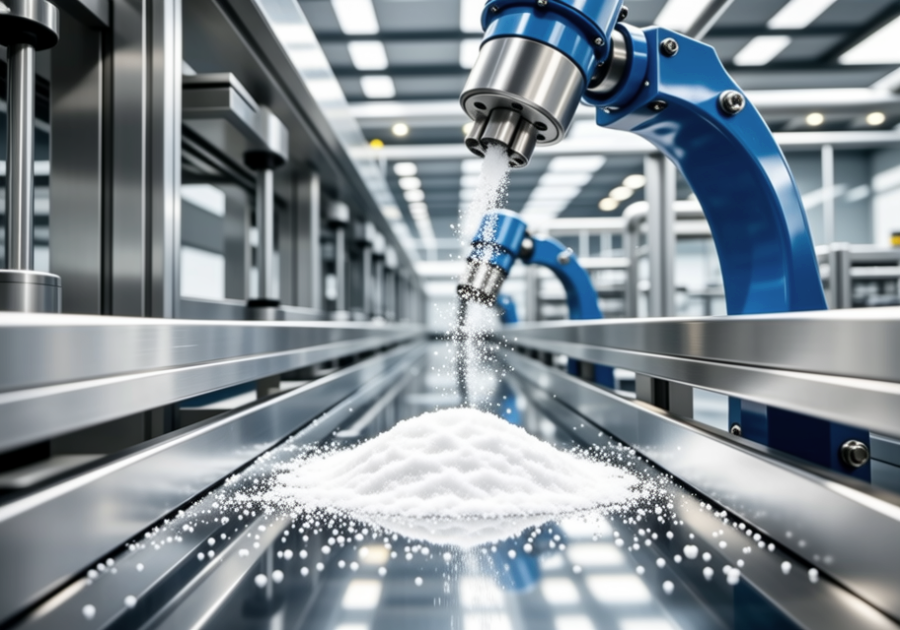
New Boron Nitride Foam Soaks Up Carbon Dioxide
Rice University materials scientists have created a light foam from two-dimensional sheets of hexagonal-boron nitride (h-BN) that absorbs carbon dioxide.
They discovered freeze-drying h-BN turned it into a macro-scale foam that disintegrates in liquids. But adding a bit of polyvinyl alcohol (PVA) into the mix transformed it into a far more robust and useful material.
The foam is highly porous and its properties can be tuned for use in air filters and as gas absorption materials, according to researchers in the Rice lab of materials scientist Pulickel Ajayan.
Their work appears in the American Chemical Society journal ACS Nano.
The polyvinyl alcohol serves as a glue. Mixed into a solution with flakes of h-BN, it binds the junctions as the microscopic sheets arrange themselves into a lattice when freeze-dried. The one-step process is scalable, the researchers said.
“Even a very small amount of PVA works,” said co-author and Rice postdoctoral researcher Chandra Sekhar Tiwary. “It helps make the foam stiff by glueing the interconnects between the h-BN sheets – and at the same time, it hardly changes the surface area at all.”
In molecular dynamics simulations, the foam adsorbed 340 percent of its own weight in carbon dioxide. The greenhouse gas can be evaporated out of the material, which can be reused repeatedly, Tiwary said. Compression tests showed the foam got stiffer through 2,000 cycles as well.
And when coated with PDMS, another polymer, the foam becomes an effective shield from lasers that could be used in biomedical, electronics and other applications, he said.
Ultimately, the researchers want to gain control over the size of the material’s pores for specific applications, like separating oil from water. Simulations carried out by co-author Cristiano Woellner, a joint postdoctoral researcher at Rice and the State University of Campinas, Brazil, could serve as a guide for experimentalists.
“It’s important to join experiments and theoretical calculations to see the mechanical response of this composite,” Woellner said. “This way, experimentalists will see in advance how they can improve the system.”
Rice graduate student Peter Owuor is lead author of the paper. Co-authors are Ok-Kyung Park, a visiting scholar at Rice and a postdoctoral researcher at Chonbuk National University, Republic of Korea; Rice postdoctoral researchers Almaz Jalilov and Rodrigo Villegas Salvatierra and graduate students Luong Xuan Duy, Sandhya Susarla and Jarin Joyner; Rice alumnus Sehmus Ozden, now a postdoctoral fellow at Los Alamos National Laboratory; Robert Vajtai, a senior faculty fellow at Rice; Jun Lou, a Rice professor of materials science and nanoengineering; and James Tour, Rice’s TT and WF Chao chair in chemistry as well as a professor of computer science and of materials science and nanoengineering; and Professor Douglas Galvão of the State University of Campinas. Ajayan is chair of Rice’s department of materials science and NanoEngineering, the Benjamin and Mary Greenwood Anderson professor in engineering and a professor of chemistry.
The Air Force Office of Scientific Research and its Multidisciplinary University Research Initiative funded the research.

You May Interested In


2026-09-10
Trade Alert
Delivering the latest product trends and industry news straight to your inbox.
(We'll never share your email address with a third-party.)

Related News
-
Interfoam Vietnam 2023
-
Wanhua chemical polyurethane hard foam recovery pilot plant started successfully
-
Redefine Foams' The 2nd Foams and Applications International Forum
-
The Growth Rate Of Automobile Foam Materials Is Amazing
-
Foam Expo China 2022
-
Adhesives and Foam Industry Sector Meets at This Exhibition
-
South Korea Tests Arctic Commercial Route as Asian Exporters Seek New Logistics Alternatives
-
Korea’s First Petrochemical Restructuring Approved, LDPE Market Concentration Surges to 82%
-
Hormuz Traffic Remains 90% Below Pre-Conflict Levels as Limited Tanker Access Offers Partial Relief
-
Chemours Sells Its Former Titanium Dioxide Site in Taiwan: Turning a “White Powder” Factory into “Wind Power Real Estate” for $360 Million—Buying Not Cash, But Breathing Room
Recommend Reading
-
![The “Counter-Wind Ledger” of CHF 11.2 Billion: Sika Barely Grew in 2025—Yet Kept Taking Market Share]()
The “Counter-Wind Ledger” of CHF 11.2 Billion: Sika Barely Grew in 2025—Yet Kept Taking Market Share
-
![End of an Era: KDC/One to Close 150-Year-Old Somerset Cosmetics Factory as Production Shifts to Scotland]()
End of an Era: KDC/One to Close 150-Year-Old Somerset Cosmetics Factory as Production Shifts to Scotland
-
![China’s PE, PP and PVC Exports Rise as Stockpile Releases Reshape Global Supply]()
China’s PE, PP and PVC Exports Rise as Stockpile Releases Reshape Global Supply
-
![Global Oil Inventories Fall: Restocking Demand May Keep Petrochemical Costs Supported]()
Global Oil Inventories Fall: Restocking Demand May Keep Petrochemical Costs Supported
-
![Rhine Drought Disrupts German Chemical Logistics, Raising Supply Risks for BASF, Covestro and Evonik]()
Rhine Drought Disrupts German Chemical Logistics, Raising Supply Risks for BASF, Covestro and Evonik
-
![Change Rate Remains Positive, This Round of Refined Oil Retail Prices in China Is About to Increase]()
Change Rate Remains Positive, This Round of Refined Oil Retail Prices in China Is About to Increase
-
![Vendor Shipment Surge Halts Mid-October PC Price Increase]()
Vendor Shipment Surge Halts Mid-October PC Price Increase
-
![Premium Global Chemical Sourcing Requests (3-7 Nov 2025)]()
Premium Global Chemical Sourcing Requests (3-7 Nov 2025)
-
![Supply and Demand Expectations Gradually Weakening, PTA Prices Tend to Remain Weak]()
Supply and Demand Expectations Gradually Weakening, PTA Prices Tend to Remain Weak
-
![Crude Oil Prices First Fall, Then Rise; Retail Prices of Refined Oil Products See First Increase Since 2026]()
Crude Oil Prices First Fall, Then Rise; Retail Prices of Refined Oil Products See First Increase Since 2026