How does carboxylic acid dissolve in water and its physical properties
Carboxylic acid dissolve in water to form a carbonic acid and a hydronium ion. As the reaction proceeds, the equilibrium shifts from the left side to the right side, until all of the reactants are consumed and no more reactant molecules remain. The hydrolysis products that result from this process include hydrogen gas (H2) and a carboxylate salt such as sodium acetate or acetic acid. At equilibrium, the concentrations of all products are equal to the concentrations of the reactants. The key is to identify all reactant and product molecules and then balance them.
The reaction between a carboxylic acid, like acetic acid (CH3COOH) and water can be described by this equation:
CH3COOH + H2O <-> H3O+ + CH3COONa
In this equation, carboxylic acid molecules (CH3COOH) and water molecules (H2O) combine to form hydronium ions (H3O+) and carboxylate ions (CH3COONa). The product, carboxylate ions, is a salt; it combines with water to form the corresponding carboxylic acid (CH3COOH) in solution. This shows carboxylic acid dissolve in water.
Carboxylic acids can be either strong or weak. In solutions of high concentration, such as concentrated acetic acid, the reaction proceeds according to the expression:
CH3COOH <-> CH3COONa + H2O
In this case, the equilibrium shifts toward the right side. At equilibrium, however, all three molecules are present in equal concentrations.
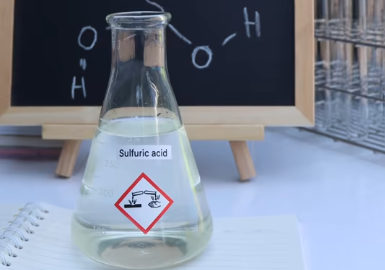
Carboxylic acids that are strong, like acetic acid, form only a weak carbonic acid (H2CO3) and a hydronium ion when reacted with water. In fact, the reaction of a strong acid such as sulfuric acid (H2SO4) with water is even more complex because it involves carbon dioxide in addition to water. This is because carbon dioxide can be viewed as both a gas and an acid. The more common explanation for this apparent paradox is that H2SO4 dissociates into its constituent parts: sulfur trioxide (SO3) and hydrogen sulfide gas (H2S). The reaction of sulfur trioxide with water (also known as dissociation) is as follows:
H2SO4 <-> H2O + SO3 + H2S
Carbonic acid, H2CO3 is an intermediate in the formation of the molecules that will be discussed later. Carbonic acid, which forms in part by way of water molecules hydrogen bonding with carbon dioxide, has a very short lifetime. In fact, carbonic acid has a lifetime of about one nanosecond. This type of reaction, where something reacts to form other things and then itself reverts back to a less energetic state is called an equilibrium reaction.
Physical properties of carboxylic acid
1.Odor of carboxylic acid
The smell of acetic acid is sour and pungent, like that of vinegar. It is well known for its sharp, vinegar-like smell. The smell of acetic acid can be detected from the vapors of a dilute solution with a concentration as low as 0.012%.
2.Carboxylic acid boiling point and melting point
The boiling points of different carboxylic acids vary widely, ranging from 78℃ (m-COOH) to 202℃ (p-C6H5COOH). At normal pressure, the melting point is approximately 30-40℃; higher than the boiling point. The melting points are more than 100℃; lower at low pressure. The melting points of carboxylic acids decrease with increasing chain length, whereas their boiling points increase with increasing chain length.
3.Carboxylic acid density
The density of saturated solutions of some typical carboxylic acids in water at 25℃ is: The density differs widely depending on the substitution pattern on the ring and the degree of unsaturation. The densities are typically 1.05-1.20 g/cm3. There is no direct correlation between solubility in water and molecular weight; only a weak correlation exists between solubility and molecular volume (a long hydrocarbon chain lowers solubility).
4.Carboxylic acid polymorphism
In organic compounds, the term polymorphism describes the difference in physical properties that result from different isomers having the same molecular formula. There are many different types of isomers that can arise in simple organic molecules. For example, two hydrocarbons with the same empirical formula (CX) can have a variety of physical and chemical properties. The terms cis and trans are used to refer to one or more substituents on a carbon atom of a carboxylic acid around which all the aromatic and resonance configurations lie. This gives rise to two groups of structural isomers, called cis-forms and trans-forms, respectively.
In conclusions, carboxylic acid dissolve in water when a strong base treat with carboxylic acid. This reaction is very easy and safe to do at home or in the lab.
Looking for chemical products? Let suppliers reach out to you!
You May Interested In


Glow70/KLOW80 99% China Peptides Warehouse Direct Delivery Lyophilized Powder in Stock
$169/UNIT FOB


2026-10-23
Trade Alert
Delivering the latest product trends and industry news straight to your inbox.
(We'll never share your email address with a third-party.)

Related News
-
The Conversion of Carboxylic Acid to Ester: What Are the Mechanisms and Benefits
-
How to Use Alcohol to Carboxylic Acid? Two Ways for You
-
How is carboxylic acid soluble in water and its properties
-
Isoascorbic Acid: Uses and Safety
-
Uses and Properties of Copper Acetate
-
Bivalirudin: Medical Uses, Properties, and Safety
-
Calcium Hypochlorite: Properties, Uses, and Safety
-
SiO2: Properties, Uses, and Applications
-
Ascorbyl Palmitate: Properties, Uses, and Benefits
-
Sodium Pentothal: Medical Applications and Safety
Recommend Reading
-
![What is Serine? (Amino Acid Function & Sources)]()
What is Serine? (Amino Acid Function & Sources)
-
![Sulfuric Acid Reactions: With Sugar (Dehydration), Water, and Metals]()
Sulfuric Acid Reactions: With Sugar (Dehydration), Water, and Metals
-
![Melamine: Toxicity, Industrial Resin Uses, and Food Safety Scandals]()
Melamine: Toxicity, Industrial Resin Uses, and Food Safety Scandals
-
![Methylamine: Chemical Properties, Synthesis, and Industrial Applications]()
Methylamine: Chemical Properties, Synthesis, and Industrial Applications
-
![Chemical Properties and Uses of Caesium Fluoride]()
Chemical Properties and Uses of Caesium Fluoride
-
![Business Society’s DOP Trend Analysis for September 18, 2026: Volatile Rebound and Pullback]()
Business Society’s DOP Trend Analysis for September 18, 2026: Volatile Rebound and Pullback
-
![BDO Market Trends Primarily Consolidating]()
BDO Market Trends Primarily Consolidating
-
![Business Society September 29, 2026 Acrylic Acid Trend Analysis: Strong Rebound]()
Business Society September 29, 2026 Acrylic Acid Trend Analysis: Strong Rebound
-
![Business Society’s Trend Analysis for Hydrofluoric Acid on September 18, 2026: Volatile Consolidation]()
Business Society’s Trend Analysis for Hydrofluoric Acid on September 18, 2026: Volatile Consolidation
-
![Business Society, October 16, 2026: Fuel Oil 180CST Trend Analysis – Volatility]()
Business Society, October 16, 2026: Fuel Oil 180CST Trend Analysis – Volatility