China丨Chitin biosynthesis study sheds light on green pesticide development
Chinese scientists have revealed for the first time the complete process of chitin biosynthesis, providing a new direction for the research and development of green pesticides, according to the Chinese Academy of Agricultural Sciences (CAAS).
Chitin is the most abundant aminopolysaccharide on earth, and its biosynthesis is essential for the survival and reproduction of a number of organisms, including pests, pathogenic fungi, and oomycetes that harm crop production. Meanwhile, it is an ideal molecular target for the development of green fungicides or insecticides.
The core of developing safe pesticides with a new mechanism of action lies in pesticide molecular targets. However, little is known about the mechanism of chitin biosynthesis in previous studies.
"A specific pesticide molecular target may give birth to dozens or even hundreds of new pesticides," said Song Baoan, academician at the Chinese Academy of Engineering (CAE) and president of Guizhou University.
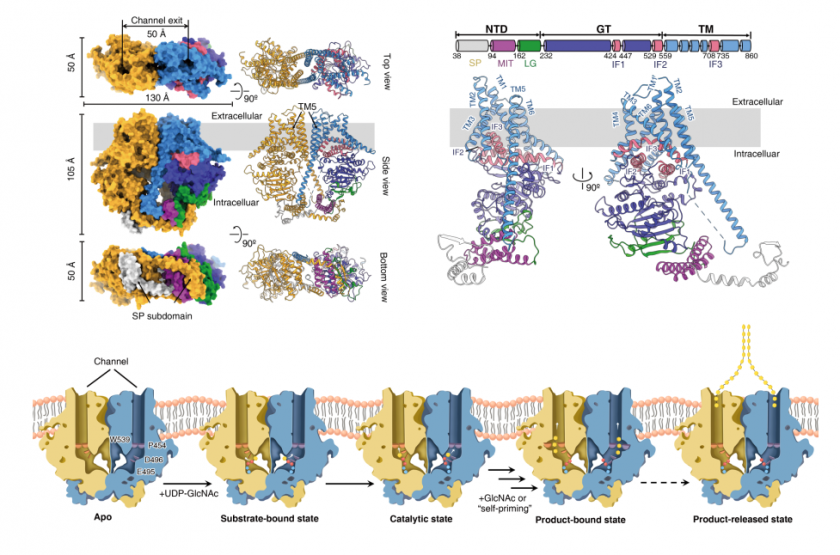
The three-dimensional structure of the PsChs1 (above) and a model of chitin biosynthesis (below). CAAS
Scientists from CAAS's Institute of Plant Protection studied PsChs1, a chitin synthase from Phytophthora sojae, the main pathogen causing soybean rhizome rot, and revealed the whole process of chitin biosynthesis for the first time.
"The research is a milestone ... It will help to increase green pesticide varieties, improve the core competitiveness of China's pesticide industry and the ability to prevent and control pests, so as to ensure food security," Song added.
Qian Xuhong, academician at the CAE and president of East China Normal University, said the research has "broken through a bottleneck in the field of chitin pesticides in the past 50 years," and it is "one of the most important fundamental advances in global pesticide innovation research and development."
The study was published in Nature last Wednesday.

You May Interested In


High Quality β-Nicotinamide adenine dinucleotide CAS 53-84-9 NADwith ready stock and best price
$3/UNIT FOB


2026-10-04
Trade Alert
Delivering the latest product trends and industry news straight to your inbox.
(We'll never share your email address with a third-party.)

Related News
-
China Keeps Registering Pesticides
-
The Indian biopesticide market will grow at a CAGR of 9.38%
-
The Indian biopesticide market will grow at a CAGR of 9.38%
-
The JAGRI TOKYO 2024 will be held in Tokyo from October 9-11, 2024
-
Paraquat in Australia is about to face restrictions, and Roundup safety is supported
-
Generics dominate the top 20 pesticides by sales worldwide, with $70.2 billion in 2022
-
Corteva launched a $600 million barter trade program in Brazil and Paraguay to facilitate the trading of agricultural inputs
-
Argentina will recognize the results of isotropic certification of pesticide active ingredients in some countries
-
Agri Tech(India) will be held in Bangalore from August 22-24
-
The US EPA issued new regulations for Chlorpyrifos, and Corteva and Gharda voluntarily canceled many products
Recommend Reading
-
![Lianolong Bets Big on Electronic Adhesives with $50M Strategic Stake in Sidofu]()
Lianolong Bets Big on Electronic Adhesives with $50M Strategic Stake in Sidofu
-
![India Targets Fake Drug Packaging]()
India Targets Fake Drug Packaging
-
![India’s Pharma Cost Problem Gets Worse]()
India’s Pharma Cost Problem Gets Worse
-
![European Petrochemicals Enter 'Era of Downsizing' as Dow, TotalEnergies, Shell Exit Older Cracker Assets]()
European Petrochemicals Enter 'Era of Downsizing' as Dow, TotalEnergies, Shell Exit Older Cracker Assets
-
![Canada Scraps PV Module Tariffs! Market Reopens, Demand for Supporting Chinese Chemical New Materials Set to Take Off]()
Canada Scraps PV Module Tariffs! Market Reopens, Demand for Supporting Chinese Chemical New Materials Set to Take Off
-
![This week, the market price of propylene oxide in China has risen (12.1-12.3)]()
This week, the market price of propylene oxide in China has risen (12.1-12.3)
-
![Supply Maintains Contraction, Boosting PTA Prices in China]()
Supply Maintains Contraction, Boosting PTA Prices in China
-
![FDA Warning Letters Put GMP Back in Focus]()
FDA Warning Letters Put GMP Back in Focus
-
![FDA Fast-Tracks U.S. Drug Manufacturing]()
FDA Fast-Tracks U.S. Drug Manufacturing
-
![International Oil Prices Experience a]()
International Oil Prices Experience a "Heart-Stopping Day" as U.S.-Iran Tensions Trigger Massive Shockwaves in the Energy Market