




With a second drug in Phase III for Alzheimer's, Can Bonjian turn the tide this time?
On September 28, Bojian and Eisai jointly announced that lecanemab, an ongoing Alzheimer's disease (AD) treatment jointly developed by the two companies, met the primary endpoint in Clarity AD, a phase III validation clinical trial for patients with mild Alzheimer's disease and mild cognitive impairment (MCI) caused by it. Significantly improved CDR-SB scores, while the trial met all key secondary endpoints.
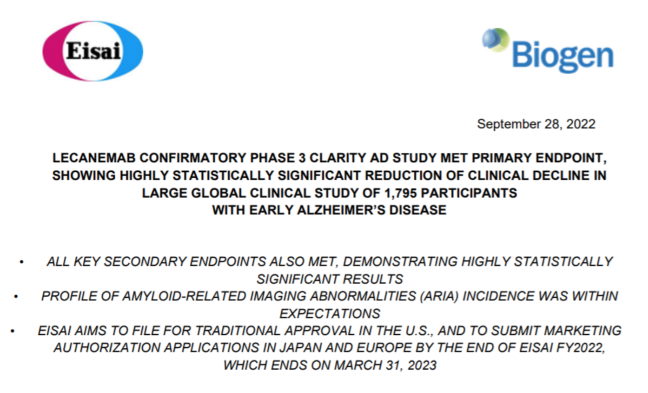
A total of 1,795 patients with early-stage AD participated in the clinical trial. This was a randomized, double-blind, placebo-controlled, Phase III study. The treatment group received lecanemab at a dose of 10 mg/kg every two weeks, and participants were assigned in a 1:1 ratio to receive placebo or lamotrigine, with similar baseline characteristics in both groups.
The results showed that the primary end point, CDR-SB (Cognitive and Functional Scale) score, was 27% lower in the Lecanemab group than in the placebo group at 18 months (p=0.00005), meaning that the magnitude of clinical decline in CDR-SB was 27% slower than in the placebo group. In the intention-to-treat population analysis, the change in score for treatment was -0.45 (p = 0.00005).
CDR-SB is the reference standard for evaluating the results of Alzheimer's disease-related trials, which primarily measure cognitive and memory function. Scores range from 0 to 18, with higher scores indicating poorer cognitive function and day-to-day living.
All secondary end points also showed significant differences (p < 0.01). The key secondary endpoint was highly statistically significant changes in brain amyloid levels measured by PET, ADAS-cog14, ADCOMS, and ADCS MCI-ADL at 18 months compared with placebo (p < 0.01).
Logan showed excellent improvement data for both primary and secondary endpoints. However, Lecanemab's side effects remain severe, including brain swelling and bleeding. Of the 1,795 patients in the trial, 21.3 percent who received the drug experienced brain swelling or bleeding.
As early as July 2022, the FDA accepted Lecanemab's BLA application and granted preferential review status based on the results of Phase IIb study 201. The Prescription Drug User Fee Act Date (PDUFA) is set for January 6, 2023. At this time, the FDA has agreed that the Clarity AD results can be used as a confirmatory study to test the clinical benefits of Lecanemab.
The Aβ hypothesis had made Bonjian suffer, and Lecanemab was an influential understudy.
As the pathogenesis of Alzheimer's disease is very complex, it is still not completely understood by the medical community. However, there are two main hypotheses that have become breakthroughs for drug companies. One is the Aβ hypothesis, which suggests that β-amyloid protein (Aβ) is abnormally deposited outside nerve cells, forming amyloid plaques. The other is the Tau hypothesis, in which Tau is over-phosphorylated and folded to form neurofibrillary tangles.
Although the Aβ hypothesis has been involved in fraud, it is still widely accepted by pharmaceutical companies, especially Bojian. In June 2021, Bojian's first Alzheimer's treatment, Aduhelm, was approved by the FDA for the treatment of patients with early-stage AD. It is the first time in almost two decades that the FDA has approved a new treatment for AD.
Aduhelm is a monoclonal antibody that selectively binds to amyloid deposits in the brain of AD patients by targeting the Aβ protein, which is then cleared from the brain by activating the immune system.
In studies evaluating patients in the early stages of AD (mild cognitive impairment and mild dementia), Aduhelm consistently showed dose-and time-dependent effects in reducing amyloid plaques, and the FDA accelerated its approval of Aduhelm on the basis of this clinical outcome.
However, Aduhelm's listing did not bring the expected benefits to Bojian, but became a "drag bottle" for Bojian. The Iditarod has been controversial since its inception. Three professors resigned from the FDA advisory board over questions and concerns about the manufacturing process, efficacy and annual costs of Adderall. U.S. doctors stopped prescribing Adderall because of its unclear efficacy, and insurance coverage restrictions forced Bausch & Lomb to abandon its marketing program almost entirely.
Why then did Lecanemab, which also targets beta-amyloid, lead to better results? This is because the action epitopes of Lecanemab and Aduhelm are quite different. Lecanemab became an essential backup after Bonjean dropped Adderall.
Can Lekanemab turn Bonjian against the wind?
These results seem to predict a significant effect of Lecanemab, so what is a "clinically valid" improvement? Analysts at RBC Capital Markets said in a note to clients on September 27 that the experts they spoke to did not consider a benefit of around 0.3 to 0.5 to be clinically significant.
The CDR-SB score decreased by 0.45 points in the Lecanemab-treated group in the Phase III study. So the 0.45-point improvement is still open to debate. Second, there are concerns about the safety of liraglutide, which has no low-level side effects.
So success in clinical trials is not the same as commercial success, and time will tell how well Lecanemab will fare when it is marketed.
Due to the complex pathogenesis, the research and development of new drugs for Alzheimer's disease is a widely recognized problem. A.D. has not been overcome since its discovery in 1906. Worldwide, more than $600 billion has been spent on Alzheimer's research and development and more than 300 clinical drugs have failed, with a failure rate of 99.6 percent, according to the Pharmaceutical Research and Development Association of the United States. Alzheimer's is a black hole in current drug development.
That has not stopped drug companies from exploring. In addition to Bristol-Myers, Eli Lilly and Roche have joined the field. Lilly's meal met its primary endpoint in the Phase II trial, delaying clinical progression by 32 percent in patients with early-stage Alzheimer's disease.
Containers from Roche's Genentech are in a Phase III trial with cognitive performance as the primary endpoint, rather than just lowering amyloid beta levels, with clinical data expected in the second half of the year.
According to the data of the Lancet Public Health in 2020, the number of AD patients in the Chinese population aged 60 and above is as high as 9.83 million, and the number of AD patients will reach an even higher peak in 2035 when China enters a severe aging population. The number of people worldwide with AD is expected to grow from the current 50 million to 150 million by 2050.
The medical burden is heavy, so drug development in the field of AD is urgent. As for Bojian, after the "fiasco" of its first drug, Aduhelm, it is brave to work with Eisai to develop its second drug, Lecanemab.

You May Interested In


High Quality β-Nicotinamide adenine dinucleotide CAS 53-84-9 NADwith ready stock and best price
$3/UNIT FOB


2026-10-16
Trade Alert
Delivering the latest product trends and industry news straight to your inbox.
(We'll never share your email address with a third-party.)

Related News
-
An Insight Into The Alzheimer's Breakthrough New Drug
-
New Titanium Dioxide Alternative Moves Closer to Market
-
U.S. Chemical Companies Are Benefiting from This Feedstock Shock
-
Rising API Costs Threaten Drug Prices
-
Lilly Bets Bigger on China
-
Strait of Hormuz Reopens, Oil Prices Plunge: Is the Chemical Price Rally Over?
-
Evonik Releases Financial Results Statement and Expects No Recovery in Global Chemical Market Demand in 2026
-
Qatar LNG Supply Disruption Persists for Nearly Six Months, Exports Plunge 96%
-
September 1: Chemical Price Hikes Take Effect Across the Board
-
Aldi Expands Its Ingredient Ban
Recommend Reading
-
![IPEC Updates Excipient Qualification Guidance]()
IPEC Updates Excipient Qualification Guidance
-
![Pharmaceutical Tariffs Put Ingredients Back in Focus]()
Pharmaceutical Tariffs Put Ingredients Back in Focus
-
![U.S. Onshoring Debate Exposes API Raw-Material Gap]()
U.S. Onshoring Debate Exposes API Raw-Material Gap
-
![Natural Color Claims Get Easier]()
Natural Color Claims Get Easier
-
![FSANZ Advances Caffeine Permission Changes]()
FSANZ Advances Caffeine Permission Changes
-
![As the peak season for formic acid arrives in September, prices may continue to rise]()
As the peak season for formic acid arrives in September, prices may continue to rise
-
![Business Society’s BDO Market Outlook on August 26, 2026: Clearly Upward Trend]()
Business Society’s BDO Market Outlook on August 26, 2026: Clearly Upward Trend
-
![Business Society’s Market Outlook for Propylene Oxide on September 1, 2026: Volatile (Bullish Bias)]()
Business Society’s Market Outlook for Propylene Oxide on September 1, 2026: Volatile (Bullish Bias)
-
![Business Society’s Market Outlook for Ethyl Acetate on August 26, 2026: Strong Consolidation]()
Business Society’s Market Outlook for Ethyl Acetate on August 26, 2026: Strong Consolidation
-
![Business Society September 1, 2026 Epichlorohydrin Market Perspective: Price Trend is Fluctuating]()
Business Society September 1, 2026 Epichlorohydrin Market Perspective: Price Trend is Fluctuating






- Hot Searches
- boron trifluorid
- buy glp 3 retatrutide
- what's the price of kerosene
- n-isopropylbenzylamine for sale
- current urea price per ton
- alpha olefin sulfonate price
- dapagliflozin propanediol 10 mg tablet
- where to buy coumarin
- where can i get retatrutide
- retatrutide for sale online usa
- dextroamphetamine sulfate
- lpg gas price