




2-Bromo-6-fluorobenzaldehyde
-
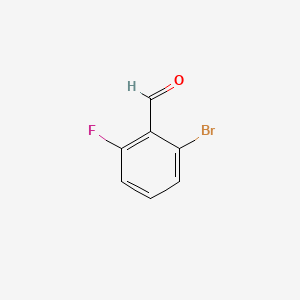
2-Bromo-6-fluorobenzaldehyde
structure -
-
CAS No:
360575-28-6
-
Formula:
C7H4BrFO
-
Chemical Name:
2-Bromo-6-fluorobenzaldehyde
-
Synonyms:
2-BROMO-6-FLUOROBENZALDEHYDE;2-BROMO-6-FLUOROBENZENECARBALDEHYDE;Benzaldehyde,2-broMo-6-fluoro-;2-BroMo-6-fluorobenzaldehyde 96%;2-BroMo-6-fluorobenzaldehyde, 95+%
- Categories:
-
CAS No:
Characteristics
17.1
2.2
Solid
1.7±0.1 g/cm3
45-48
100-102℃/8mm
>110°(230°F)
1.585
Slightly soluble in water.
Safety Information
9
UN 3335
3
22-36/37/38
26-36
Xi,Xn
Irritant
P261-P305 + P351 + P338
H302-H315-H319-H335
2-Bromo-6-fluorobenzaldehyde Use and Manufacturing
To a stired solution of iPr2NH (2.25 mL, 1.63 g, 16.1 mmol) in THF (20 mL) in a 50-mL 3-necked flask under dry argon nBuLi (6.3 mL, 2.35 M in hexanes, 14.7 mmol) was added dropwise during 10 minutes at 0 °C. After stirring for an additional 20 minutes at 0°C, the mixture was cooled to −78°C and a solution of 1-bromo-3-fluorobenzene (2.45 g, 14.0 mmol) in THF (10 mL) was added dropwise during 12 minutes with temperature maintaining within the range −85 ÷ −75 °C to give deep red solution. After stirring for 1 hour at −78°C, solution of DMF (1.32 g, 18.2 mmol) in THF (7 mL) was then added dropwise during 5 minutes and the mixture was kept for additional 1 hour. The reaction mixture was quenched with AcOH (2.5 mL), and it was allowed to gradually warm to room temperature. The reaction mixture was poured into mixture of 0.2 M HCl (40 mL) and MeOAc (50 mL). The organic layer was separated out and the aqueous layer was extracted with MeOAc (30 mL). The combined organics were washed with brine (60 mL) then dried over Na2SO4, filtered, and concentrated under reduced pressure to give an orange oil. The latter was recrystallized from hexanes to give pure aldehyde SI-1f (2.31 g, 11.4 mmol, 81percent)Step 1: (0363) A 500 mL three-necked flask was charged with tetrahydrofuran (250 ml) and diisopropylamine (28 ml), n-butyllithium (78 ml) was added dropwise at −10° C.0° C. under a nitrogen atmosphere. The mixture was stirred at 0° C. for 30 minutes and then cooled to −78° C. 3-Bromofluorobenzene (21 ml) was added dropwise, after stirring at −78° C. for 1 hour, N, N-dimethylformamide (17 ml) was added followed by stirring 20 minutes at the same temperature. Then glacial acetic acid (28 ml) and water (200 ml) was quickly added and the mixture was warmed to 15° C. The mixture was extracted with ethyl acetate (500 ml×2), the organic phase was washed with water (300 ml×2) and brine (200 ml×1), dried over anhydrous sodium sulfate, concentrated and subjected to column chromatography to obtain the target 14-b (32 g, yield: 81percent).Step 1: 2-Bromo-6-fluorobenzaldehydeTo a stirred solution of diisopropylamine (1.4 mL, 0.00571 mol) in dry tetrahydrofuran (7.2 mL) was added dropwise n-butyllithium (1.6M in hexane) (3.56 mL, 0.00571 mol) at 0°C and stirring was continued for 15 min at 0°C. The reaction mixture was cooled to -78°C and l-bromo-3-fluorobenzene (1 g, 0.00571 mol) was added over 10 min. After stirring for 1 h at -78°C, anhydrous N, N-dimethylformamide (7.2 mL) was added dropwise over 5 min and the resulting mixture was stirred for another 20 min at -78°C. The reaction was quenched with addition of acetic acid (0.6 mL) followed by water (15 mL) and the mixture was warmed to room temperature. The mixture was extracted with ethyl acetate (2x20 mL) and the combined organic layers were washed with water (2x10 mL) followed by brine solution and dried over anhydrous sodium sulfate. The solvent was evaporated under vacuum to afford the title compound as a pale yellow solid (850 mg, 73percent). H NMR (400 MHz, DMSO-dA nitrogen-protected four-necked flask was charged with 268 g of diisopropylamine and 100 g of tetrahydrofuran, cooled to -40 ° C to -50 ° C, and 340 g was added dropwise at -40 ° C to -50 ° C Butyl lithium, stirring and holding 1 hour, the raw material reaction is completed. Cooling to -70 ~ -80 , A mixture of 200 g of fluorobromobenzene and 100 g of tetrahydrofuran was added dropwise, Stir for 2 hours. After the addition of dimethylformamide 112 g, stirring for 1 hour, hydrochloric acid quenching pH = 1 ~ 2.The ethyl acetate extract was distilled under vacuum under reduced pressure to give 165 g of 2-fluoro-6-bromobenzaldehyde and 98percent pure GC.Step 1 2-bromo-6-fluoro-benzaldehydeA solution of butyllithium (2.5M in hexanes, 2.866 L, 7.17 mol) is added dropwise to a stirred solution of diisopropylamine (745.7 g, 7.37 mol) in tetrahydrofuran (1.630L) such that the temperature is maintained hi the range -60 to -78 PREPARATION 6 Step 1: (0458) Diisopropylamine (5.14 g, 50.8 mmol) was dissolved in dry tetrahydrofuran (50 ml) under a nitrogen atmosphere, n-butyllithium in hexane (20.3 ml, 50.8 mml) was added dropwise thereto at 0° C. followed by stirring for 30 minutes. The reaction mixture was cooled to −78° C., 1-bromo-3-fluorobenzene 31-a (10.0 g, 42.4 mml) in dry tetrahydrofuran (100 ml) solution was added dropwise thereto followed by stirring for 30 minutes. Methyl formate (7.63 g, 127.2 mml) was added dropwise thereto followed by stirring for 30 minutes. The mixture was warmed to room temperature, extracted with ethyl acetate (100 ml×3) and 1N hydrochloric acid (100 ml). The combined organic phase was dried over anhydrous sodium sulfate, filtered, concentrated, subjected to column chromatography to give 31-b as a white solid (8.0 g, yield: 93percent).
Recommended Suppliers of 2-Bromo-6-fluorobenzaldehyde
-
![China]() CN
CN
5 YRS
Business licensedTrader Supplier of Intermediates,Building blocks,API,Silicones,Peptides,Lab chemicals,Biochemicals,Pharmaceuticals,Screening Compounds,Food Additives -
![China]() CN
CN
5 YRS
Business licensedTrader Supplier of Peptides,Chemicals,API,AdditivesInquiryCAS No.: 360575-28-6Grade: Pharmaceutical GradeContent: 99%

Learn More Other Chemicals
-
4-(Trifluoromethyl)benzeneacetic acid
32857-62-8
-
3-BROMO-2-FLUORO-6-PICOLINE
375368-78-8
-
2,4-Diisopropylphenol
2934-05-6
-
1,2-Diiodotetrafluoroethane Formula
354-65-4
-
6-METHYL-2-PIPERIDINECARBOXYLICACID Formula
99571-58-1
-
2,4-Dichloro-6-picoline Formula
42779-56-6
-
1-BROMO-1H,1H,2H,2H-PERFLUORODECANE Structure
21652-57-3
-
Perfluorohexanoic acid Structure
307-24-4
-
What is 6-chloro-2-naphthalenethiol
392330-26-6
-
What is 2,3-Dichloro-5-nitropyridine
22353-40-8