




Sodium propionate
-
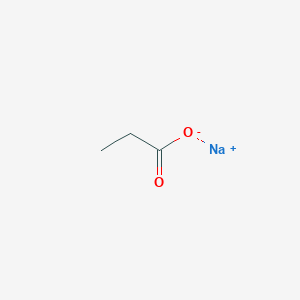
Sodium propionate
structure -
-
CAS No:
137-40-6
-
Formula:
C3H6O2.Na
-
Chemical Name:
Sodium propionate
-
Synonyms:
bioban-s;component of Prophyllin;deketon;Impedex;propisol;sodiumpropanoate;Spac;whit-pro
- Categories:
-
CAS No:
Description
Colourless crystals or, white or almost white powder, slightly hygroscopic.ChEBI: An organic sodium salt comprising equal numbers of sodium and propionate ions.Sodium propanoate or sodium propionate is the sodium salt of propionic acid which has the chemical formula Na(C2H5COO).It appears as transparent particles or crystal with specific smelly odor. It is easily subject to deliquescence in wet air. It is soluble in water, slightly soluble in alcohol.
DryPowder|White crystalline hygroscopic powder, or a fine white powder|WHITE HYGROSCOPIC CRYSTALLINE POWDER WITH CHARACTERISTIC ODOUR.
Sodium propionate is an organic sodium salt comprising equal numbers of sodium and propionate ions. It has a role as an antifungal drug and a food preservative. It contains a propionate.|Sodium Propionate is the sodium salt form of propionic acid, a short chain fatty acid (SCFA) and food additive, with potential gastrointestinal (GI) protective activity. Upon oral administration of sodium propionate, it converts to propionic acid which may protect the GI tract and reduce incidence and severity of GI toxicity from radiation therapy.
Sodium propanoate or sodium propionate is the sodium salt of propionic acid which has the chemical formula Na(C2H5COO).
ChEBI: An organic sodium salt comprising equal numbers of sodium and propionate ions.
Sodium propionate Basic Attributes
96.06
96.018723
3566934
205-290-4
391O0PO49R|DK6Y9P42IN
0557
TSCA listed
DTXSID7021996
C84167
White
S - Sensory organs
29159000
Characteristics
40.1
-0.85370
DryPowder
1.51[at 20℃]
285-286 °C (lit.)
141.7°C at 760 mmHg
57.7ºC
995 g/L (20 ºC)
Store at RT.
0Pa at 20℃
ADI has not been subject to any specific restriction (FAO/WHO, 2001).LD50 5.1 g/kg (mouse, oral).GRAS (FDA, § 184.1784, 2000).
Not classified
at 100.00%. bland
SLIGHT CHEESE-LIKE FLAVOR
8-9.5 (10g/l, H2O, 20℃)
Deliquescent in moist air
Dust explosion possible if in powder or granular form, mixed with air.
Inert atmosphere,Room Temperature
Safety Information
NONH for all modes of transport
1
Xn
36/37-36/37/39-26-36
UF7525000
Xn
Dry. Well closed.
Stable. Incompatible with strong oxidizing agents. Hygroscopic.
P280
21-38-36/37/38
SRP: At the time of review, criteria for land treatment or burial (sanitary landfill) disposal practices are subject to significant revision. Prior to implementing land disposal of waste residue (including waste sludge), consult with environmental regulatory agencies for guidance on acceptable disposal practices.
Substances classified as antimycotics, when migrating from food-packaging material include sodium propionate.|Substance added directly to human food affirmed as generally recognized as safe (GRAS) when meeting specified requirements.|Sodium propionate used as a chemical preservative in animal drugs, feeds, and related products is generally recognized as safe when used in accordance with good manufacturing or feeding practice.
Combustible. Gives off irritating or toxic fumes (or gases) in a fire. Finely dispersed particles form explosive mixtures in air.
|Warning|H312 (84.21%): Harmful in contact with skin [Warning Acute toxicity, dermal]|P261, P264, P271, P280, P302+P352, P304+P340, P305+P351+P338, P312, P321, P322, P332+P313, P337+P313, P362, P363, P403+P233, P405, and P501|Aggregated GHS information provided by 354 companies from 11 notifications to the ECHA C&L Inventory. Each notification may be associated with multiple companies.|H319: Causes serious eye irritation [Warning Serious eye damage/eye irritation]|P264, P280, P305+P351+P338, and P337+P313
Use water in large amounts.
Combustible
SODIUM PROPIONATE IS NOT IRRITATING WHEN USED CLINICALLY AS DUSTING POWDER FOR CONTROL OF FUNGUS INFECTIONS.
Personal protection: particulate filter respirator adapted to the airborne concentration of the substance. Sweep spilled substance into covered containers. If appropriate, moisten first to prevent dusting. Wash away remainder with plenty of water.
Dry. Well closed.
Evaporation at 20 °C is negligible; a nuisance-causing concentration of airborne particles can, however, be reached quickly when dispersed.
NO open flames. PREVENT DISPERSION OF DUST. Prevent build-up of electrostatic charges (e.g., by grounding).
Use local exhaust.
Protective gloves.
Wear safety spectacles.
Toxicity
IN RATS, VITAMIN B12 PREVENTED GROWTH LOSS CAUSED BY SODIUM PROPIONATE.|SODIUM PROPIONATE EXERTED SIGNIFICANT PROTECTIVE EFFECT AGAINST AMMONIA INTOXICATION IN CHICKS WHEN ADMIN IP 7 HR PRIOR TO AMMONIUM ACETATE CHALLENGE. EFFECTIVE DOSES RANGED FROM 3-4 MMOLE/KG.
LD50 Mouse oral 6332 mg/kg|LD50 Mouse sc 2100 mg/kg|LD50 Rabbit skin 1640 mg/kg
Drug Information
MANY PROPRIETARY PREPARATIONS ARE AVAILABLE FOR TREATING DERMATOPHYTIC INFECTIONS, ESPECIALLY TINEA PEDIS (ATHLETE'S FOOT). THESE INCLUDE ... SODIUM PROPIONATE ...|CLINICALLY, MEDICATION: SODIUM PROPIONATE IS USED IN TREATMENT OF OTOMYCOSIS. IT IS ALSO USED IN TREATMENT OF EPIDERMOPHYTOSIS, BUT IT IS NOT AS EFFECTIVE AS MOST OTHER AGENTS FOR THIS CONDITION. IT IS NOT FUNGICIDAL, SO THAT OTHER HYGIENE MEASURES MUST BE EMPHASIZED. ... DOSE--TOPICAL, IN DOSAGE FORMS CONTAINING 0.5-10% OF SODIUM PROPIONATE.|MEDICATION (VET): ALTHOUGH SOME COWS FIND HIGH DOSAGE (250 G) UNPALATABLE & IT MAY LACK SUBSTANTIAL EFFECTIVENESS AS PROPHYLACTIC & THERAPEUTIC AGENT IN ACETONEMIA, IT IS A USEFUL ADJUNCT TO THERAPY & ITS BENEFICIAL EFFECTS ON MILK PRODUCTION HAVE BEEN ATTRIBUTED TO CONTROL OF SUBCLINICAL KETOSIS.|MEDICATION (VET): EFFECTIVE IN EARLY TREATMENT OF KETOSIS OF CATTLE OR AS FOLLOWUP TREATMENT AFTER DEXTROSE THERAPY OF THIS DISEASE.|For more Therapeutic Uses (Complete) data for SODIUM PROPIONATE (6 total), please visit the HSDB record page.
SRP: In an acidic medium propionic acid is rapidly absorbed.
INCORPORATION RATE OF SPECIFICALLY LABELED SODIUM PROPIONATE INTO METHYLMALONATE & TRICARBOXYLIC ACID CYCLE INTERMEDIATES STUDIED. INCORPORATION OF (14)C FROM SODIUM PROPIONATE INTO METABOLIC INTERMEDIATES BEYOND METHYLMALONATE WAS POSITIVELY CORRELATED WITH LIVER VITAMIN B-12 CONCN.|MICE RECEIVED IV LABELED SODIUM PROPIONATE. ANALYSIS OF TOTAL BODY FATTY ACIDS 12 MIN LATER SHOWED 89 & 11 OF THE LABELS TO BE INCORPORATED INTO ODD-NUMBERED & EVEN-NUMBERED FATTY ACIDS, RESPECTIVELY. RESULTS CONFIRMED PROPOSED DEMETHYLATION OF PROPIONIC ACID IN VIVO.
Rinse with plenty of water (remove contact lenses if easily possible).
Fresh air, rest.
Rinse skin with plenty of water or shower.
Prophyllin
Cough. Sore throat.
Redness. Pain.
Sodium propionate Use and Manufacturing
REACTION OF PROPIONIC ACID AND SODIUM CARBONATE OR SODIUM HYDROXIDE|Propionic acid + sodium hydroxide (salt formation)
Primary uses: Antifungal agent, antiseptic agent (topical), disinfectant, food additive, ophthalmic agent.
It is used primarily as a mold inhibitor in bakery products. It is approved for use as a food additive in the EU, USA and Australia and New Zealand (where it is listed by its INS number 281). Chemically synthesized sodium propionate is most commonly used as a preservative in the food industry. It prevents the growth of mold and some bacteria, thereby prolonging the shelf life of pack
chemical food additive
chemical food additive
Fungicide, mold preventative.
Sodium Propionate is an antimicrobial agent that is the sodium salt of propionic acid. it occurs as colorless, transparent crystals or a gran- ular crystalline powder. it is odorless or has a faint acetic–butyric acid odor, and is deliquescent. it is prepared by neutralizing propionic acid with sodium hydroxide. it is used in baked goods; nonalcoholic beverages; cheeses; confections and frostings; gelatins, puddings, and fillings; jams and jellies; meat products; and soft candy.
(1972) 1.87X10+9 GRAMS|(1973) 1.63X10+6 GRAMS|(1984) 9.52X10+8 g|Separate statistics for this item are not published to avoid disclosure of individual company operations.
Mold inhibitor-Baked goods, 80%; Feed grain preservative, 10%; and Misc, 10% (1983) /Sodium & Calcium propionate/
SODIUM PROPIONATE NF; PROPANOIC ACID, SODIUM SALT, HYDRATE|SODIUM PROPIONATE IS OFTEN COMPOUNDED WITH ANTIBIOTICS OR ANTISEPTICS.|Grades: National Formulary; Food Chemical Codex|Propionic acid and sodium propionate ... may be compounded together or with sodium caprulate ... Sodium propionate is used in proprietary preparations in concentrations of 1 to 5%.
Food, beverage, and tobacco product manufacturing|Propanoic acid, sodium salt (1:1): ACTIVE|Propanoic acid, sodium salt (2:1): INACTIVE|PROPIONATES ARE MORE ACTIVE AGAINST MOLDS THAN SODIUM BENZOATE, BUT HAVE ESSENTIALLY NO ACTIVITY AGAINST YEAST. THEY HAVE LITTLE ACTION /IN BAKED GOODS/ ... AGAINST BACTERIA WITH NOTABLE EXCEPTION OF THEIR ABILITY TO INHIBIT THE ORGANISM WHICH CAUSES ROPE. THE PH FOR OPTIMUM ACTIVITY OF PROPIONATES RANGES UP TO 5.0, ALTHOUGH IN SOME FOODS THEY ARE ACTIVE UP TO PH 6, OR SLIGHTLY HIGHER. ... IN CHEESE PRODUCTS ... /PROPIONATES/ ARE LIMITED TO 0.3%. PROPIONATES ARE NOT MENTIONED IN FOOD-ADDITIVE REGULATIONS OF WEST GERMANY, INDIA, PAKISTAN, PHILIPPINES, & SOUTH AFRICA BUT THEY ARE INCLUDED IN THOSE OF OTHER WEST EUROPEAN COUNTRIES ... AS WELL AS CANADA. /PROPIONATES/|... /IT IS/ BACTERIOSTATIC AGAINST NUMBER OF GRAM-POSITIVE COCCI.|MOST ACTIVE AT ACID PH|... /BLENDS/ READILY WITH EMULSIFYING AGENTS USED IN PROCESSED & BLENDED CHEESE, AS WELL AS WITH BASIC DOUGH INGREDIENTS & IN FILLING FOR PIES.|For more General Manufacturing Information (Complete) data for SODIUM PROPIONATE (7 total), please visit the HSDB record page.
AOAC Method 970.36. Propionates in food. /Total propionates/
EPA Safer Chemical Functional Use Classes -> Preservatives and Antioxidants;Processing Aids and Additives|Safer Chemical Classes -> Green circle - The chemical has been verified to be of low concern|Food additives|Agrochemicals -> Fungicides|Cosmetics -> Preservative
Food Additives -> PRESERVATIVE;
Recommended Suppliers of Sodium propionate
-
![China]() CN
CN
8 YRS
Business licensed Certified factoryManufactory Supplier of Biochemicals Ingredients,Vitamin Amino Acid Ingredients,Cosmestic Ingredients,Pharma Chemicals,Organic Fine Chemicals,Food Nutrient Ingredients,Natural Plant Ingredients,APIS Intermidiates,Daily Chemicals,Agricultural Chemicals,Surfactant Chemicals,Ultraviolet Absorbents,Antioxidant Ingredients,Scientific Research Chemical,Flavors and Fragrances ChemicalsInquiryCAS No.: 137-40-6Grade: Food GradeContent: 99% -
![China]() CN
CN
8 YRS
Business licensedTrader Supplier of Food additives,Pharmaceutical raw materials,Chemicals,Comestic raw materials -
![China]() CN
CN
4 YRS
Business licensedTrader Supplier of intermediates ,fine chemical,food additives -
![China]() CN
CN
5 YRS
Business licensed Certified factoryManufactory Supplier of Calcium Propionate,Vanilla,Calcium Acetate,Potassium Sorbate,Erythritol,Sodium Cyclamate,Guar Gum,Dextrose,Food Colors,Sodium Acid Pyrophosphate,Xanthan Gum,Sodium Saccharin,Modified Potato Starch,Modified Tapioca Starch,Citric Acid,Monosodium Glutamate,Modified Corn Starch,Sodium Benzoate,Sodium Tripolyphosphate,VanillinInquiryCAS No.: 137-40-6Grade: Food GradeContent: 99% -
![China]() CN
CN
4 YRS
Business licensedTrader Supplier of calcium chloride,monosodium phosphate,magnesium citrate,tricalcium phosphate,magnesium chloride,disodium phospahte,trisodium phospahte,calcium citrate,tripotassium phosphate,dicalcium phosphate,monocalcium phosphate,zinc citrate,dipotassium phosphate,monopotassium phosphateInquiryCAS No.: 137-40-6Grade: Food Grade

Learn More Other Chemicals
-
Desacetyl Cephapirin SodiuM Salt
104557-24-6
-
D-Fructose, 1,6-bis(dihydrogen phosphate), sodium salt (1:4)
23784-19-2
-
Poly(oxy-1,2-ethanediyl), α-(carboxymethyl)-ω-(decyloxy)-, sodium salt (1:1)
38815-93-9
-
DIAMMONIUM SODIUM HEXANITRORHODATE(III)& Formula
14640-47-2
-
DECANOIC ACID-CARBOXY-14C SODIUM Formula
94033-36-0
-
1H-Tetrazole-1-acetic acid, 2,5-dihydro-5-thioxo-, sodium salt (1:1) Formula
113221-74-2
-
Phosphonic acid, (dichloromethylene)bis-, sodium salt Structure
29329-69-9
-
Benzoic acid, 2,3-dichloro-, sodium salt (1:1) Structure
118537-84-1
-
What is Sodium arsenate heptahydrate
10048-95-0
-
What is Periodic acid (H5IO6), sodium salt (1:3)
13940-38-0