




Cyclopropyl bromide
-
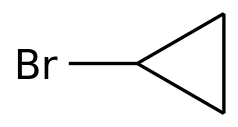
Cyclopropyl bromide
structure -
-
CAS No:
4333-56-6
-
Formula:
C3H5Br
-
Chemical Name:
Cyclopropyl bromide
-
Synonyms:
bromo-cyclopropan;Cyclopropane, bromo-;CYCLOPROPYL BROMIDE;BROMOCYCLOPROPANE;Cyclopropylbromide,99%;Bromocyclopropane,99%;Cyclopropyl;Cyclopropyl bromide(CPB)
- Categories:
-
CAS No:
Description
clear colourless liquid
Cyclopropyl bromide is also named as Bromocyclopropane. It is used in organic synthesis, for instance, for the formation of a Grignard Reagent, cyclopropyllithium. It is also used as an intermediate in the manufacture of pharmaceutical and agrochemical products.
Light yellow to clear colourless liquid, boiling point 67-69°C, refractive index (nD20) 1.4605, density (d420) 1.5120, flash point -6°C.
Cyclopropyl bromide Basic Attributes
120.98
120.98
1900287
224-375-7
89692
TSCA listed
DTXSID8063418
Clear colorless
29035990
Characteristics
0
1.5
Clear colorless Liquid
1.51 g/mL at 25 °C (lit.)
69 °C (lit.)
20 °F
n20/D1.458(lit.)
immiscible
2-8°C
2-8°C
Safety Information
II
3
UN 1993 3/PG 2
3
F,Xi
16-26-36-37/39
F,Xi
Irritant
Stable at room temperature in closed containers under normal storage and handling conditions.
P210-P261-P305 + P351 + P338
11-36/37/38
UN 1993 3/PG 2
|Danger|H225 (100%): Highly Flammable liquid and vapor [Danger Flammable liquids]|P210, P233, P240, P241, P242, P243, P261, P264, P271, P280, P302+P352, P303+P361+P353, P304+P340, P305+P351+P338, P312, P321, P332+P313, P337+P313, P362, P370+P378, P403+P233, P403+P235, P405, and P501|Aggregated GHS information provided by 50 companies from 7 notifications to the ECHA C&L Inventory. Each notification may be associated with multiple companies.
Cyclopropyl bromide Use and Manufacturing
(1) Add 179 g of 1, 3-bromochloropropane to a three-necked flask, 29 g of potassium cyanide and 50 ml of water, and stirred while heating until dissolved.Further, 70 ml of an ethanol solution was added, and the mixture was stirred and refluxed for 2 hours.Cool to room temperature, dilute with 300 ml of water, and separate the oil and water layer.Extract and dry with 40 ml of chloroform and anhydrous calcium chloride.Chloronitrile 316.9g was obtained.In the produced chlorobutyronitrile 241.6gAdd 100 ml of sodium hydroxide solution, and add stirring reaction for 2 hours.Then add water 200ml, cooled to about 10 °C, add 44ml of concentrated sulfuric acid acidification reaction, extraction and extraction agent drying and drying, to obtain cyclopropionic acid 330.1g;The obtained cyclopropionic acid 324.8 was added dropwise to contain 48 g of oxidized mercury, 160ml of a mixed solution of 1, 1, 2, 2-tetrachloroethane and liquid bromine 64.4g, Stir well, after reacting for 2 hours, cool it to 5 ° C.Drying with a detergent and a desiccant to obtain 419.15 g of bromocyclopropane;The separation extractant used for separation and extraction of cyclopropionic acid 3 is petroleum ether.The desiccant is anhydrous sodium sulfate; the detergent and desiccant used for washing and drying the bromocyclopropane 4 are respectively tetrachloroethane and calcium chlorideUnder nitrogen, 220 ml of 1, 2-dichloroethane was added to the above reaction intermediate in a 500 mL three-necked flask and(0.44 mol) of trichlorobromomethane, and the mixture was stirred well. After the temperature was raised to 75C, a mixed solution of m-chloroperbenzoic acid dissolved in 1, 2-dichloroethane was added dropwise. During the addition, the solution was released from the gas, and the dropping speed was controlled in accordance with the amount of generation of the bubbles. After the completion of the reaction, the reaction was stirred for 3 hours while maintaining the temperature, and the starting material point was disappeared by TLC, and the reaction product was detected in the gas phase. After the reaction, the reaction mixture was quenched by adding aqueous sodium bisulfite solution, and the organic layer was separated and washed with saturated brine. After drying over anhydrous magnesium sulfate, the organic layer was heated to atmospheric distillation (rectification column length: 10 cm) 60-72 ° C to obtain crude liquid yellow liquid, re-distillation to collect 67-69 ° C distillate to be colorless and transparent liquid cyclopropyl bromide, GC: 99.5percent, HNMR structure.
Pharmaceutical intermediates.
Bromocyclopropane is primarily used an intermediate in the manufacture of pharmaceutical and agrochemical products. It is also used in the production of cyclopropyl boric acid. It is used as an intermediate in organic synethesis.
Cyclopropane, bromo-: ACTIVE
Computed Properties
Molecular Weight:120.98
XLogP3:1.5
Exact Mass:119.95746
Monoisotopic Mass:119.95746
Heavy Atom Count:4
Complexity:22.5
Covalently-Bonded Unit Count:1
Compound Is Canonicalized:Yes
Recommended Suppliers of Cyclopropyl bromide
-
![China]() CN
5 YRS
Business licensed Certified factoryManufactory Supplier of Dichloromethane,Linocaine hydrochloride -
![China]() CN
5 YRS
Business licensedTrader Supplier of Intermediates,Building blocks,API,Silicones,Peptides,Lab chemicals,Biochemicals,Pharmaceuticals,Screening Compounds,Food Additives -
![China]() CN
5 YRS
Business licensedTrader Supplier of PVC resin,pvc paste resin,melamine -
![China]() CN
4 YRS
Business licensed Certified factoryManufactory Supplier of Flavors & Fragrances,Catalyst & Auxiliary,Intermediates,Dyes & Pigments,Inorganic Chemistry,petro chemicals,Surfactant,Food Additives,Water Treatment Chemicals -
![China]() CN
5 YRS
Business licensedDistributor Supplier of DIMETHYL SULFOXIDE,NMP,MMT

Learn More Other Chemicals
-
Neodymium bromide (NdBr3)
13536-80-6
-
diallylnormorphinium bromide
69576-07-4
-
2,3-DICHLORO-6-(TRIFLUOROMETHYL)BENZYL BROMIDE
886501-99-1
-
1-Tetradecanaminium, N,N,N-triethyl-, bromide (1:1) Formula
18144-35-9
-
1-Butanaminium, N,N,N-tripropyl-, bromide (1:1) Formula
61175-77-7
-
1-Hexanaminium, N-butyl-2-ethyl-N,N-dimethyl-, bromide (1:1) Formula
93839-31-7
-
3-Bromo-4-fluorobenzoyl bromide Structure
78239-66-4
-
2-BROMOBENZYLZINC BROMIDE Structure
307496-27-1
-
What is 1-Dodecanaminium, N-(2-ethoxy-2-oxoethyl)-N,N-dimethyl-, bromide (1:1)
1794-75-8
-
What is Benzothiazolium, 3-(2-hydroxyethyl)-2-methyl-, bromide (1:1)
63123-34-2