Japan's Plan to Discharge Fukushima Nuclear Water into the Pacific Ocean Sparks Controversy and Health Concerns
Japan is expected to receive the final report from the United Nations regulatory agency on Tuesday (July 4th), approving the plan to discharge over 1.3 million tons of treated Fukushima nuclear disaster water into the Pacific Ocean over the next 30 to 40 years.

Japan is running out of space to store waste water(source:REUTERS)
Rafael Grossi, Director General of the International Atomic Energy Agency (IAEA), began a four-day visit to Japan on Tuesday, during which he will meet with Japanese Prime Minister Fumio Kishida and submit a safety review report on the plan to discharge the contaminated water into the ocean, which has been under review for two years. Japan's domestic nuclear regulatory agency will also release an important assessment.
It is understood that both reports will support Tokyo Electric Power Company (TEPCO) in starting to discharge the treated nuclear waste water into the ocean, which is equivalent to about 500 Olympic-sized swimming pools. The 2011 earthquake and tsunami in Japan triggered the world's most serious nuclear disaster at the Fukushima Daiichi nuclear power plant since the Chernobyl nuclear accident, and the contaminated water from the cooling of the reactors has been increasing.
Japan has assured other countries that the plan to discharge the nuclear waste water into the ocean is safe, in line with industry standards and necessary, as by early 2024, about 1,000 tanks in Fukushima will be filled with waste water and there will be no more space for additional tanks. In addition, other stages of the decommissioning process of the nuclear power plant also require space.
Japan has not yet set a specific date for the discharge, pending the final review by the International Atomic Energy Agency and formal approval by the national nuclear regulatory agency for TEPCO's review. The regulatory agency could make a final decision as early as this week.
The Japanese government announced the plan to discharge the water into the ocean in 2021, which has been strongly opposed by some neighboring countries, including China. Last month, Chinese Foreign Ministry spokesperson Wang Wenbin strongly criticized Japan as "extremely selfish and irresponsible" and emphasized that "the ocean is a common asset of the world, not Japan's 'sewer'." On Monday, Wang Wenbin reiterated that "the International Atomic Energy Agency should come up with responsible conclusions on the discharge of Fukushima nuclear contaminated water into the ocean, and must not endorse Japan's wrongful act of discharging nuclear contaminated water into the ocean."
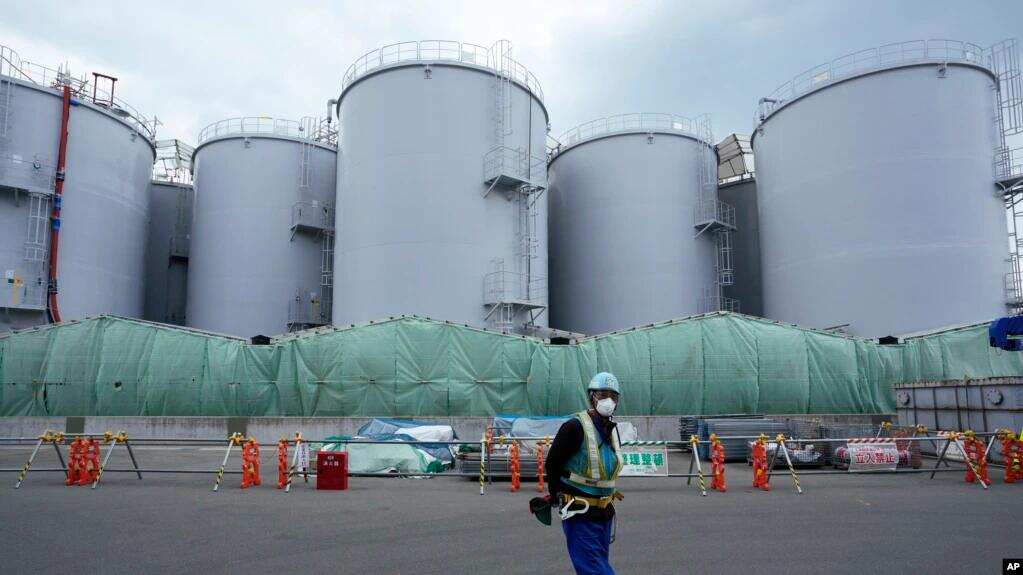
Nuclear waste water storage tanks at the Fukushima
Beijing expressed a strong protest again through its embassy in Japan on Tuesday, stating that "the assessment report of the International Atomic Energy Agency cannot become a pass for Japan's discharge into the ocean," and called for a suspension of the plan.
Wu Jianghao, the Chinese Ambassador to Japan, said at a press conference on Tuesday that Japan's plan to discharge the water into the ocean lacks legitimacy and poses enormous risks to the global marine environment and human health. He said that Japan's strong push for the discharge violates its obligations under international law, and the International Atomic Energy Agency report neither proves the legitimacy and legality of Japan's discharge, nor absolves Japan of its moral responsibility and international legal obligations.
According to the Global Times, a Chinese state-run media outlet, an online questionnaire survey was conducted from June 16th to June 29th targeting 11 countries along the Pacific coast. The survey results reportedly showed that nearly 90% of respondents had a negative attitude towards Japan's decision to discharge nuclear contaminated water into the ocean, with China's figure reaching 98% and South Korea exceeding 90%. In addition, nearly 90% of respondents supported China's intervention in Japan's discharge of nuclear contaminated water. Another survey conducted by Yomiuri Shimbun and The Korea Times in May found that 84% of respondents opposed the discharge.
The Japanese Ministry of Foreign Affairs stated that it has made multiple attempts to explain the scientific basis behind Tokyo's position to Beijing officials, but the proposals have been ignored.
TEPCO plans to mix the treated water with seawater, remove most of the radioactive elements, and dilute the concentration of tritium to a level "far below" the guidelines of the Japanese government and the World Health Organization, and then discharge the water into the ocean through an underwater tunnel over a period of up to 40 years. According to the International Atomic Energy Agency, other countries with nuclear power plants have safely discharged similar diluted waste water.
Ambassador Wu Jianghao emphasized at the press conference on Tuesday that "Japan's comparison of the tritium content in Fukushima contaminated water with the tritium content in normal discharge cooling water from nuclear power plants is completely confusing concepts and misleading public opinion."

You May Interested In


High Quality β-Nicotinamide adenine dinucleotide CAS 53-84-9 NADwith ready stock and best price
$3/UNIT FOB


2026-10-13
Trade Alert
Delivering the latest product trends and industry news straight to your inbox.
(We'll never share your email address with a third-party.)

Related News
-
Sichuan speeds up the revision of the plan for heavily polluted weather
-
11 people were sentenced to criminal detention fines for polluting
-
Ningxia Launches the Struggle of Agricultural and Rural Pollution Control
-
Australia Approves Lab-Grown “Milk Sugar” for Babies—A Breakthrough in Infant Nutrition
-
From Coffee Waste to Superfood Additive: EU Declares Pectin-Rich Arabica Extract Safe for Food Use
-
Kemira Acquires AquaBlue
-
Sherwin-Williams Opens High-Performance Industrial Coatings Facility in Saskatchewan
-
Alipay, Baidu, and iFlytek Win Big—As the Government Spends $1.1 Billion on AI Healthcare, Is This a Lifeline or a Feeding Frenzy for Tech Giants?
-
$530 Million Lawsuit Unheard, $76 Million Counterclaim Filed: Is Qicai Chemical’s ‘Reputation Defense’ a Desperate Last Stand or a Calculated PR Gambit?
-
Echoes of Overcapacity: The Structural Anxiety of China’s EVA Industry Chain
Recommend Reading
-
![The Cold Cycle: PVC Market’s Chill and Faint Light Ahead]()
The Cold Cycle: PVC Market’s Chill and Faint Light Ahead
-
![Arkema's New Singapore Plant Commences Operations, Tripling Polyamide Capacity]()
Arkema's New Singapore Plant Commences Operations, Tripling Polyamide Capacity
-
![Behind Arkema’s ¥430 Million Claim: A Patent War Over Acrylic Acid Is Tearing Off the “Technical Fig Leaf” of China’s Chemical Giants]()
Behind Arkema’s ¥430 Million Claim: A Patent War Over Acrylic Acid Is Tearing Off the “Technical Fig Leaf” of China’s Chemical Giants
-
![“Deregulation” or “Concession”? The Hidden Crisis Behind India’s Repeal of QCOs on Seven Key Petrochemicals]()
“Deregulation” or “Concession”? The Hidden Crisis Behind India’s Repeal of QCOs on Seven Key Petrochemicals
-
![MDI Price Surge Hits EMEAI: Is This a Market Correction or the Beginning of a Supply Crisis?]()
MDI Price Surge Hits EMEAI: Is This a Market Correction or the Beginning of a Supply Crisis?
-
![2025 Titanium Dioxide Market Review and 2026 Outlook]()
2025 Titanium Dioxide Market Review and 2026 Outlook
-
![Insufficient Support, Shandong Cyclohexanone Market in Decline]()
Insufficient Support, Shandong Cyclohexanone Market in Decline
-
![Business Society September 29, 2026 Ethylene Glycol Trend Analysis: Volatile with a Bearish Bias]()
Business Society September 29, 2026 Ethylene Glycol Trend Analysis: Volatile with a Bearish Bias
-
![This Week Sodium Metabisulfite Prices Stabilize in China (10.20-10.24)]()
This Week Sodium Metabisulfite Prices Stabilize in China (10.20-10.24)
-
![December Phosphate Market Trends Fluctuate and Decline in China]()
December Phosphate Market Trends Fluctuate and Decline in China