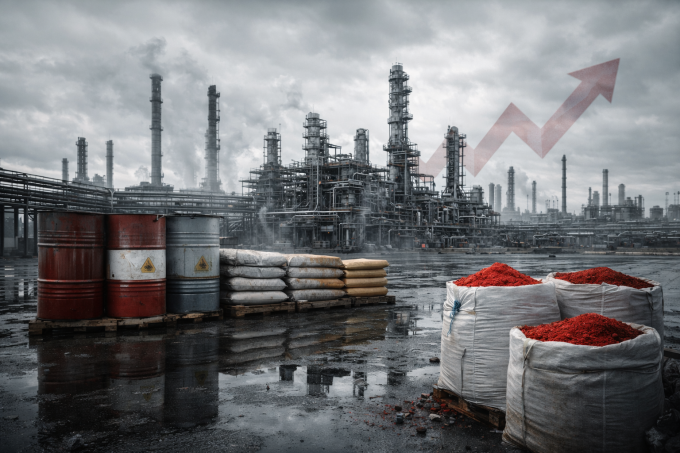
The German Chemical Industry Association (VCI) has reported disappointing performance in the first half of this year, with a decline of 11.5% in sales and a 10.5% decline in production.
The German Chemical Industry Association (VCI) has reported disappointing performance in the first half of this year, with a decline of 11.5% in sales and a 10.5% decline in production. VCI President Markus Steilemann stated, "The data for the first half of this year is in the red, and Germany's production costs are not competitive." Therefore, annual forecasts need to be revised downward.
Brenntag, the world's largest chemical distributor based in Essen, also reported weak mid-year performance. The company's overall report stated that sales in the second quarter declined nearly 14% to 4.26 billion euros after adjusting for exchange rates, while profits fell by over a quarter. Brenntag is facing challenges of significantly reduced demand, continuous depletion of customer inventories, and declining global chemical prices. Therefore, CEO Christian Kohlpaintner described it as a "challenging and unfavorable market environment."
However, Kohlpaintner also believes that the current environment is expected to improve over time. He expressed optimism when discussing the balance sheet. "We have certainly hit rock bottom," but Kohlpaintner believes that a slight recovery can now be seen. "We expect orders to increase month by month," he said. Although he also believes that this "slight recovery" cannot save this year, the expected improvement in the second half of the year is not sufficient to reverse the situation. "But for the chemical industry, 2024 is likely to be better than 2023."
One of the CEO's major tasks is to maintain morale and find some inspiring hope in difficult times. Kohlpaintner seems to analyze the market without being influenced by politics. "We mainly hope for Europe and Asia. The US market is already very strong and on the right track. Now we also see signs of recovery in Europe," Kohlpaintner said. "However, the Asian market is still very challenging, especially the current disappointment in the Chinese market. But even so, it may not get worse, and there is hope for a rebound." At this point, Kohlpaintner seems to have forgotten about Germany's federal government's policy towards China regarding "decoupling" and "de-risking," and has fallen into a "wanting both" mindset.
Economists are closely monitoring the situation in the chemical industry because it is seen as a leading indicator and benchmark of the global economic situation. Even if the chemical economy recovers, there are still questions about how much benefit Germany, as a production location, can gain.
The VCI continues to paint a gloomy picture because the economic downturn is by no means the biggest problem. According to a survey by the chemical industry association among its members, German manufacturers are clearly more concerned about domestic structural deficits. "People's confidence in Germany as a business location is weakening. We are certainly not notorious opponents, but high energy prices and corporate taxes, outdated infrastructure, shortage of skilled workers, digital challenges, and concentration of risks brought about by bureaucratic madness have eroded the confidence of our entrepreneurs," said VCI President Markus Steilemann, who is also the CEO of Covestro, a plastics manufacturer.
The topic of energy prices is particularly urgent for the chemical industry. The industry currently has nearly 2,000 companies, 550,000 employees, and 260 billion euros in turnover. Compared to energy prices in other countries, nearly 90% of industry respondents consider electricity and gas costs to be poor or very poor. "That's why we are striving for industrial electricity prices as a bridge to the future until we have sufficient energy from renewable sources," said Steilemann, adding that only in this way can Germany's chemical industry survive international competition.
However, contrary to Steilemann's expectations, things are happening that involve the planned elimination of "peak compensation." According to VCI's calculations, this means additional costs for energy-intensive industrial companies. For the already struggling chemical industry, the annual electricity tax will increase by approximately 1.5 billion euros.
"We are the first domino to shake," Steilemann warned, "If things are not going well in the initial stages of the value chain, other industries will soon be affected." However, maintaining the strength of the German chemical industry is crucial for the success of structural transformation. "High-tech chemical products from Germany, such as battery technology, also apply to chips and semiconductors, as well as energy and transportation transformations." Therefore, Steilemann believes that politicians must take action instead of continuous debate.
The Munich Ifo Institute's business climate index has fallen to -31 points, indicating how bad the current industry situation and sentiment are. This figure is the lowest level for the chemical industry since June 2020, during the summer of the COVID-19 pandemic. However, companies emphasize that the supply of preliminary products has recovered well after months of supply chain issues.
In terms of costs, there are signs that the upward spiral is coming to an end. Most companies want to reduce costs, which may have a positive effect on boostingSorry, but I don't have any information on the most recent developments in the German chemical industry as my knowledge was last updated in September 2021. It would be best to refer to recent news sources or industry reports for the latest information on the topic.

You May Interested In


High Quality β-Nicotinamide adenine dinucleotide CAS 53-84-9 NADwith ready stock and best price
$3E+1/UNIT FOB


2026-10-24
Trade Alert
Delivering the latest product trends and industry news straight to your inbox.
(We'll never share your email address with a third-party.)

Related News
-
VCI: German chemical production will still decline in 2023
-
VCI: Gas surcharge will affect German chemical industry
-
Korea’s First Petrochemical Restructuring Approved, LDPE Market Concentration Surges to 82%
-
Hormuz Traffic Remains 90% Below Pre-Conflict Levels as Limited Tanker Access Offers Partial Relief
-
European Petrochemicals Enter 'Era of Downsizing' as Dow, TotalEnergies, Shell Exit Older Cracker Assets
-
China’s Chemical Time Bomb Just Got a Legal Fuse: The New Law That Could Save Thousands of Lives
-
Trump Tariff "Boomerang": $2.5 Billion Polysilicon Factory Faces Shutdown Crisis
-
Panama Canal Delays Deeper Draft Cut, but Transit Capacity Is Still Tightening
-
U.S. Strikes Three Iranian Tankers as “Tanker-for-Tanker” Escalation Raises Chemical Shipping Risk
-
Middle East Conflict Pushes Up Oil Prices as More Than 100 Chemical Raw Materials Rise in Concentration
Recommend Reading
-
![Redwall Raises Prices by as Much as 80%, Songwon Launches Global Increases, and Chemical Companies Are Collectively Passing On Costs]()
Redwall Raises Prices by as Much as 80%, Songwon Launches Global Increases, and Chemical Companies Are Collectively Passing On Costs
-
![US Imposes Heavy Duties on Chinese L-Lysine with Combined Rates up to 188%]()
US Imposes Heavy Duties on Chinese L-Lysine with Combined Rates up to 188%
-
![Hormuz Closes, Paint Feels It First: How a Barrel of Oil Rewrites the Cost of Every Barrel of Coatings]()
Hormuz Closes, Paint Feels It First: How a Barrel of Oil Rewrites the Cost of Every Barrel of Coatings
-
![U.S. 10% Temporary Tariff Expires, New Section 301 Tariffs Not Yet Implemented]()
U.S. 10% Temporary Tariff Expires, New Section 301 Tariffs Not Yet Implemented
-
![Wanhua Shuts 1.1 Million-Tonne Yantai MDI Unit for 45-Day Maintenance]()
Wanhua Shuts 1.1 Million-Tonne Yantai MDI Unit for 45-Day Maintenance
-
![What is the Formula for Ammonia? (NH3 Structure & Properties)]()
What is the Formula for Ammonia? (NH3 Structure & Properties)
-
![Business Society’s PTA Market Outlook on September 7, 2026: Volatile]()
Business Society’s PTA Market Outlook on September 7, 2026: Volatile
-
![Premium Global Chemical Sourcing Requests (3-6Sep.,2026)]()
Premium Global Chemical Sourcing Requests (3-6Sep.,2026)
-
![Business Society’s PVC Market Outlook on September 7, 2026: Relatively Strong Fluctuations]()
Business Society’s PVC Market Outlook on September 7, 2026: Relatively Strong Fluctuations
-
![Premium Global Chemical Sourcing Requests (22-26 Dec 2025)]()
Premium Global Chemical Sourcing Requests (22-26 Dec 2025)