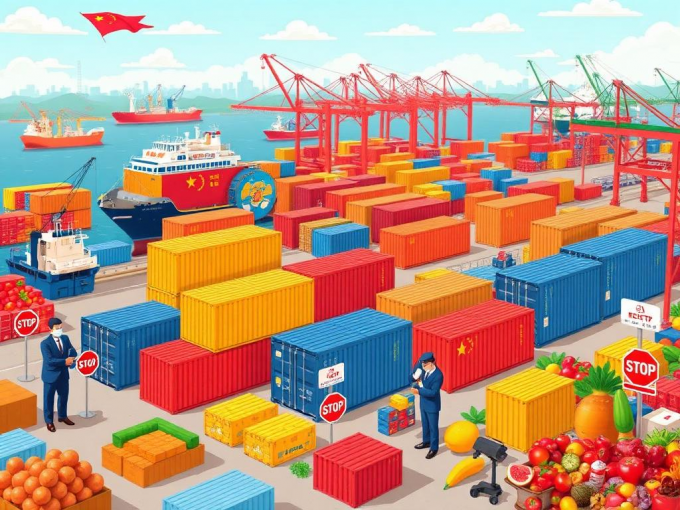
40 New Food Regulations Spark Crisis! Chinese Export Foods Recalled by the EU for the 10th Consecutive Time, Major Standards Change Expected by 2025
In this week (October 21 to October 25), South Korea, Japan and other countries and regions have issued policies and notifications on food. The following are elaborated from the two aspects of foreign import and export policies and measures and notification of violations.
I. Foreign import and export policies and measures
Japan has strengthened the monitoring and inspection of thiamethoxam residues in Chinese scallions
On October 16, 2024, the Ministry of Health, Labor and Welfare of Japan issued the Announcement No. 1016 of Health Food Distribution No. 2, pointing out that in the process of implementing import monitoring and inspection of Chinese scallions, it was found to violate the provisions on pesticide residues in the food hygiene Law. Accordingly, Japan decided to increase the frequency of monitoring and inspection of thiamethoxam residues in Chinese scallions to 30%.
The ROK has lifted measures to strengthen import inspection of processed food from a Chinese company
On October 23, 2024, the Korean Ministry of Food and Drug Safety (MFDS) officially lifted the enhanced import inspection requirements for processed foods of a Chinese enterprise, effective from the date of publication.
South Korea has issued an import inspection directive on Chinese peppers and fresh carrots
On October 23, 2024, the Korean Ministry of Food and Drug Safety (MFDS) issued import inspection instructions for Chinese chili peppers and fresh carrots, among which the inspection items are chlorpyrifos residues in chili peppers and mepiperidine residues in carrots.
Israel has adopted 40 new EU directives and regulations to regulate imported food
On October 15, 2024, the Israeli government published the 10th Legislative Amendment to Public Health Protection (Food), which decided to adopt more than 40 new food directives and regulations aimed at bringing the country's food standards in line with those of the European Union. The legislative amendment will be formally implemented on January 1, 2025, and will affect many food categories.
II. Notification of export violations
China's cumin exports have been recalled in Denmark. According to the EU Rapid Warning System for Food and Feed (RASFF), on October 18, 2024, the EU notified that cumin exported from China did not meet its relevant standards. Food Partner network hereby reminds export enterprises to strictly follow the requirements of importing countries to ensure the safety of food and related products to effectively avoid export risks.
Enrofloxacin residue was found in eggs exported from our country. According to the EU Rapid Warning System for Food and Feed (RASFF), on October 22, 2024, the EU notified that eggs exported from China did not meet its relevant standards. The unqualified products have been sold to Belgium, Croatia, Finland, France, Germany, Ireland, Norway, Poland, Spain and Sweden. The Food partner network once again reminds export enterprises to strictly follow the requirements of importing countries and strengthen the inspection of veterinary drug residues in products to ensure the safety of food and related products and avoid export risks.
Green tea exported from our country was detained in Romania. According to the EU Rapid Warning System for Food and Feed (RASFF), on October 24, 2024, the EU notified that green tea exported from China did not meet its relevant standards. The Food partner network reminds export enterprises to strictly follow the requirements of exporting countries and strengthen the inspection of pesticide residues in products to ensure the safety of food and related products and avoid export risks.
The United States has imposed automatic detention measures on a Chinese company's rice flake products. Recently, the US FDA website updated its import alert measures, including the automatic detention of related products from a Chinese company.
Black tea exported from China has been found to contain excessive pesticide residues. According to the EU Rapid Warning System for Food and Feed (RASFF), on October 23, 2024, the EU notified that black tea exported from China did not meet its relevant standards. The Food Partner network once again reminds export enterprises to strictly follow the requirements of importing countries and strengthen the inspection of pesticide residues in products to ensure the safety of food and related products and avoid export risks.
The EU notified that cod and pueraria extract exported from China did not meet its relevant standards. According to the EU Rapid Warning System for Food and Feed (RASFF), on October 22, 2024, the EU notified this. The Food partner network reminds export enterprises to strictly follow the requirements of exporting countries and pay attention to the existence of environmental pollutants in products to ensure the safety of food and related products and avoid export risks.
The EU notified that China's exports of jelly candy and nylon kitchenware do not meet its relevant standards. According to the EU Rapid Warning System for Food and Feed (RASFF), the EU notified this on October 24, 2024. The Food partner network reminds export enterprises to strictly follow the requirements of exporting countries, do not use substances not authorized by the EU, and pay attention to the migration amount of substances in food contact materials to ensure the safety of food and related products and avoid export risks.
Japan reported that fresh scallions and fresh carrots exported by China did not comply with its food hygiene law. According to a recent update from the Japanese Ministry of Health, Labor and Welfare, five batches of food in China have been notified as unqualified.
A Chinese company has been added to the US FDA's red list for refusing to accept inspections. Recently, the US FDA website updated its import alert measures, including the automatic detention of a variety of products from a Chinese company.
The EU notified that China's exports of kitchenware and food contact materials do not meet its relevant standards. According to the EU Rapid Warning System for Food and Feed (RASFF), on October 21, 2024, the EU notified this. The Food partner network reminds export enterprises to strictly follow the requirements of the importing country and pay attention to the migration amount of substances in food contact materials to ensure the safety of food and related products and avoid export risks.
In September 2024, 11 batches of food in China were notified for breaching Australia's Imported Food Control Act. Australia's Department of Agriculture, Fisheries and Forestry has updated its imported food breaches for September.
In October 2024, there were violations involving aquatic products, processed foods and agricultural and forestry products among the food exported from China to South Korea. Those found in violation of food and food-related regulations at the export stage shall be returned to the exporting country or disposed of.
Recently, the Japanese Ministry of Health, Labor and Welfare updated the situation of food exported to Japan in violation of Japan's food hygiene law, and multiple batches of food and related products were notified as substandard.
According to the official website of the European Union, in the notification of the 42nd week of 2024, the EU Rapid Warning System for food and feed (RASFF) notified that there were three cases of Chinese food and related products that did not meet its relevant standards. Among them, the unqualified ginger powder has been sold to Austria, Belgium, Croatia, the Czech Republic, Denmark, Finland, France, Germany, Hungary, Ireland, Italy, Malta, the Netherlands, Norway, Poland, Portugal, Romania, Slovakia, Spain and Sweden and other countries. Food Partners once again reminds export enterprises to strictly follow the requirements of importing countries to ensure the safety of food and related products and avoid export risks.

You May Interested In


Glow70/KLOW80 99% China Peptides Warehouse Direct Delivery Lyophilized Powder in Stock
$169/UNIT FOB


2026-10-26
Trade Alert
Delivering the latest product trends and industry news straight to your inbox.
(We'll never share your email address with a third-party.)

Related News
-
FDA Revokes Orange B Authorization and Proposes Removing Citrus Red No. 2
-
EFSA’s Updated Food-Additive Application Guidance Takes Effect
-
India Approves ₹30.3 Billion Chemical-Park Scheme to Build Three Mega Industrial Hubs
-
EU Set to Seek Import Quotas on PET, Epoxy Resins and Fibreglass as Trade Curbs Reach Chemicals
-
South Korea’s Largest Petrochemical Hub Moves to Cut Cracker Capacity by 40%
-
关于将4-amino-1-boc-piperidine、tert-buty 4-aminopiperidine-1-carboxylate产品列入《ECHEMI平台禁限售商品目录》的公告 Announcement on Including 4-amino-1-boc-piperidine and tert-buty 4-aminopiperidine-1-carboxylate in the Announcement on the List of Prohibited Sales of Prohibited and Controlled Items on ECHEMI
-
Pesticide Market in Limbo: Prices Plunge Amid Weak Demand and Overcapacity—Only a Few Hold Firm
-
FDA Dye Tracker Raises Reformulation Pressure Across Food Brands
-
关于全面排查下架易制毒及易制爆产品信息的公告 Announcement on the Comprehensive Review and Removal of Product Information Related to Precursor and Explosive Precursor Chemicals
-
关于进一步规范化学品信息发布、加强全球管制目录宣导的公告 Announcement on Further Standardizing the Release of Chemical Information and Strengthening Public Awareness of Global Control Lists
Recommend Reading
-
![Brazil Expands Chemical Tax Breaks as India’s Crop Protection Industry Warns of a 25% Cost Increase]()
Brazil Expands Chemical Tax Breaks as India’s Crop Protection Industry Warns of a 25% Cost Increase
-
![After Semaglutide Patent Expiry in India, the Price System Has Been Restructured as More Than 40 Drugmakers Enter the Competition]()
After Semaglutide Patent Expiry in India, the Price System Has Been Restructured as More Than 40 Drugmakers Enter the Competition
-
![FDA Orders Removal of “Suicidality Warning”: Are Weight-Loss Blockbusters Finally Cleared—or Is Regulators Giving the Market a Reality Check?]()
FDA Orders Removal of “Suicidality Warning”: Are Weight-Loss Blockbusters Finally Cleared—or Is Regulators Giving the Market a Reality Check?
-
![FDA’s Warning to Compounders Raises the Stakes for API and Excipient Suppliers]()
FDA’s Warning to Compounders Raises the Stakes for API and Excipient Suppliers
-
![FDA Slams Door on Chinese Food Exports: Inspection Refusals Trigger Automatic Detentions]()
FDA Slams Door on Chinese Food Exports: Inspection Refusals Trigger Automatic Detentions
-
![DMF Market Runs Stable with a Slight Tendency to Strengthen]()
DMF Market Runs Stable with a Slight Tendency to Strengthen
-
![Weather Themes Remain; Palm Oil Futures Expected to Rise]()
Weather Themes Remain; Palm Oil Futures Expected to Rise
-
![Polyester Bottle Flakes Slightly Lowered on May 13, Showing Weak and Volatile Trends]()
Polyester Bottle Flakes Slightly Lowered on May 13, Showing Weak and Volatile Trends
-
![Premium Global Chemical Sourcing Requests (11-13May, 2026)]()
Premium Global Chemical Sourcing Requests (11-13May, 2026)
-
![This Week's Styrene Market Continues to Show Weakness (11.3-11.7)]()
This Week's Styrene Market Continues to Show Weakness (11.3-11.7)