Clean Food Group and THG Labs Partner to Convert Food Waste into Beauty Ingredients
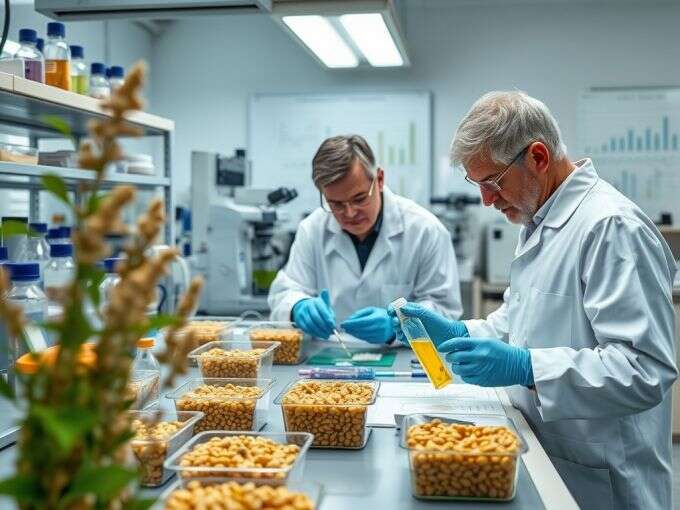
UK biotech company Clean Food Group is working with THG Labs to help improve the production of environmentally friendly beauty products by converting food waste into valuable cosmetic ingredients through fermentation.
This approach will reportedly reduce the environmental impact of traditional ingredient sourcing and provide the cosmetics industry with more bioequivalent alternatives to commonly used, agriculturally intensive ingredients.
Clean Food Group and THG Labs claim that the technology platform uses scalable non-GMO yeast strains and fermentation technology, and uses bread waste as a food source to provide a sustainable alternative to traditional oil ingredients.
Professor Chris Chuck, Technical Director of Clean Food Group, said: “We are delighted to be working with THG Labs, a leading innovator and full-service manufacturer in the cosmetics industry. With the help of THG Labs, we are excited to bring to market a range of science-based cosmetics and personal care products with sustainability at their core.”
Kristal Goodman, Head of Product Innovation at THG Labs, said: “With THG Labs’ passion for biotechnology and commitment to a more sustainable future, we are very excited to be working with Clean Food Group to usher in a new era of innovation in sustainability. We are constantly challenging ourselves to improve the environmental impact of our products, not only within the manufacturing facilities, but also in the raw material supply chain.”
Goodman added: “The work done by Professor Chris Chuck and his team inspired us to explore the full potential of Clean Food Group’s revolutionary technology, and the innovation team at THG LABS is behind this project and helping to drive progress in the cosmetics industry with more sustainable solutions.”

You May Interested In


High Quality β-Nicotinamide adenine dinucleotide CAS 53-84-9 NADwith ready stock and best price
$3/UNIT FOB


2026-10-06
Trade Alert
Delivering the latest product trends and industry news straight to your inbox.
(We'll never share your email address with a third-party.)

Related News
-
Clean Food Group Secures UK, EU, and US Approval for Fermentation-Derived Cosmetic Oils
-
EFSA Evaluates Safety of Triacylglycerol Lipase from Ruminant Pregastric Tissue
-
Canada Proposes Revised Maximum Residue Limits for Pyrethrins and Penthiopyrad
-
Zimbabwe Blueberries Position for Growth Following China Market Access and Zero-Tariff Policy
-
The GLP-1 Sweet Shot in India’s Diabetic Gut
-
APVMA Suspends Dimethoate Use on Select Berries Amid Updated Exposure Assessment
-
Spain Authorizes Emergency Use of Sulfoxaflor Formulation to Combat Cabbage Whitefly Outbreak
-
EFSA Publishes Peer Review Conclusions on Phenmedipham Herbicide Assessment
-
Moldova Proposes Stricter Quality Standards for Edible Casein and Caseinates
-
Hormuz Is Reopening, But Chemical Logistics May Take Months to Recover
Recommend Reading
-
![EFSA Unable to Conclude on Full-Scope Safety of Genetically Modified Oilseed Rape LBFLFK]()
EFSA Unable to Conclude on Full-Scope Safety of Genetically Modified Oilseed Rape LBFLFK
-
![Global Chemical Exports Are Freezing in 2026]()
Global Chemical Exports Are Freezing in 2026
-
![Wanhua Shuts 1.1 Million-Tonne Yantai MDI Unit for 45-Day Maintenance]()
Wanhua Shuts 1.1 Million-Tonne Yantai MDI Unit for 45-Day Maintenance
-
![European Chemical Firms Face Pressure on First-Quarter Earnings as the War Shock Continues to Spread]()
European Chemical Firms Face Pressure on First-Quarter Earnings as the War Shock Continues to Spread
-
![“Oil Sheikhs” Buy Germany’s Chemical Crown: A €14.7 Billion Green Gamble or a Power Play in the Age of Carbon Neutrality?]()
“Oil Sheikhs” Buy Germany’s Chemical Crown: A €14.7 Billion Green Gamble or a Power Play in the Age of Carbon Neutrality?
-
![Remote Raw Material Boost, PC Prices Recover After Falling in the First Half of July in China]()
Remote Raw Material Boost, PC Prices Recover After Falling in the First Half of July in China
-
![U.S. Exempts Critical Chemical Manufacturers from Emissions Rules for Two Years]()
U.S. Exempts Critical Chemical Manufacturers from Emissions Rules for Two Years
-
![China Releases 15th Five-Year Carbon-Peaking Action Plan, Pushing Coal Chemicals into a Mandatory Low-Carbon Upgrade Cycle]()
China Releases 15th Five-Year Carbon-Peaking Action Plan, Pushing Coal Chemicals into a Mandatory Low-Carbon Upgrade Cycle
-
![Consumption Fails to Match High Supply, October PP Refutes Peak Season Trend in China]()
Consumption Fails to Match High Supply, October PP Refutes Peak Season Trend in China
-
![Premium Global Chemical Sourcing Requests (19 - 23 Jan, 2026)]()
Premium Global Chemical Sourcing Requests (19 - 23 Jan, 2026)