




Japan's Chemical Sector Wary of US-Driven Headwind
Japanese chemical companies have been enjoying robust demand, but the tide is likely to soon change as shale gas-based chemical plants in the U.S. start to come online.
The Japanese chemical industry spent five years downsizing facilities by 10% or so as foreign players floundered, allowing the Japanese companies to expand its presence in global markets.
"As an entire industry, we have achieved high-level results," Osamu Ishitobi, chairman of the Japan Chemical Industry Association, said of the past fiscal year ended March in a press conference held in Tokyo on Monday.
Ishitobi also explained that the favorable outcome was attributable not only to market conditions, but also to crude oil prices and foreign exchange rates, both of which helped Japanese chemical companies maintain their competitive export prices.
Major Japanese companies, such as Mitsui Chemicals, Tosoh and Asahi Kasei, posted record high profits for the year ended March. But experts are already beginning to worry that the upturn could end as early as this fall, due largely to a number of U.S chemical plants that rely on inexpensive shale gas starting operations soon.
In September, Dow Chemical will open a new plant on an existing site in Texas. The plant will produce ethylene -- an essential element for many chemical products -- from low-cost ethane found in shale gas. The plant will be able to produce 1.5 million tons of the chemical a year, roughly a fourth of Japan's production capacity.
Starting next year, Exxon Mobil and other players also plan to start production in the U.S. The additional output in the global market during this year through 2020 is expected to total about 8 million tons a year.
"Even if some construction plans are delayed, the shale gas-based plants will surely dominate the market," says Ishitobi.
Japan's operating ratio of ethylene production facilities is as high as 96% to 97%. However, domestic supply will likely exceed demand, with the ratio falling to below 90% in several years, a threshold dividing upward and downward cycles, according to a senior director at research company
There are indications that this is already beginning. The chemical unit of Exxon Mobil is constructing polyethylene plants in Texas near the Gulf of Mexico. The unit's president, Neil Chapman, said Friday that the majority of output will be exported to Asia and Africa.
Japanese companies are trying to find ways to remain competitive in this new environment.
Sumitomo Chemical is building a 50 billion yen ($449 million) methionine plant in Ehime Prefecture on Japan's southwestern island of Shikoku in order to increase production capacity. The site was formerly produced ethylene.
Methionine is a type of amino acid used to help raise poultry.
Sumitomo Chemical, Germany's Evonik, and two other companies currently control 80% to 90% of the methionine market. Production of the chemical allows Sumitomo to maintain a double-digit operating margin ratio even if the market weakens. The company wants to focus on areas such as refined chemicals where it can fully leverage its technological strengths.
Mitsui Chemicals and Tosoh are also strengthening their core competencies, such as in polypropylene and other commodities. They hope to increase capacity and efficiency in order to compete with U.S. players eager to grab a piece of markets in Japan and other parts of Asia.
Despite efforts to revamp their operations, "Japanese chemical businesses haven't done enough," says Ishitobi. Sumitomo has postponed plans to restructure its synthetic fiber materials unit, a move that was expected to be finalized by March this year, but was delayed mainly due to the already favorable market.

You May Interested In






2026-07-28
Trade Alert
Delivering the latest product trends and industry news straight to your inbox.
(We'll never share your email address with a third-party.)

Related News
-
"Zipper-Like" Opening and Closing of Hormuz Coupled with Russian Export Ban Send Energy and Chemical Prices Soaring
-
Global Countries Impose Tariffs on Chinese Chemical Products
-
Japanese Plastics Market Accelerates its Shifts to Recycled Materials and Bioplastics
-
AUTOMA Chem 2026: Powering Industry 4.0 in Chemistry
-
Chemical Raw Materials: How to Source Quality Suppliers & Understand Grades
-
India imposes anti-dumping duties on water treatment chemicals from China, Japan
-
Big adjustment! Basf quietly closed 11 factories in Germany and transferred to China for plant investment!
-
Fluorine chemical: profit generally declined, under the pressure to expand profit space
-
Chemical production in the 27 EU countries has continued to recover, and the market recovery is still cautious
-
China: The development of green agricultural is the trend, and the future focus is on innovation and quality
Recommend Reading
-

A 95 % Volume Swing from Peak to Trough (Dec 2024 – Nov 2025): Navigating Supply Shocks and Pricing Compression in the Global Ammonium Sulfate Trade
-

Global Hyaluronic Acid Trade Analysis: A 4.1x Volume Gap and Sixfold Price Swing Reshape Procurement Strategy
-

Global Propylene Glycol Trade Contracts 70% from Peak: Pricing Pressure, Demand Risk and Procurement Opportunities
-

Global Omega-3 Trade Falls 81% from Peak: February Freeze Exposes Pricing and Liquidity Risks
-

Global Vitamin E Trade Drops 81% from Peak: $1.40 Billion Market Enters a Sharp 2026 Slowdown
-
Demand Fails to Expand, ABS Struggles Through Golden September
-
Demand Release Fails to Meet Expectations, PP "Golden September" Goes Against the Market Trend
-
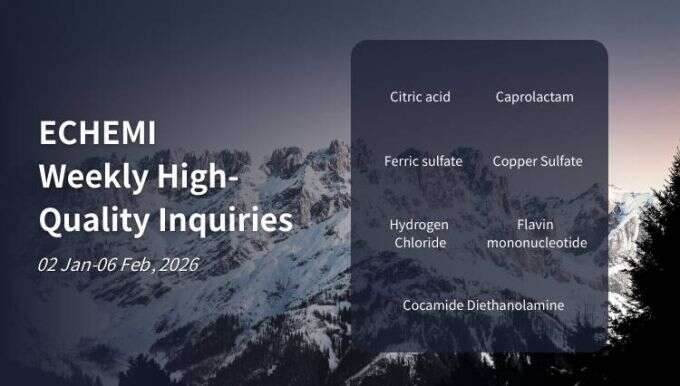
Premium Global Chemical Sourcing Requests (2 - 6 Feb, 2026)
-

What is Amylum Starch? (Old Terminology & Modern Equivalent)
-

September Isobutanol Prices Fluctuate and Decline